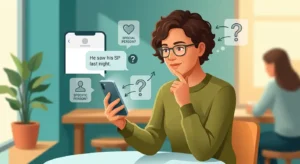
In text and online messaging, a reaction is a quick response to a message, post, or comment, often shown with an emoji, like, heart, or other reaction button instead of a written reply. The exact meaning depends on the symbol, message, platform, and conversation context.
When someone says they “reacted” to your text, they usually mean they acknowledged it with a quick emoji or reaction rather than sending a separate message. A reaction can show agreement, appreciation, amusement, surprise, sympathy, or another feeling.
Key Takeaways
- Reaction usually means a quick response to a message, post, or comment.
- It can appear as an emoji, like, heart, or other platform reaction.
- A reaction is not always the same as a written reply.
- The meaning depends heavily on context and the specific emoji or symbol.
- A reaction by itself does not necessarily indicate romantic interest.
- “Reaction” is a regular English word, not a texting abbreviation or acronym.
Reaction Meaning in Text
In everyday digital communication, a reaction is a short way of responding to something someone posted or sent.
For example, if you send a friend:
“I finally finished my project!”
They might react with 👍 instead of typing “Nice!” The reaction communicates acknowledgment or approval without requiring a full response.
On messaging and social platforms, reactions can make conversations faster and can communicate emotion without adding another written message. Depending on the platform, reactions may include options such as like, love, laugh, surprise, sadness, or anger.
So, when someone asks, “What does reaction mean in text?”, the simplest answer is: it means a quick response to something someone said, sent, or posted.
What Does Reaction Stand For?
Reaction does not stand for anything. It is not an acronym, abbreviation, or initialism.
The word comes from the ordinary English idea of responding to something that happens. In digital communication, the word has also become associated with quick online responses such as emoji reactions and reaction buttons.
How Is Reaction Used?
The word can be used in several ways in online conversations.

In Text Messages
Someone might say:
- “Did you see my reaction?”
- “Why did you react with that emoji?”
- “I just reacted to your message.”
- “She reacted with a heart.”
Here, “reaction” usually refers to a quick response attached to a message.
In Group Chats
Reactions are especially useful in group conversations because several people can acknowledge a message without sending multiple replies.
For example, someone posts:
“Meeting starts at 6 PM.”
Several people might react with 👍 to show they saw and understood it.
On Social Media
A reaction can also refer to responding to a post, comment, photo, or video with an available reaction option.
A social-media reaction can communicate a feeling without requiring a written comment.
Reaction GIFs
A reaction GIF is a GIF used as a response to a message, post, or comment, usually to visually express an emotion such as excitement, disbelief, amusement, or annoyance.
For example, instead of writing “I can’t believe that happened,” someone might send a reaction GIF showing a surprised facial expression.
Real Chat Examples
Here are natural examples of how “reaction” can appear in online conversations:
- A: “Did you react to my message?”
B: “Yeah, I sent a 👍.” - A: “Why did you give my text a ❤️?”
B: “I liked what you said.” - A: “Everyone reacted to the announcement.”
B: “What kind of reactions did they give?” - A: “He reacted with 😂.”
B: “Okay, at least he thought it was funny.” - A: “I didn’t get a reply.”
B: “They might have just reacted to your message.” - A: “She reacted to my story.”
B: “Did she send a message too?” - A: “Why did you react with 😭?”
B: “Because that was hilarious.” - A: “I reacted with a thumbs-up.”
B: “Got it.” - A: “What was your reaction to the news?”
B: “Honestly, I was surprised.” - A: “He only reacted to my message.”
B: “Maybe he didn’t have anything else to add.” - A: “Did everyone see the photo?”
B: “Yeah, I saw a bunch of reactions.” - A: “Your reaction was so funny.”
B: “I couldn’t help it 😂.” - A: “Why didn’t you reply?”
B: “I reacted because I didn’t know what else to say.” - A: “She reacted with a heart.”
B: “That’s a positive response, at least.” - A: “What does that reaction mean?”
B: “It could just mean they liked the message.” - A: “He reacted to the announcement.”
B: “What did he say?” - A: “I sent the details.”
B: “I reacted so you know I saw them.” - A: “Everyone reacted with 😂.”
B: “Sounds like the joke worked.” - A: “I got a reaction but no reply.”
B: “That doesn’t necessarily mean anything negative.” - A: “Did you see my reaction?”
B: “Yep, I noticed it.”
How to Reply to a Reaction
The best response depends on what the person reacted with and what the original message meant.
Casual Replies
If the reaction is simple and friendly, you may not need to respond at all. If you want to continue the conversation, you can simply say:
- “Haha 😂”
- “Exactly!”
- “Right?”
- “I know!”
- “Glad you agree.”
Friendly Replies
For a positive reaction from a friend, you could say:
- “Thanks!”
- “Haha, I knew you’d like it.”
- “Appreciate it!”
- “Glad you saw it.”
- “That made me laugh too.”
Funny Replies
If the conversation is playful:
- “That reaction says everything 😂”
- “I knew you’d react like that.”
- “Okay, I deserved that reaction.”
- “Your reaction is killing me 😂”
Neutral Replies
If you’re unsure what the reaction means:
- “What did you mean by that reaction?”
- “Haha, how should I take that?”
- “Was that a good reaction?”
- “Everything okay?”
Flirty or Relationship Replies
If the conversation is already clearly romantic, you can respond according to the existing tone:
- “I noticed that heart 👀”
- “Was that reaction intentional?”
- “I’ll take that as a good sign.”
However, a reaction by itself does not prove that someone is flirting or romantically interested. The surrounding conversation matters much more.
Context & Relationship Meaning
A reaction does not have a special definition depending on whether it comes from a guy, girl, friend, crush, or partner.
For example, a ❤️ reaction could mean affection, appreciation, agreement, or simply that the person liked the message. A 😂 reaction generally signals amusement, but the exact emotional meaning still depends on the message.
From a Guy
If a guy reacts to your message, the reaction itself does not automatically indicate attraction or romantic interest. Look at the overall conversation, what was said before the reaction, and whether he continues communicating.
From a Girl
The same principle applies when a girl reacts to your message. A reaction can simply acknowledge or respond to what you said.
From a Friend
Friends commonly use reactions as quick acknowledgments, especially in group chats.
From a Crush
A reaction from a crush can feel more meaningful, but the emoji alone is not enough to determine romantic interest. The broader conversation provides better context.
In Dating or a Relationship
Partners may use reactions to express affection, humor, support, or acknowledgment. Even then, different people use emojis differently, so one reaction should not be treated as a definite message about the relationship.
What Tone Does Reaction Have?
The word reaction itself is neutral. Its emotional tone comes from the reaction being described.
A reaction can be:
- Positive — 👍 ❤️
- Amused — 😂
- Surprised — 😮
- Supportive — ❤️ or 👍
- Sad or sympathetic — 😢
- Negative or angry — 😡
- Playful — 😂 or another humorous response
- Unclear — when the chosen reaction could have several interpretations
The same emoji can also feel different depending on the conversation.
Is Reaction Rude or Offensive?
No. Reaction is not a rude or offensive term.
Using a reaction is generally normal in casual digital communication. However, the specific reaction can sometimes seem dismissive, sarcastic, or inappropriate depending on what was said.
For school, work, or professional communication, reactions can be perfectly acceptable when the platform supports them, but a written response may be better when the message requires a detailed answer.
Who Uses Reaction?
“Reaction” is ordinary English rather than a specific generational slang term.
People use the word in everyday conversation when talking about messages, social media, comments, emojis, and online responses. Its digital meaning is especially common because many messaging and social platforms provide ways to react directly to content.
There is no need to classify it specifically as Gen Z slang or as a teen-only expression.
Other Meanings of Reaction
The word reaction has several meanings outside online messaging.
Reaction in Everyday English
A reaction can mean a response to something that happens.
For example:
“Her reaction to the news was surprising.”
This is the normal dictionary meaning of the word.
Reaction in Science
In chemistry, a chemical reaction is a process in which substances interact and change into different substances.
In biology, “reaction” can also describe how a body responds to a stimulus or substance.
Reaction in Social Media
In social media, a reaction is a quick engagement response, often represented by an emoji or button. Different platforms provide different reaction options.
Reaction GIF
A reaction GIF is a short animated image used to communicate an emotional or humorous response to something someone posted or said.
Reaction vs. Similar Terms
| Term | Meaning | Difference |
|---|---|---|
| Reaction | A quick response to something | Can be an emoji, button, GIF, or other response |
| Reply | A written response | Usually contains words or a message |
| Response | An answer or reaction to something | Broader term that can include a reaction or reply |
| Comment | A written or posted response | Usually appears publicly under content |
| Like | A positive acknowledgment | One specific type of online reaction |
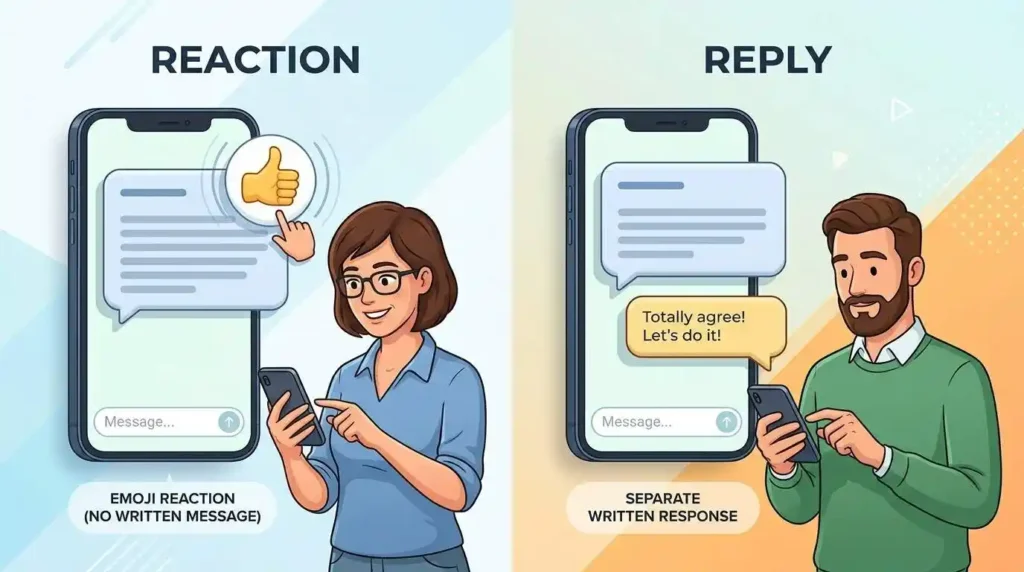
A reaction and a reply are therefore not always the same thing. You can react to a message without writing a reply.
Common Mistakes About Reaction
Assuming Every Reaction Has One Fixed Meaning
A reaction depends on the symbol, platform, message, and relationship. A heart, for example, can communicate different levels of affection or appreciation.
Assuming a Reaction Means Romantic Interest
A reaction from a crush does not automatically mean they like you romantically. Consider the entire conversation rather than interpreting one emoji in isolation.
Confusing a Reaction With a Reply
A reaction can acknowledge a message without actually answering it. If someone reacts but does not reply, they may simply be indicating that they saw or appreciated the message.
Assuming No Written Reply Is Negative
Someone may use a reaction because the message does not require an answer. A reaction can function as a brief acknowledgment rather than a sign of disinterest.
Treating “Reaction” as an Acronym
“Reaction” is a regular English word. It does not have a standard texting full form.
Related Internet Slang
| Term | Meaning | Common Use |
|---|---|---|
| LOL | Laughing out loud | Showing amusement |
| LMAO | Laughing very hard | Stronger humorous reaction |
| OMG | Oh my God | Surprise or excitement |
| WTF | Strong expression of surprise or confusion | Casual, sometimes offensive reaction |
| W | Win or something positive | Approval or celebration |
| RT | Retweet; also used informally to express agreement | Social media and casual online conversation |
Real-World Conversation
Maya: “I just sent you the picture from yesterday.”
Alex: “I reacted 😂”
Maya: “You didn’t even reply!”
Alex: “What was I supposed to say? It was hilarious.”
Here, the reaction is simply a quick way for Alex to show amusement without writing a longer response.
People Also Ask
What does a reaction mean in a text message?
A reaction is a quick response to a message, often using an emoji or reaction button. It can show acknowledgment, amusement, agreement, appreciation, or another emotion.
Is a reaction the same as a reply?
No. A reaction can acknowledge a message without adding a written response. A reply normally involves sending another message.
What does it mean when someone reacts but doesn’t reply?
It usually means they chose to acknowledge the message without continuing the conversation in writing. The meaning can vary depending on the message and the reaction used.
Does a reaction mean someone likes you?
Not necessarily. A reaction can show appreciation, amusement, agreement, or simple acknowledgment, so one reaction is not enough to establish romantic interest.
What does a heart reaction mean in text?
A heart reaction generally communicates a positive feeling such as appreciation, affection, support, or liking the message. Its exact meaning depends on the relationship and context.
What does a thumbs-up reaction mean?
A thumbs-up can indicate agreement, acknowledgment, approval, or that someone has seen the message. In some conversations it can feel brief or dismissive, so context matters.
Is “reaction” slang?
No. “Reaction” is a normal English word. In digital communication, it is commonly used for quick emoji- or button-based responses to messages and social-media content.
Can a reaction be a full response?
Yes, sometimes. If a message only needs acknowledgment, a reaction can effectively serve as the person’s response without requiring a written reply.
Conclusion
In text and social media, a reaction is a quick way to respond to a message, post, or comment, often through an emoji or reaction button. It can communicate acknowledgment, amusement, support, surprise, or another feeling without a written reply.
The word itself is not an acronym or texting abbreviation, and its meaning is generally straightforward. When interpreting a particular reaction, pay attention to the emoji, original message, relationship, platform, and overall tone rather than assuming one fixed meaning.

Charlotte Reed creates captions and quotes built around moments, moods, and personal expression. Over three and a half years, she has worked on content covering travel experiences, lifestyle themes, relationships, events, social media posts, entertainment topics, and aesthetic styles. Her process involves studying language patterns, refining caption structure, and adjusting wording to match different occasions and visual themes.