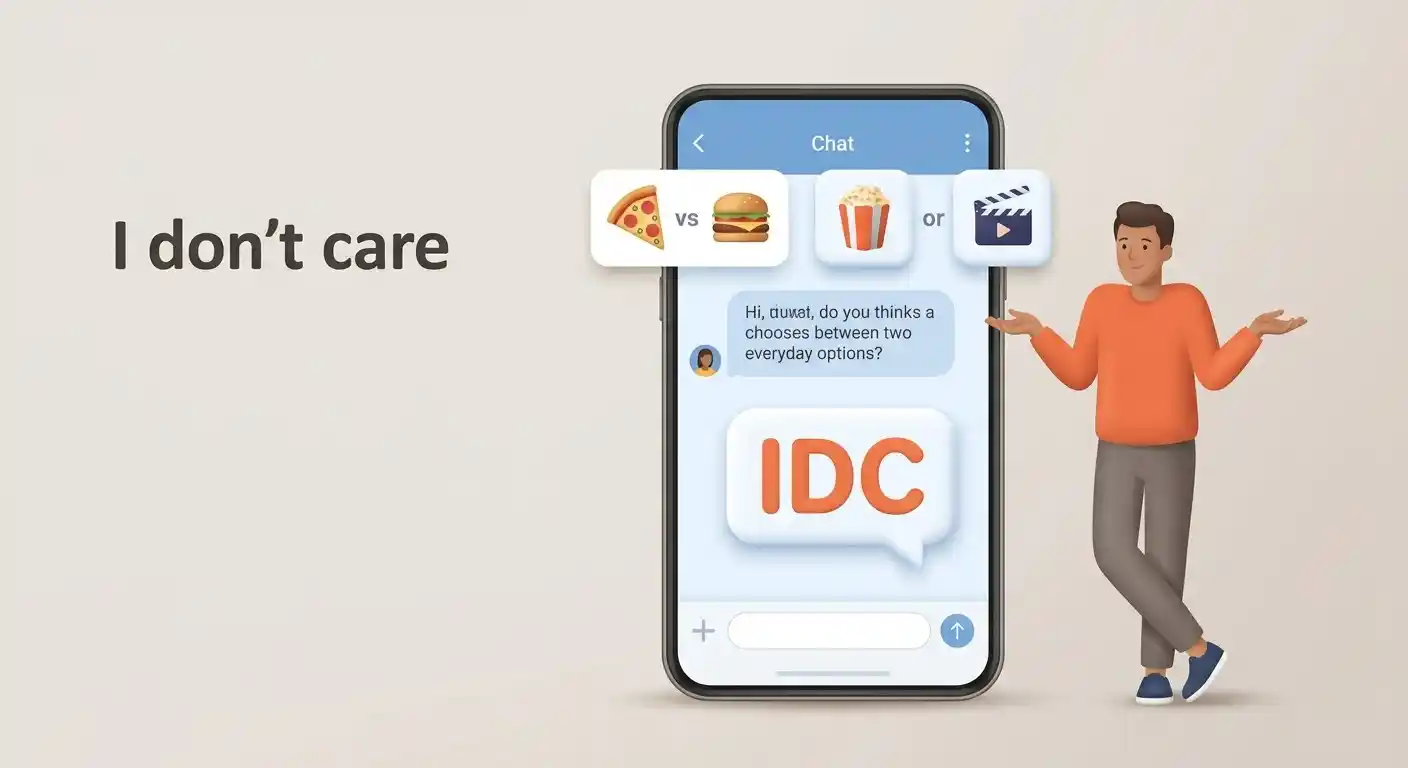
IDC in text means “I don’t care.” It is an informal texting abbreviation used to show that someone has no strong preference, is not concerned about something, or does not want to focus on the topic. The exact tone depends on the surrounding conversation.
Key Takeaways
- IDC = “I don’t care.”
- It is an internet slang abbreviation commonly used in texts and online conversations.
- It can mean “either option is fine” or sound dismissive, depending on context.
- Lowercase “idc” and uppercase “IDC” generally have the same basic meaning.
- It can appear in texts, DMs, group chats, comments, and other casual digital conversations.
- IDC is usually informal, so a more polite phrase is better for professional or sensitive situations.
IDC Meaning in Text
IDC is an initialism for “I don’t care.” In digital communication, people use it when something does not matter to them, they have no preference, or they are uninterested in continuing a particular topic.
For example:
“Pizza or burgers?”
“IDC, you choose.”
Here, IDC is relatively neutral. The person is saying that either choice works.
But the same abbreviation can sound much colder in another conversation:
“I’m really upset about what happened.”
“IDC.”
In that situation, IDC can sound dismissive or insensitive.
So, the words themselves are simple; the context determines much of the tone.
What Does IDC Stand For?
IDC stands for “I don’t care.”
It is formed from the first letters of:
- I = I
- D = don’t
- C = care
It is a shortened form of an ordinary phrase used in casual digital communication. Unlike some abbreviations with several equally common meanings, “I don’t care” is the dominant meaning of IDC in texting and social media.
How Is IDC Used?
People generally use IDC when they want to communicate indifference, lack of preference, or a lack of interest.
In Text Messages
A person might use IDC when they genuinely have no preference:
“Where should we eat?”
“IDC. Anywhere is fine.”
It can also be used more bluntly:
“What they think about me? IDC.”
The second example communicates stronger emotional distance.
On Social Media
IDC can appear in comments, replies, captions, or direct messages when someone wants to express an unbothered or indifferent attitude.
For example:
“Everyone is arguing about that show.”
“idc, I’m still watching it.”
In Group Chats
In a group conversation, IDC can mean that the sender is happy to let everyone else decide:
“Movie at 7 or 8?”
“IDC, either works.”
However, a one-word “IDC” can sometimes be interpreted as shutting down the conversation, especially when the topic is personal.
Real Chat Examples
Here are varied examples showing how the meaning can change with context:
- Friend: “Pizza or tacos?”
You: “IDC, both are good.” - Friend: “Which movie should we watch?”
You: “idc, you pick.” - Friend: “Are you mad that she went without you?”
You: “IDC honestly.” - Person: “What do you think about my new haircut?”
Reply: “IDC 😭”
This could sound playful among close friends, but potentially rude in another relationship. - Friend: “Do you want to sit inside or outside?”
You: “IDC either way.” - Friend: “He said he doesn’t like your idea.”
You: “IDC what he thinks.” - Group chat: “Should we meet Friday or Saturday?”
Reply: “IDC, both work for me.” - Friend: “Are you watching the game tonight?”
Reply: “Probably not. IDC about it.” - Person: “You have to choose one.”
Reply: “IDC which one.” - Friend: “Are you still thinking about what happened?”
Reply: “Nah, idc anymore.” - Friend: “Do you want coffee or tea?”
Reply: “IDC.” - Comment: “People are going to complain about this.”
Reply: “idc 😂” - Friend: “Do you care if we leave early?”
Reply: “IDC.” - Friend: “What color should I get?”
Reply: “IDC, whichever you like.” - Person: “Everyone is talking about the drama.”
Reply: “IDC, I’m staying out of it.” - Friend: “Does it bother you?”
Reply: “Not really. IDC.” - Group chat: “Who wants to choose the restaurant?”
Reply: “IDC, someone else can pick.” - Friend: “Are you worried about what they say?”
Reply: “Honestly, IDC.”
The key difference is whether IDC means “I have no preference” or “I don’t want to engage with this.”
How to Reply to IDC
The best response depends on what the sender appears to mean.
Casual Replies
If IDC simply means they do not have a preference:
- “Okay, I’ll choose.”
- “Cool, let’s go with the first option.”
- “Sounds good.”
- “Works for me too.”
Friendly Replies
If you want to keep the conversation warm:
- “Haha okay, I’ll decide.”
- “Fair enough 😄”
- “No worries, I got it.”
- “Okay, your loss 😂”
Funny Replies
Among friends, you can answer playfully:
- “Wow, passionate answer 😂”
- “That narrows it down.”
- “Helpful as always 😭”
- “Okay, mysterious.”
Neutral Replies
If you are unsure about the tone:
- “Okay.”
- “Got it.”
- “No problem.”
- “Alright, I’ll decide.”
Flirty/Relationship Replies
If IDC appears in a conversation with someone you like, do not automatically assume it is flirting or rejection. Look at the surrounding messages.
You could simply say:
- “Okay, I’ll pick then.”
- “Fair enough 😄”
- “No worries.”
- “I’ll take that as a vote for whatever I choose.”
Context & Relationship Meaning
IDC From a Guy
If a guy texts “IDC,” it still normally means “I don’t care.” Being sent by a guy does not create a special definition.
Whether it sounds relaxed, annoyed, or dismissive depends on what he was responding to and how the conversation was going.
IDC From a Girl
The same applies when a girl uses IDC. The abbreviation itself does not change based on the sender’s gender.
IDC From a Friend
Between friends, IDC can be completely casual:
“Where do you want to go?”
“IDC, you decide.”
It may simply mean “I have no preference.”
IDC From a Crush
If someone you have a crush on says IDC, avoid reading too much into the abbreviation itself. It could indicate indifference toward a particular choice, but it could also sound dismissive depending on the conversation.
IDC in Dating or a Relationship
In a relationship, context matters even more. For example:
“Do you want Italian or Mexican?”
“IDC.”
This probably means the person has no food preference.
But:
“Do you care that I was upset earlier?”
“IDC.”
That carries a much more dismissive tone.
IDC alone cannot prove that someone is angry, losing interest, flirting, or rejecting you.
What Tone Does IDC Have?
IDC can have several tones:
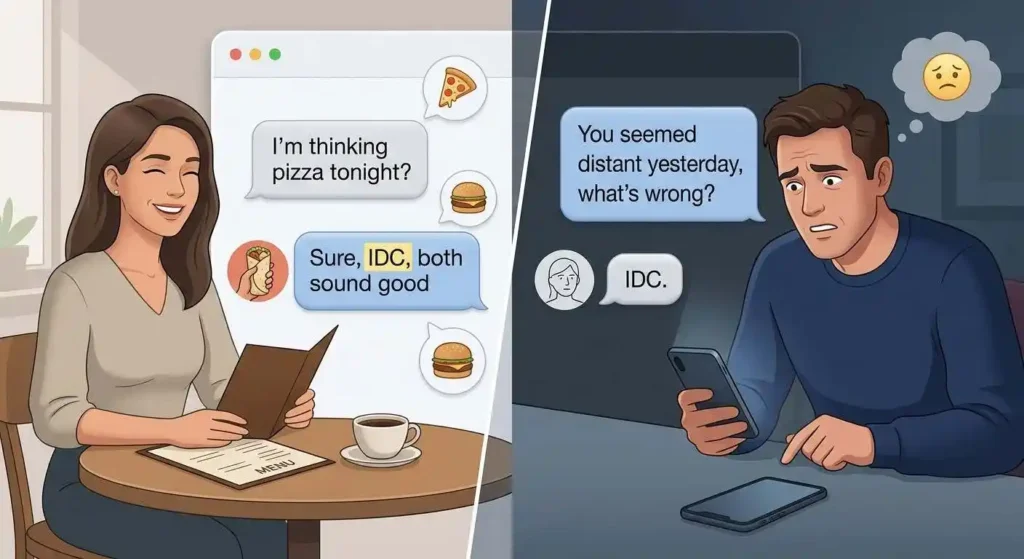
- Neutral: “IDC which movie we watch.”
- Relaxed: “IDC, either one is fine.”
- Playful: “idc 😂”
- Unbothered: “IDC what people say.”
- Blunt: “IDC.”
- Dismissive: “IDC about that.”
- Annoyed: “IDC anymore.”
Punctuation and emojis can change how the message feels. For example, “idc 😂” may seem more playful than a standalone “IDC.”
Is IDC Rude or Offensive?
IDC is not inherently offensive, but it can sound rude or dismissive.
In a casual conversation about something unimportant, it may be perfectly harmless:
“Window or aisle?”
“IDC.”
But using it in response to someone’s feelings can come across as uncaring:
“That really hurt my feelings.”
“IDC.”
For school, work, professional messages, or sensitive conversations, clearer wording is usually better. Instead of “IDC,” you could say “I don’t have a preference” or “Either option works for me.”
Who Uses IDC?
IDC is an informal form of digital communication that can appear among people who use texting, messaging, and social media. It should not automatically be classified as belonging to one particular generation.
Its meaning is straightforward enough that the important issue is usually tone and context, not the age of the person using it.
Other Meanings of IDC
In texting and social media, “I don’t care” is the main meaning. However, IDC can have other meanings in specialized contexts.
IDC in Business and Technology
IDC can refer to International Data Corporation, a technology market research and advisory company. That meaning is unrelated to the texting abbreviation.
IDC as “In Due Course”
In some abbreviation references, IDC is also used to mean “in due course.” This is different from the informal texting meaning and is more likely to appear in formal or professional language.
IDC in Other Specialized Contexts
IDC can have additional meanings in specific professional or organizational contexts. Therefore, if you see IDC in a report, workplace document, technical material, or another specialized setting, the surrounding text should be used to determine its meaning.
IDC vs. Similar Slang
Some abbreviations are easy to confuse because they express different kinds of uncertainty or indifference.
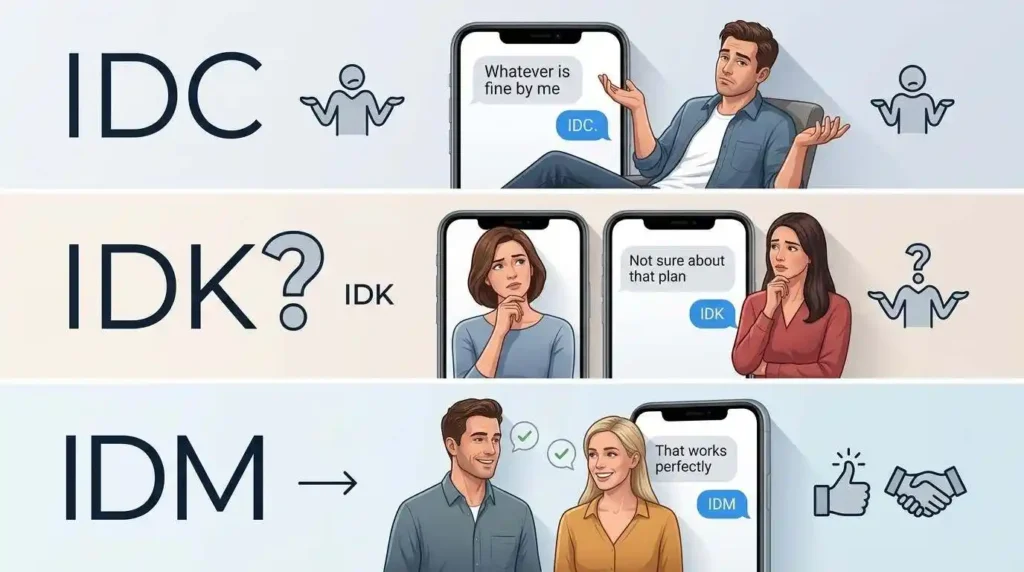
| Term | Meaning | Difference |
|---|---|---|
| IDC | I don’t care | Shows indifference or lack of preference |
| IDK | I don’t know | Shows lack of knowledge or certainty |
| IDM | I don’t mind | Usually sounds more accepting or flexible |
| IDGAF | I don’t give a f*** | A much stronger and more profane version of indifference |
| TBH | To be honest | Introduces a candid opinion rather than indifference |
For example, “IDK where we should eat” means the person does not know what to choose, while “IDC where we eat” means the choice does not matter to them.
Common Mistakes About IDC
Assuming IDC Always Means Anger
It does not. Someone might say IDC simply because they are happy with either choice.
Assuming IDC Means “I Hate It”
IDC does not necessarily mean dislike. It generally communicates lack of concern, preference, or interest.
Confusing IDC With IDK
IDK = I don’t know.
IDC = I don’t care.
Someone can even use both:
“IDK and IDC.”
That means they do not know and are not particularly concerned about it.
Assuming IDC Proves Someone Does Not Care About You
A message such as “IDC” usually refers to the specific topic being discussed, not necessarily the entire relationship.
Related Internet Slang
| Term | Meaning | Common Use |
|---|---|---|
| IDK | I don’t know | Uncertainty or lack of information |
| IDM | I don’t mind | Saying either option is acceptable |
| IDGAF | I don’t give a f*** | Stronger, profane indifference |
| TBH | To be honest | Introducing an honest opinion |
| IMO | In my opinion | Sharing a personal view |
| NVM | Never mind | Dropping or dismissing a previous point |
Real-World Conversation
Alex: “Should we get pizza or burgers?”
Sam: “IDC, you choose.”
Alex: “Pizza it is.”
Sam: “Cool.”
Here, IDC is not necessarily rude. Sam is simply saying that either choice is fine.
Compare that with:
Alex: “I’m still upset about what happened yesterday.”
Sam: “IDC.”
In this situation, the same abbreviation sounds much more dismissive because of the emotional context.
People Also Ask
What does IDC mean in texting?
IDC usually means “I don’t care.” It is an informal abbreviation used to express indifference, lack of preference, or little concern about something.
Is IDC rude in a text?
It can be. If the topic is a simple choice, IDC may sound relaxed, but responding with IDC to someone’s feelings or concerns can come across as cold or dismissive.
What does IDC mean from a guy?
It normally means “I don’t care,” just as it does when anyone else uses it. The surrounding conversation matters more than the sender’s gender.
What does IDC mean from a girl?
The definition does not change based on gender. Depending on the conversation, it can express either casual indifference or a more dismissive attitude.
Is IDC a bad word?
No. IDC itself is not a swear word. However, it can sound blunt or insensitive depending on how it is used.
What is the difference between IDC and IDK?
IDC means “I don’t care,” while IDK means “I don’t know.” IDC concerns interest or preference; IDK concerns knowledge or certainty.
What is the difference between IDC and IDM?
IDC says something does not matter to you, while IDM (“I don’t mind”) usually sounds more accepting or flexible. In many everyday situations, IDM can sound softer.
Can IDC mean “I don’t care about you”?
Not necessarily. Usually, IDC refers to whatever topic is being discussed. The rest of the conversation is needed to understand whether it refers to a specific issue or something more personal.
Conclusion
IDC means “I don’t care” in texting and online communication. It can express anything from simple indifference to a blunt or dismissive attitude. The meaning does not change based on who sends it, and it does not automatically reveal someone’s feelings toward you. Always consider the conversation, wording, punctuation, emojis, and relationship before interpreting its tone.

Michael Anderson is a writer focused on captions and quotes designed for different moments, moods, and social settings. Over three and a half years, he has created collections covering travel, lifestyle, relationships, events, social media, entertainment, and aesthetic themes. Michael studies tone, context, and phrasing to craft captions that match specific occasions and visual styles.