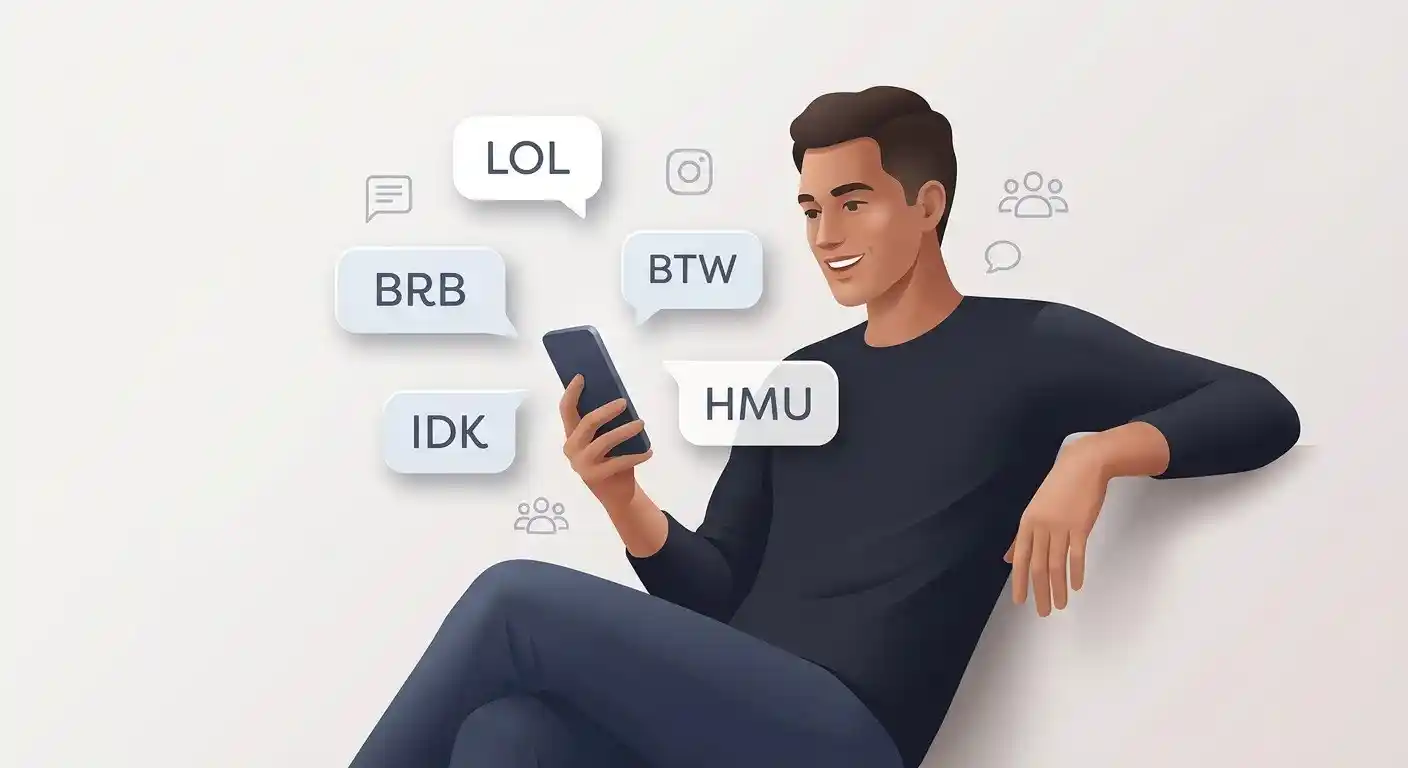
Chat slang refers to informal words, abbreviations, acronyms, and shortened expressions used in online conversations, text messages, DMs, comments, and group chats. It helps people communicate quickly and casually in digital conversations.
Key Takeaways
- Chat slang is informal language used in digital conversations.
- It can include abbreviations, acronyms, shortened words, expressions, and internet slang.
- Common examples include LOL, BRB, IDK, BTW, TTYL, and HMU.
- The same slang can have different meanings depending on the conversation and context.
- Chat slang is generally better suited to casual messages than formal school or professional communication.
- Platform culture can influence which expressions people recognize and use.
Chat Slang Meaning in Text
In text, chat slang means informal language used to make online communication shorter, quicker, or more conversational.
It can include a single shortened word, such as “rn” for “right now,” an acronym such as “IDK” for “I don’t know,” or an expression such as “sus” for “suspicious.”
Unlike a traditional dictionary word, chat slang often depends heavily on context, tone, and the conversation around it. Some terms are straightforward abbreviations, while others are expressions that developed through internet and social-media culture.
Chat slang can appear in:
- Text messages
- Private messages
- Group chats
- Social media comments
- Gaming chats
- Livestream conversations
- Online communities
- Casual online discussions
The terms used in chat can also change over time, so not every expression has the same level of familiarity across different communities.
What Does Chat Slang Stand For?
Chat slang does not have a specific full form.
“Chat slang” is a general phrase describing informal language used in online conversations. It is not itself an abbreviation or acronym.
For example, LOL, BRB, and IDK are individual examples of chat slang, and each has its own meaning:
| Term | Meaning |
| LOL | Laughing out loud |
| BRB | Be right back |
| IDK | I don’t know |
| BTW | By the way |
| TTYL | Talk to you later |
| HMU | Hit me up |
| IMO | In my opinion |
| TBH | To be honest |
These types of abbreviations are commonly grouped under texting, internet, or chat slang.
How Is Chat Slang Used?
Chat slang is mainly used to make informal digital communication feel faster and more natural.
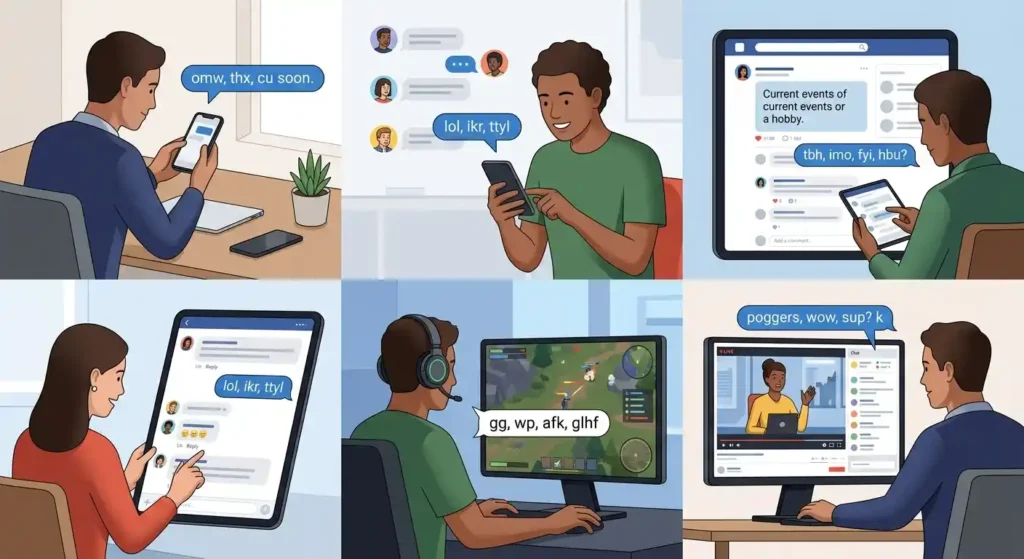
Someone might write:
“IDK what time we’re leaving.”
instead of:
“I don’t know what time we are leaving.”
Likewise:
“BRB, grabbing some food.”
is a shorter way of saying:
“Be right back, I’m grabbing some food.”
Chat slang can also communicate emotion or attitude. For example, LOL may show amusement, while SMH can express disappointment or disbelief.
In Text Messages
Text messages are one of the most common places for abbreviations and informal shorthand.
Examples include:
- “WYD?” — What are you doing?
- “OMW” — On my way.
- “LMK” — Let me know.
- “NP” — No problem.
- “TY” — Thank you.
In Group Chats
Group chats often use quick expressions because several people may be responding at once.
For example:
“WBU? Are you coming too?”
Here, WBU means “What about you?”
On Social Media
Chat slang can appear in comments, captions, DMs, livestreams, and replies. Social platforms can also spread expressions between different online communities.
One distinctive use of “chat” itself appears in livestream-style language. A creator may say “Chat, what do you think?”, using “chat” to address the viewers as a group. This usage has also appeared in social-media content beyond traditional livestream chats.
In Gaming
Gaming communities frequently use short forms such as AFK (“away from keyboard”), GG (“good game”), and IRL (“in real life”).
The exact vocabulary can vary between games and communities, so context matters.
Real Chat Examples
Here are varied examples of how chat slang can naturally appear:
- Friend: “WYD?”
You: “Just watching a movie.” - Friend: “BRB, my phone is dying.”
You: “Okay.” - Friend: “IDK what to eat.”
You: “Pizza?” - Friend: “LMK when you get home.”
You: “Will do.” - Friend: “That was hilarious LOL.”
You: “I know 😂” - Friend: “BTW, did you finish the assignment?”
You: “Almost.” - Friend: “OMW.”
You: “See you soon.” - Friend: “WBU?”
You: “I’m staying home.” - Friend: “TY for helping me.”
You: “NP!” - Friend: “TTYL, I have to go.”
You: “Okay, later!” - Friend: “HMU when you’re free.”
You: “Sure.” - Gamer: “AFK for a minute.”
Friend: “No problem.” - Friend: “TBH, I didn’t like the ending.”
You: “Same.” - Friend: “SMH, I forgot my keys again.”
You: “Seriously? 😭” - Friend: “NGL, that looks really good.”
You: “Thanks!” - Friend: “OMG, you actually did it!”
You: “Yep 😂” - Friend: “Chat, should we watch a movie?”
Group: “Yes!” - Friend: “JK, I was kidding.”
You: “You got me.” - Friend: “IRL, that place is even better.”
You: “I need to visit.” - Friend: “GG!”
You: “GG!”
These examples show why context matters more than the abbreviation alone.
How to Reply to Chat Slang
There is no single correct response to chat slang. Your reply should match the original message and your relationship with the person.
Casual Replies
For everyday conversations, keep your response simple:
- “Yeah, same.”
- “Lol true.”
- “Okay!”
- “Sounds good.”
- “For sure.”
- “Got it.”
Friendly Replies
If someone uses slang while talking casually, you can respond naturally:
- “Haha, I know what you mean.”
- “No worries!”
- “Absolutely.”
- “That works for me.”
- “I’ll let you know.”
Funny Replies
When the conversation is playful:
- “You’re actually ridiculous 😂”
- “Okay, that was funny.”
- “I wasn’t ready for that 😂”
- “You got me there.”
Neutral Replies
If you are unsure about the tone:
- “Okay.”
- “Got it.”
- “What do you mean?”
- “Can you explain?”
- “Sure.”
Asking for clarification is often better than guessing what an unfamiliar abbreviation means.
Flirty/Relationship Replies
If the conversation already has a friendly or romantic tone, you can respond according to the existing context. However, chat slang by itself does not prove that someone is flirting or interested in a relationship.
For example, “HMU later” could simply mean “contact me later.” The meaning depends on the surrounding conversation and relationship.
Context & Relationship Meaning
Chat slang usually does not change its basic definition because it comes from a guy or a girl.
If someone sends “WYD?” to you, the abbreviation still means “What are you doing?” regardless of who sends it.
What can change is the context.
Consider:
- Who sent the message?
- What was discussed before it?
- Was the conversation serious or playful?
- Were emojis used?
- Was punctuation added?
- How well do you know the person?
- What was said immediately afterward?
For example, “LOL” can simply indicate laughter, but the surrounding conversation can make it sound enthusiastic, playful, or slightly dismissive.
Likewise, a message from a friend and the same message from someone you have a crush on may feel different emotionally, even though the slang itself has not changed.
What Tone Does Chat Slang Have?
Chat slang is usually casual and informal, but its tone can vary.
Depending on the expression and context, it may sound:
- Friendly
- Playful
- Funny
- Relaxed
- Excited
- Uncertain
- Dry
- Sarcastic
- Dismissive
For example, “LOL” can show genuine amusement, but it can also simply soften a casual message. “K” may sound neutral in one conversation and blunt in another.
That is why interpreting slang requires looking at the whole message rather than one abbreviation.
Is Chat Slang Rude or Offensive?
Chat slang is not automatically rude or offensive. Most everyday abbreviations are simply informal ways of communicating.
However, some slang expressions can be inappropriate depending on their meaning or context.
Usually Fine for Casual Chats
Common abbreviations such as IDK, BTW, LOL, BRB, LMK, and TTYL are generally suited to informal conversations.
Be Careful in School or Work
Chat slang is usually not the best choice for:
- School assignments
- Formal essays
- Job applications
- Professional emails
- Official documents
- Formal customer communication
A professional message is usually clearer when written in standard language.
Who Uses Chat Slang?
Chat slang is used across many online communities, and there is no single age group that owns all of it.
Some abbreviations have been used in digital communication for many years, while other expressions develop or become popular within particular online communities.
It is therefore better to understand a term based on its meaning and context rather than automatically calling every piece of chat slang “Gen Z slang.”
Other Meanings of Chat Slang
“Chat slang” is primarily a broad description of informal language used in online conversations, rather than a term with several unrelated dictionary meanings.
However, “chat” itself can have different uses.
In ordinary communication, “chat” can mean a conversation or an informal talk.
In livestream and creator culture, “chat” can refer to the audience watching and commenting. For example:
“Chat, should I do it?”
Here, the speaker is addressing the audience collectively rather than referring to the word “chat” as a private conversation.
Chat Slang vs. Similar Terms
Several terms overlap, but they are not always identical.
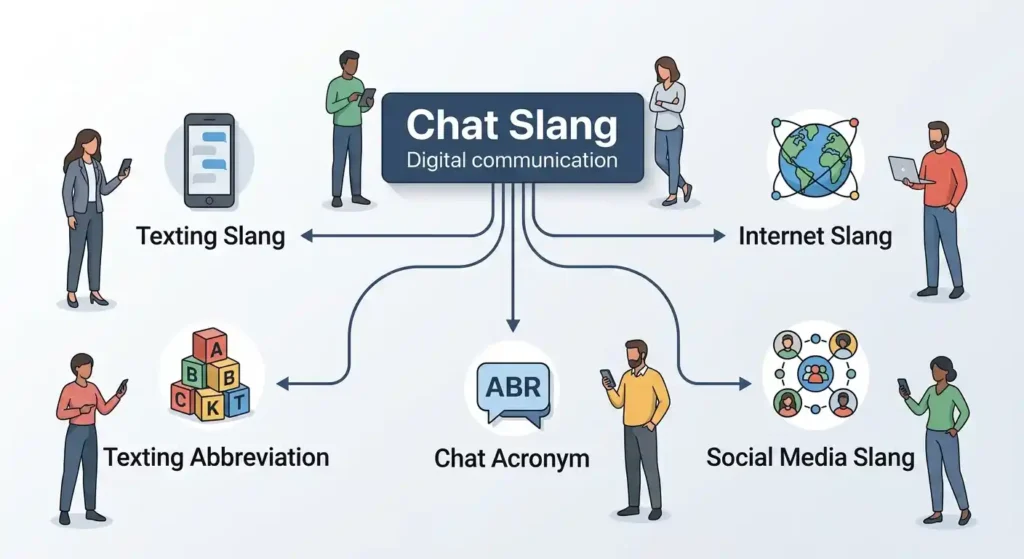
| Term | Meaning | Main Difference |
| Chat slang | Informal language used in online chats | Broad category |
| Text slang | Informal shorthand used in messages | Often focused on texting |
| Internet slang | Informal language developed or used online | Broader than chat alone |
| Texting abbreviation | Shortened form of a word or phrase | Usually specifically an abbreviation |
| Chat acronym | Initial-based shortened expression | A specific type of chat shorthand |
| Social media slang | Informal language used on social platforms | Often tied to platform culture |
So, chat slang is an umbrella term, while texting abbreviations and chat acronyms are specific types of language that can fall under it.
Common Mistakes About Chat Slang
Assuming Every Short Word Is an Acronym
Not every piece of chat slang is an acronym. Some are shortened words, initialisms, expressions, numbers, or ordinary words that have developed an informal online meaning.
Assuming One Meaning Always Applies
Some abbreviations have multiple meanings. The surrounding conversation can determine which interpretation makes sense.
Treating All Chat Slang as New
Some common abbreviations have been used in online and text communication for years. Not every familiar abbreviation is a recent social-media trend.
Assuming Slang Proves Romantic Interest
A phrase such as “HMU,” “LOL,” or “WYD” does not automatically mean someone is flirting. Relationship meaning comes from the broader conversation, not the abbreviation alone.
Using Slang in Formal Writing
Even if a slang term is perfectly normal in a group chat, it may not fit a formal assignment, professional email, or official communication.
Related Internet Slang
| Term | Meaning | Common Use |
| LOL | Laughing out loud | Showing amusement |
| BRB | Be right back | Temporarily leaving a chat |
| IDK | I don’t know | Expressing uncertainty |
| BTW | By the way | Adding another point |
| LMK | Let me know | Asking someone to provide information |
| TTYL | Talk to you later | Ending a conversation temporarily |
| HMU | Hit me up | Asking someone to contact you |
| WYD | What are you doing? | Asking about someone’s current activity |
| AFK | Away from keyboard | Gaming and online chats |
| IRL | In real life | Distinguishing offline life from online activity |
| TBH | To be honest | Introducing an honest opinion |
| SMH | Shaking my head | Showing disappointment or disbelief |
These examples represent common forms of texting and online shorthand rather than a complete list of chat slang.
Real-World Conversation
Imagine a group of friends planning a movie:
Alex: “WYD tonight?”
Sam: “Nothing much. Why?”
Alex: “Wanna watch a movie?”
Sam: “Sure LOL. What time?”
Alex: “8?”
Sam: “Sounds good. LMK if anyone else is coming.”
In this conversation, the slang keeps the messages short and casual without changing the basic meaning of the conversation.
People Also Ask
What is chat slang?
Chat slang is informal language used in digital conversations. It includes abbreviations, acronyms, shortened words, and expressions used in texts, DMs, group chats, gaming, and social media.
What are examples of chat slang?
Examples include LOL, BRB, IDK, BTW, LMK, TTYL, HMU, and AFK. Each abbreviation has its own meaning and is used in different situations.
Is chat slang the same as texting slang?
They overlap, but they are not exactly the same. Texting slang focuses more specifically on text messages, while chat slang can include language used in messaging apps, online communities, gaming chats, livestreams, and other digital conversations.
Why do people use chat slang?
People often use chat slang because it makes informal messages quicker and more conversational. Abbreviations can also become familiar expressions within particular online communities.
Is chat appropriate for school?
It depends on the situation. Casual messages with classmates may use slang, but formal assignments and academic writing should generally use standard language unless the assignment specifically asks for informal language.
Is chat slang appropriate at work?
It is usually safest to use standard language in professional communication. Some workplaces may use casual language internally, but formal emails and important business messages should prioritize clarity.
Does chat have the same meaning everywhere?
Not always. An abbreviation can have multiple meanings, and some expressions are specific to particular communities or platforms. Context is important when interpreting unfamiliar slang.
Does using chat mean someone is a certain age?
No. Individual slang terms can be used by people of different ages and backgrounds. A person’s use of one abbreviation does not reliably identify their generation.
Conclusion
Chat slang is informal language used in digital conversations, including abbreviations, acronyms, shortened words, and online expressions. It is especially common in casual texts, DMs, group chats, gaming, and social-media conversations.
Its tone can be friendly, playful, neutral, humorous, or context-dependent. The safest way to understand unfamiliar slang is to consider the full message, surrounding conversation, and relationship between the people communicating.

Charlotte Reed creates captions and quotes built around moments, moods, and personal expression. Over three and a half years, she has worked on content covering travel experiences, lifestyle themes, relationships, events, social media posts, entertainment topics, and aesthetic styles. Her process involves studying language patterns, refining caption structure, and adjusting wording to match different occasions and visual themes.