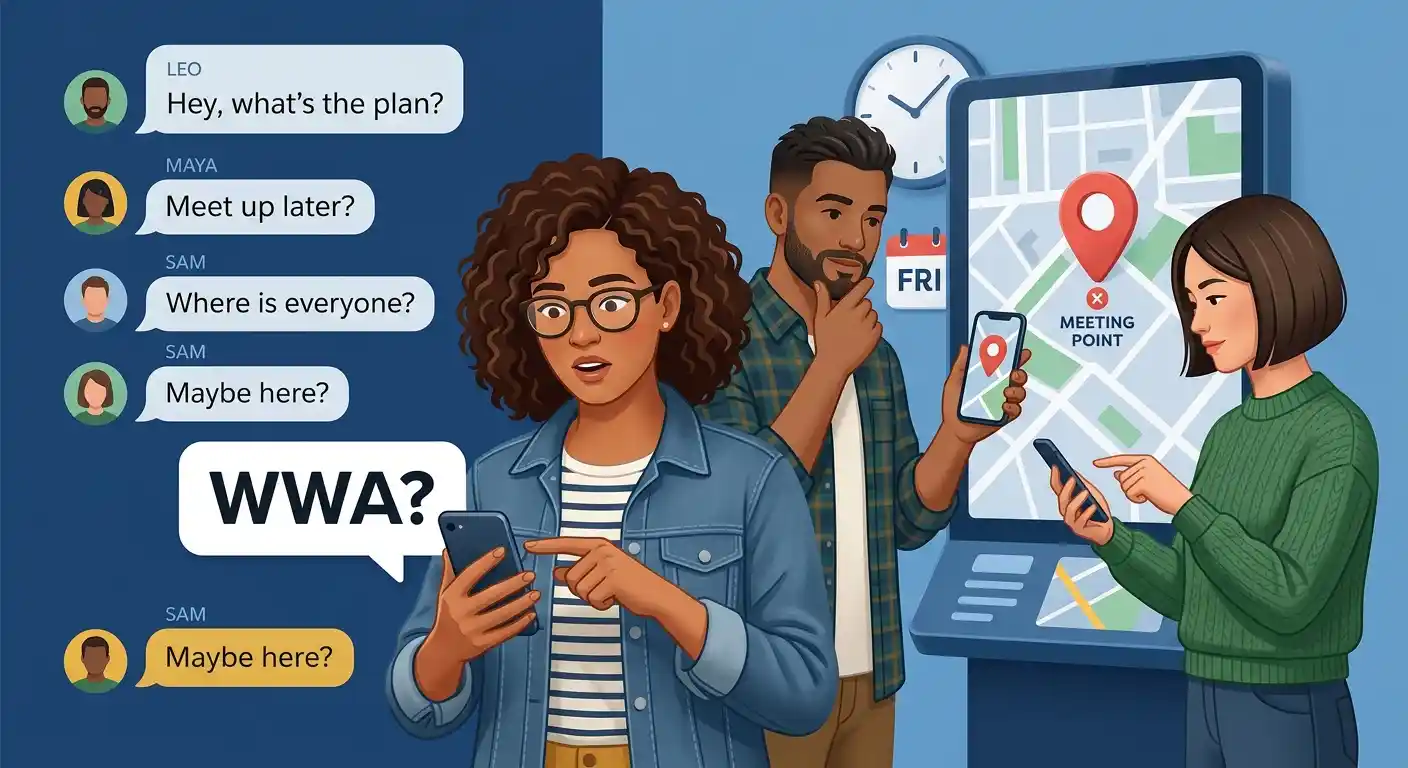
WWA in text most commonly means “Where We At?” It is a casual texting abbreviation used to ask about someone’s location, current plans, or what is happening. However, WWA is context-dependent and can have other interpretations in online conversations.
Key Takeaways
- WWA commonly means “Where We At?” in casual texting.
- It can ask about a location, plan, status, or current situation.
- WWA is an informal texting abbreviation, not a universally fixed acronym.
- Context matters because some people use WWA for phrases such as “What’s With That?”
- It is most suitable for casual conversations, rather than formal or professional writing.
- WWA by itself does not indicate romantic interest; the surrounding conversation determines the tone.
WWA Meaning in Text
The most common texting interpretation of WWA is “Where We At?” In natural conversation, this can mean “Where are we?”, “Where is everyone?”, “What’s the plan?” or “What’s happening right now?”
WWA is a form of text slang and messaging shorthand. Instead of typing a complete question, someone may use three letters to get a quick update.
For example:
“WWA?”
Depending on the conversation, the sender may be asking where everyone is.
Another example:
“WWA tonight?”
Here, the question is more likely about the evening’s plans.
WWA is informal and context-dependent. Unlike highly standardized texting abbreviations such as LOL or BRB, it does not have one universally accepted meaning across every conversation.
What Does WWA Stand For?
In casual texting, WWA can stand for “Where We At?”
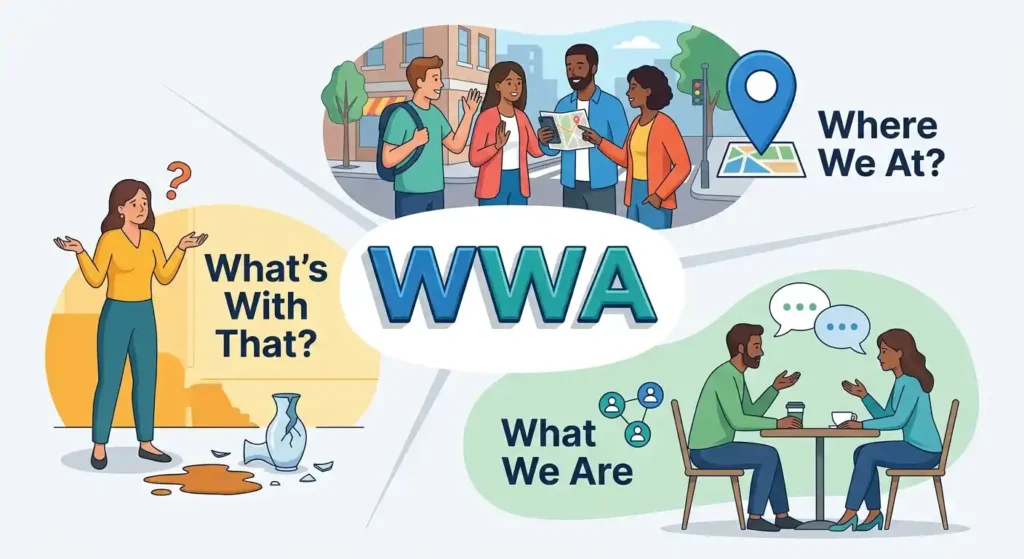
The phrase is intentionally informal. In standard English, you would normally say “Where are we at?” or, depending on the situation, “Where are we?”
Other interpretations can appear in online communication. For example, “What’s With That?” can fit when WWA appears as a reaction to something surprising or confusing.
Because these meanings overlap, the words surrounding WWA are important.
| WWA interpretation | Meaning | Typical context |
|---|---|---|
| Where We At? | Asking about location, plans, or status | Friends, group chats |
| What’s With That? | Asking why something happened or expressing confusion | Reactions, comments |
| What We Are | Referring to the nature of a relationship or situation | Relationship discussions |
The first interpretation is the clearest fit when WWA appears during planning, meetups, or location updates.
How Is WWA Used?
WWA is generally used in casual digital communication when someone wants a short answer.
Text Messages
A person might send:
“WWA? I’m already here.”
The sender is asking where the other person or group is.
Group Chats
WWA can work as a quick status check:
“WWA with dinner?”
This could mean, “What’s the plan for dinner?” or “Where are we going for dinner?”
Social Media and DMs
In a private message, WWA can be used similarly to a normal text message. The exact interpretation depends on what was discussed immediately beforehand.
Comments
A comment containing WWA may have a different meaning if it reacts to something surprising. For example, a conversation about an unusual situation could make “What’s With That?” a more natural interpretation.
The important point is that WWA should not be interpreted from the letters alone.
WWA in Different Contexts
From a Friend
If a friend sends “WWA?” while you are making plans, they are probably asking where everyone is or what the current plan is.
You could answer:
“Downtown. We’re grabbing food first.”
From a Guy or Girl
The abbreviation itself does not change meaning based on whether the sender is a guy or a girl. WWA still depends on the conversation.
If the conversation is about meeting up, it may be a location or planning question. If the conversation is about something confusing, another interpretation may fit better.
From a Crush
WWA does not automatically mean flirting or romantic interest. If a crush sends “WWA tonight?”, look at the conversation before and after the message to understand whether they are simply asking about plans or discussing something more personal.
In Dating or a Relationship
In a relationship conversation, context can sometimes make “What We Are” relevant, particularly if the discussion is about defining the relationship.
For example:
“We’ve been seeing each other for months. WWA?”
In that specific context, the sender could be referring to “What We Are.”
However, you should not assume that interpretation without supporting context.
In a Group Chat
Group chats are a natural setting for the “Where We At?” interpretation because people often use short messages to coordinate plans.
On Social Media
A public comment may use WWA differently from a private DM. If the message is reacting to something strange or unexpected, “What’s With That?” may make more sense than “Where We At?”
Real Chat Examples
Here are realistic examples showing how context changes the meaning.
“Where We At?” Examples
- Friend: “WWA?”
You: “I’m still at home.” - Friend: “WWA tonight?”
You: “Probably downtown.” - Friend: “Everyone’s ready. WWA?”
You: “Meet at my place.” - Friend: “WWA rn?”
You: “Outside the restaurant.” - Friend: “WWA with the movie?”
You: “We’re still waiting for everyone.” - Friend: “WWA for dinner?”
You: “Pizza sounds good.” - Friend: “I’m here. WWA?”
You: “Parking now.” - Friend: “WWA tomorrow?”
You: “I’m free after 3.” - Friend: “WWA with the plans?”
You: “Nothing confirmed yet.” - Friend: “WWA? We’re leaving soon.”
You: “Give me five minutes.”
“What’s With That?” Examples
- Friend: “He canceled again.”
You: “WWA?” - Friend: “They changed the rules overnight.”
You: “WWA with that?” - Friend: “She deleted the whole post.”
You: “WWA 😭” - Friend: “The price went up again.”
You: “WWA?” - Friend: “Nobody told me about the change.”
You: “WWA?”
“What We Are” Context
- Person A: “We’ve been talking for a while.”
Person B: “Yeah, so WWA?” - Person A: “Are we actually dating?”
Person B: “I think we should talk about WWA.” - Person A: “I’m confused about us.”
Person B: “Same. WWA, honestly?”
These relationship examples depend heavily on the surrounding conversation. WWA alone does not prove that someone wants a romantic relationship.
How to Reply to WWA
Your best reply depends on what the sender appears to mean.
Casual Replies
If they are asking about plans or location:
- “I’m on my way.”
- “Downtown right now.”
- “Still at home.”
- “Not sure yet.”
- “We’re meeting at 7.”
Friendly Replies
- “We’re grabbing food first.”
- “Come meet us!”
- “I’ll let you know when we decide.”
- “We’re almost there.”
Funny Replies
If the conversation is playful:
- “Somewhere between hungry and lost 😂”
- “That is an excellent question.”
- “Currently surviving.”
- “You tell me 😭”
Neutral Replies
If you are unsure what WWA means:
- “What do you mean by WWA?”
- “Where do you mean?”
- “Do you mean where we are?”
Asking for clarification is often the easiest option when the context is unclear.
Relationship Replies
If the conversation is clearly about defining a relationship:
- “I think we should talk about that.”
- “What do you think we are?”
- “I’m not totally sure either.”
- “Let’s talk about it.”
What Tone Does WWA Have?
WWA is generally casual, informal, and direct.
The tone depends on how it is written and what comes before it.
For example:
- “WWA?” → brief and direct
- “WWA tonight?” → casual planning
- “WWA 😭” → potentially playful or confused
- “WWA??” → may express stronger confusion or urgency
Punctuation, emojis, and the conversation topic can change how the message feels. The abbreviation itself does not automatically make a message rude, flirtatious, or serious.
Is WWA Rude or Offensive?
WWA is not inherently rude or offensive. It is an informal abbreviation.
It can be fine in:
- Casual texts
- Friend group chats
- Social media conversations
- Informal DMs
For school, work, professional communication, or formal writing, it is better to write the full question because the recipient may not know which meaning you intend.
For example, instead of writing:
“WWA?”
a clearer professional message would be:
“Where are we with the project?”
Clarity matters more than saving a few characters in formal communication.
Other Meanings of WWA
WWA has meanings outside casual texting, but these should not automatically be applied to a text message.
WWA in Online Communities
Different online communities may assign their own meanings to short abbreviations. A specific group can also create an inside meaning that would not be recognizable outside that community.
WWA in Other Contexts
WWA can also appear as initials or an acronym for organizations, names, places, or other terms unrelated to texting slang. These meanings require the surrounding subject to identify correctly.
For a casual text, “Where We At?” is the most useful starting interpretation when the conversation involves plans, location, or status.
Common Mistakes About WWA
Assuming WWA Has Only One Meaning
WWA is not completely standardized. “Where We At?” is a common texting interpretation, but context can support other readings.
Assuming It Always Means “Where Are You?”
“Where We At?” can refer to more than physical location. It may ask about plans, progress, timing, or the current situation.
Assuming It Is Romantic
WWA does not automatically signal flirting, attraction, or relationship interest. The surrounding conversation matters.
Ignoring the Message Before It
The easiest way to interpret WWA is to read the previous message. If the conversation is about meeting somewhere, a location-related meaning is more likely. If someone just did something confusing, a reaction such as “What’s With That?” may fit better.
Treating It Like a Formal Acronym
WWA is informal when used as texting slang. It should not be treated like a standard professional abbreviation without checking the context.
WWA and Related Slang
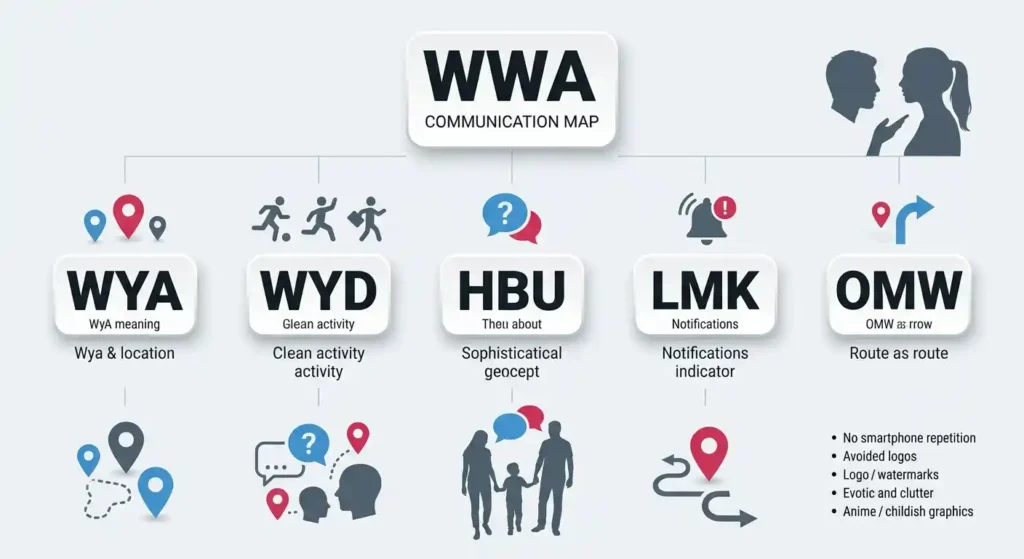
| Term | Meaning | Common Use |
|---|---|---|
| WYA | Where You At? | Asking someone’s location |
| WYD | What You Doing? | Asking what someone is doing |
| HBU | How About You? | Returning a question |
| LMK | Let Me Know | Asking someone to provide an update |
| OMW | On My Way | Saying you are traveling to a location |
WWA is closest to WYA when it is being used as a location or meetup question, but WWA can be broader because it may ask about the overall situation or plans.
People Also Ask About WWA
What does WWA stand for in texting?
In casual texting, WWA commonly stands for “Where We At?” It can refer to someone’s location, a group’s plans, or the current status of something.
Is WWA a slang word?
WWA is better described as a texting abbreviation or internet shorthand rather than a traditional slang word. Its meaning depends heavily on the conversation.
Does WWA mean “What’s With That?”
It can. When WWA appears as a reaction to something confusing, surprising, or unusual, “What’s With That?” may fit better than “Where We At?”
Does WWA mean “What We Are” in a relationship?
It can be interpreted that way when the conversation is specifically about defining a relationship. However, WWA by itself does not establish that meaning.
Is WWA the same as WYA?
No. WYA directly means “Where You At?” while WWA can mean “Where We At?” and may refer to a group, plan, or broader situation.
Is WWA appropriate for work?
It is usually better to avoid WWA in professional messages because it is informal and potentially ambiguous. A complete question is clearer.
How can I tell which meaning of WWA someone intends?
Look at the previous message, conversation topic, punctuation, emojis, and relationship with the sender. If those clues are not enough, simply ask what they mean.
Conclusion
WWA most commonly means “Where We At?” in casual text conversations, especially when someone is asking about location, plans, progress, or a current situation. It is an informal texting abbreviation rather than a fixed expression with one universal meaning.
Context is important because WWA can also fit interpretations such as “What’s With That?” or, in a relationship-focused conversation, “What We Are.” When the meaning is unclear, check the surrounding messages or ask the sender directly. For professional or formal communication, use the full phrase instead.

Charlotte Reed creates captions and quotes built around moments, moods, and personal expression. Over three and a half years, she has worked on content covering travel experiences, lifestyle themes, relationships, events, social media posts, entertainment topics, and aesthetic styles. Her process involves studying language patterns, refining caption structure, and adjusting wording to match different occasions and visual themes.