
FIWB usually means “F it, we ball,” an informal internet slang expression used to say that you are going to go ahead, take the chance, or keep moving without overthinking the situation. It is mainly used in casual online communication.
Key Takeaways
- FIWB is commonly used as shorthand for “F it, we ball.”
- It expresses a “let’s just do it” or “we’ll figure it out” attitude.
- The phrase is casual and informal, so it fits chats, memes, and social posts better than formal writing.
- The exact feeling can depend on the situation: it may sound playful, confident, spontaneous, or humorous.
- FIWB is not the same as FWB, which is a separate abbreviation with a different meaning.
- FIWB can also have non-slang meanings in specialized contexts, so the surrounding conversation matters.
FIWB Meaning in Text
In texting, FIWB generally means “F it, we ball.” The phrase is a casual way of saying that you are going to stop worrying about every detail and go for it anyway.
The expression is a form of internet slang and messaging shorthand. Someone might use it after discussing an uncertain plan, a difficult situation, or something that does not seem perfectly prepared.
For example:
“We don’t have everything planned, but FIWB.”
The idea is essentially: “Let’s go ahead anyway and see what happens.”
The wording contains a censored form of profanity, which makes FIWB informal rather than professional.
What Does FIWB Stand For?
In internet slang, FIWB stands for “F it, we ball.” The first part is commonly written as a shortened or censored form of profanity.
The phrase is associated with a carefree “go for it” attitude. FIWB does not necessarily mean someone is literally playing basketball; “ball” is part of the expression rather than a literal instruction.
There are also non-slang meanings for FIWB, including “Family Income and Wealth Building” in a business/consulting context. That meaning is different from the texting slang and should be interpreted from context.
How Is FIWB Used?
FIWB is most natural in informal online communication. It can appear when someone wants to express a decision to move forward despite uncertainty.
Text messages
- “We didn’t plan this very well. FIWB.”
- “I’m nervous, but FIWB 😂”
Group chats
- “Should we actually go?”
- “FIWB, let’s go.”
Social media
It can also work as a short reaction or caption when someone describes an unexpected, spontaneous, or imperfect situation.
Gaming and online communities
The same basic idea can be used when someone decides to keep playing, try something risky, or continue despite a setback.
The important point is that FIWB is informal shorthand, not standard formal English.
FIWB in Different Contexts
The meaning stays broadly the same, but the attitude behind it can change with context.
From a friend
A friend might use FIWB jokingly to say, “Let’s just go for it.”
From a guy or girl
The abbreviation itself does not have a different meaning based on gender. Look at the surrounding conversation instead.
From a crush
FIWB by itself does not prove flirting or romantic interest. If someone uses it during a conversation about plans or a decision, it may simply express a carefree attitude.
In dating
Someone might use FIWB when talking about an uncertain plan, but the abbreviation alone does not establish romantic intent.
In a group chat
FIWB can work as a quick way to get everyone to stop overthinking and move forward.
In social media comments
It may be used as a humorous reaction to someone’s spontaneous decision or unexpected situation.
When interpreting it, consider the previous messages, punctuation, emojis, relationship between the people, and topic of conversation rather than relying on FIWB alone.
Real Chat Examples
Here are natural examples showing how FIWB can work in different situations:
- Friend: “Should we take the earlier flight?”
You: “FIWB, let’s do it.” - Friend: “We barely planned this road trip.”
You: “FIWB 😂” - Friend: “I’m nervous about posting it.”
You: “FIWB. Just post it.” - Friend: “The project isn’t perfect yet.”
You: “FIWB, we can improve it later.” - Friend: “Do you really want to try that new restaurant?”
You: “FIWB, I’m hungry.” - Friend: “We might be late.”
You: “FIWB, let’s go.” - Friend: “I don’t know if this idea will work.”
You: “FIWB. Give it a shot.” - Friend: “Should we sign up for the tournament?”
You: “FIWB!” - Friend: “We lost the first round.”
You: “FIWB, next round.” - Friend: “I’m overthinking this decision.”
You: “FIWB and make the call.” - Friend: “Our plan changed completely.”
You: “FIWB 😂” - Friend: “We forgot to bring snacks.”
You: “FIWB, we’ll survive.” - Friend: “I’m not sure I’m ready.”
You: “FIWB. You’ll be fine.” - Friend: “Should I send the message?”
You: “FIWB 😭” - Friend: “This might be a terrible idea.”
You: “FIWB, let’s see what happens.”
These examples show that FIWB usually communicates a carefree decision to move ahead, rather than a precise factual statement.
How to Reply to FIWB
Your response depends on what the other person means in the conversation.
Casual Replies
- “Honestly, yeah 😂”
- “Let’s do it.”
- “Fair enough.”
- “I’m in.”
- “Why not?”
Friendly Replies
- “You know what? Let’s go.”
- “Okay, I’m convinced.”
- “We’re figuring it out as we go.”
- “That works for me.”
Funny Replies
- “This is how bad decisions begin 😂”
- “No thoughts, just vibes.”
- “Well, here we go.”
- “Future us can deal with it.”
Neutral Replies
- “Sounds good.”
- “Okay, let’s see how it goes.”
- “I’m fine with that.”
- “Sure, let’s try.”
Flirty/Relationship Replies
If the conversation is already clearly playful or romantic, you could respond naturally without assuming FIWB itself is romantic:
- “Okay, I’m trusting you on this one.”
- “You really don’t overthink anything, do you? 😂”
- “Fine, let’s see where this goes.”
What Tone Does FIWB Have?
FIWB is generally casual, informal, playful, and context-dependent.
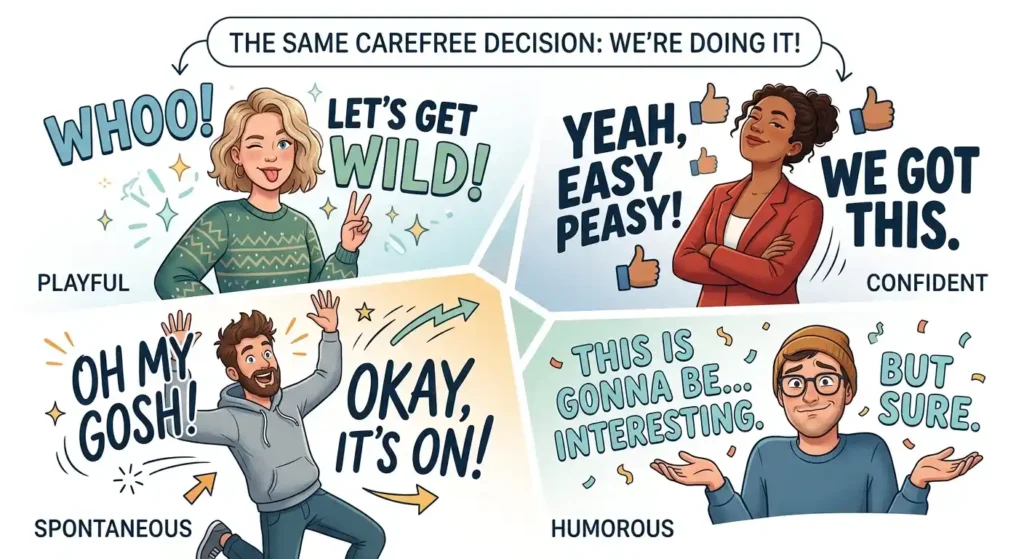
Depending on the conversation, it can sound:
- Playful when used as a joke
- Confident when someone decides to move forward
- Carefree when someone stops worrying about the outcome
- Spontaneous when a plan is made without much preparation
- Humorous when the situation is obviously imperfect
The tone comes more from the surrounding conversation than from the four letters themselves.
Is FIWB Rude or Offensive?
FIWB is not appropriate for formal writing because its expansion contains profanity.
It can be fine in casual conversations where informal language is expected, but it is better avoided in:
- School assignments
- Professional emails
- Job applications
- Formal reports
- Academic writing
- Other professional communication
If you want to express the same general idea without profanity, you could simply say “Let’s go for it,” “Why not?”, or “We’ll figure it out.”
Other Meanings of FIWB
FIWB is not exclusively internet slang. The surrounding context can point to a different meaning.
FIWB in Business
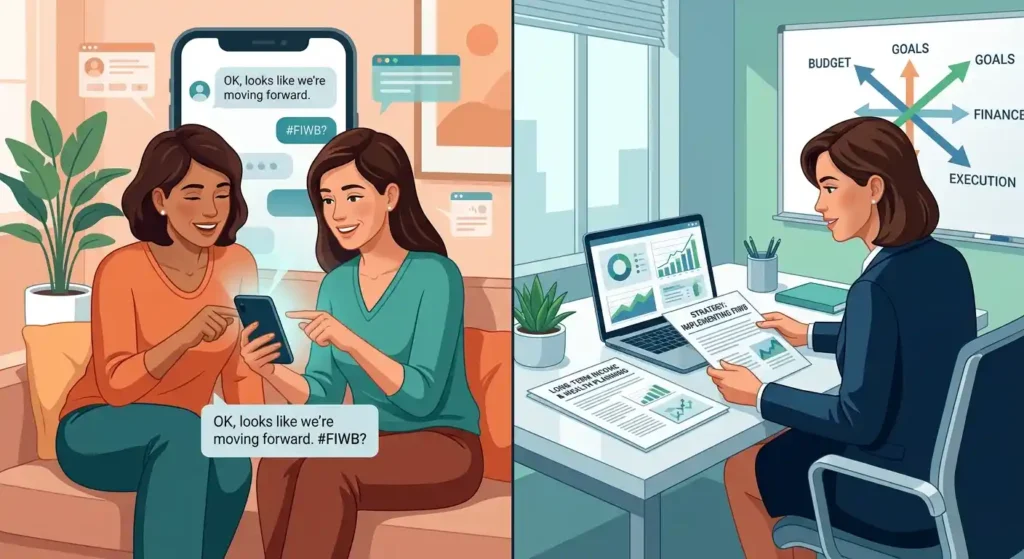
Family Income and Wealth Building is one documented non-slang expansion of FIWB in a business or consulting context. It relates to building long-term family income and wealth rather than online slang.
FIWB in Specialized Contexts
Acronym databases also list other specialized uses, so seeing FIWB outside a casual conversation does not automatically mean “F it, we ball.” Context is the best way to determine which expansion applies.
Common Mistakes About FIWB
Confusing FIWB with FWB
FIWB and FWB are different abbreviations. FIWB is associated with “F it, we ball,” while FWB is a separate abbreviation.
Assuming FIWB is always literal
The word “ball” does not necessarily mean someone is actually playing basketball. In the slang expression, it is part of the phrase.
Assuming FIWB proves romantic interest
FIWB does not automatically indicate flirting, attraction, or romantic feelings. The conversation around it matters.
Treating it as formal English
FIWB is informal internet shorthand. It should not be treated like a standard abbreviation for professional or academic writing.
Assuming there can never be another meaning
Acronyms can have different meanings in different fields. If FIWB appears in a business or specialized discussion, check the context before interpreting it as slang.
FIWB and Related Slang
| Term | Meaning | Common Use |
|---|---|---|
| FIWB | “F it, we ball” | Going ahead despite uncertainty |
| YOLO | “You only live once” | Taking a chance or enjoying an opportunity |
| FWIW | “For what it’s worth” | Adding an opinion or useful perspective |
| IDK | “I don’t know” | Expressing uncertainty |
FIWB is closest in spirit to expressions about taking a chance or not overthinking a situation, although these terms do not mean exactly the same thing.
People Also Ask About FIWB
Is FIWB the same as FWB?
No. FIWB and FWB are separate abbreviations. FIWB is commonly associated with “F it, we ball,” while FWB has a different meaning.
Does FIWB mean “just do it”?
Not exactly, but the ideas are similar. FIWB communicates a willingness to move forward without overthinking the situation, so “just do it” can capture the general idea.
Is FIWB a swear word?
FIWB itself is an abbreviation, but its common slang expansion contains a shortened form of profanity. That makes it informal and potentially unsuitable for formal settings.
Can FIWB be used at school?
It is better avoided in formal schoolwork because it is internet slang and contains profanity in its usual expansion. For casual conversation, the appropriateness depends on the setting and people involved.
Does FIWB always mean “F it, we ball”?
No. That is the main internet-slang interpretation, but FIWB can also appear as an acronym in specialized contexts, including business terminology.
Is FIWB a serious expression?
Usually, it is casual or humorous rather than formal or serious. The exact tone depends on what is happening in the conversation.
Conclusion
FIWB is commonly used in text and online communication as shorthand for “F it, we ball,” expressing a casual decision to move forward without overthinking. Its tone is usually playful, carefree, confident, or spontaneous.
Because the phrase contains profanity, FIWB is best suited to informal conversations and social media, not professional or academic writing. It can also have specialized meanings outside internet slang, so the surrounding context should always guide your interpretation.

Michael Anderson is a writer focused on captions and quotes designed for different moments, moods, and social settings. Over three and a half years, he has created collections covering travel, lifestyle, relationships, events, social media, entertainment, and aesthetic themes. Michael studies tone, context, and phrasing to craft captions that match specific occasions and visual styles.