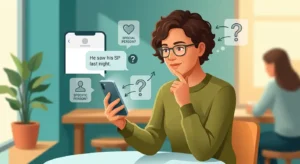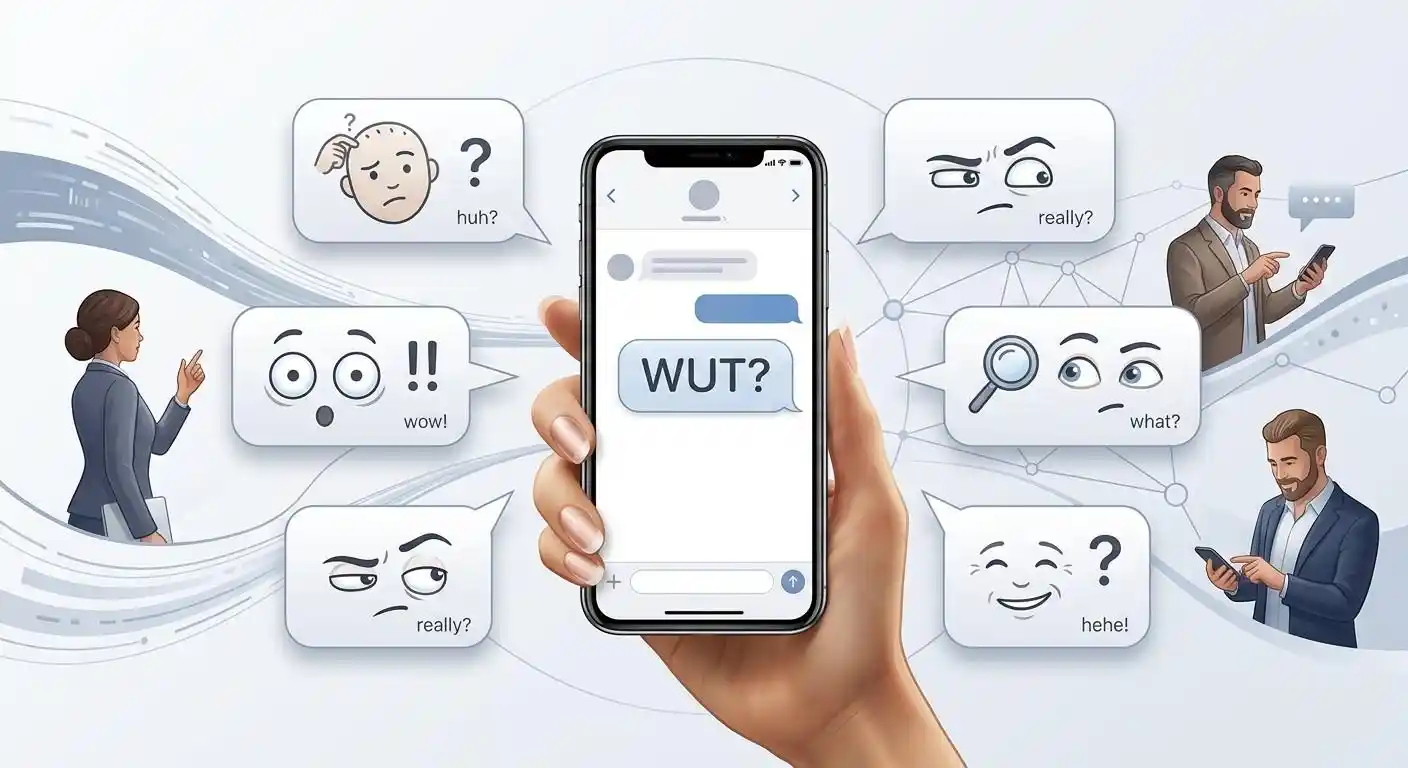
WUT in text usually means “what.” It is an informal, nonstandard spelling used in online conversations to show confusion, surprise, disbelief, curiosity, or a playful reaction. The exact tone depends on the surrounding message, punctuation, capitalization, emojis, and relationship between the people chatting.
If someone sends you “wut?”, they may simply be asking what you mean. If they write “WUT?!”, the same word can sound much more surprised or disbelieving.
Key Takeaways
- WUT usually means “what.”
- It is an informal internet spelling, not normally an acronym with a separate full form.
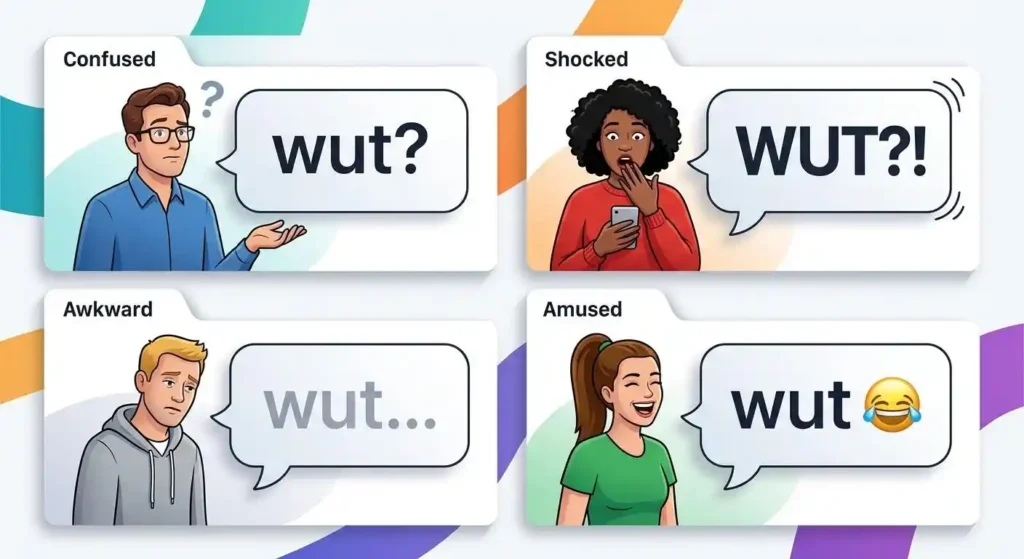
- It can express confusion, surprise, disbelief, curiosity, or amusement.
- “wut?” can sound casual or confused, while “WUT?!” often adds stronger emphasis.
- The spelling does not automatically indicate anger, flirting, or sarcasm.
- It is best suited to casual texts, chats, comments, and online conversations, rather than formal writing.
WUT Meaning in Text
In texting, wut is a stylized spelling of “what.” It functions as an informal interjection or question word in digital communication.
Unlike abbreviations such as LOL or IDK, WUT does not normally represent the first letters of several words. It is simply an altered spelling of a single word.
The meaning can shift slightly according to context:
- “wut?” — What? / What do you mean?
- “WUT?!” — What?! / Seriously?!
- “wut are you doing?” — What are you doing?
- “wut lol” — What? That’s funny or unexpected.
- “wut…” — Confusion, disbelief, or an awkward reaction.
The spelling gives the message a more casual, playful, expressive, or internet-style tone than the standard spelling “what.”
What Does WUT Stand For?
In ordinary texting and internet slang, WUT does not stand for a longer phrase. It generally means “what.”
It is more accurate to describe WUT as an informal or stylized spelling than as a traditional acronym.
So:
WUT = what
The unusual spelling can add personality or emphasis, but it does not create a completely different definition.
How Is WUT Used?
WUT can appear when someone wants clarification or reacts to something unexpected.
For example:
A: I just found out our class starts at 6 a.m.
B: Wut?!
Here, WUT communicates surprise rather than simply asking a neutral question.
It can also be used inside a sentence:
“Wut are you talking about?”
That still means “What are you talking about?” The writer is simply choosing a deliberately informal spelling.
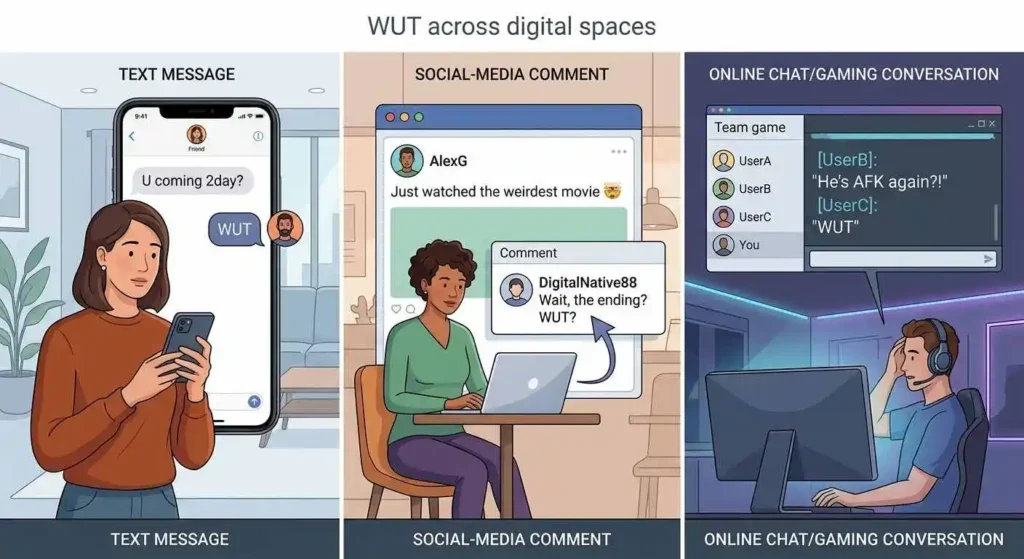
Text Messages and DMs
WUT works naturally in casual messages between people who are comfortable with informal internet language.
Social Media Comments
It can be used as a short reaction to something surprising, confusing, funny, or unexpected.
Online Chats and Gaming
Fast-moving online conversations can also use WUT as a quick reaction when someone says something unusual.
The important point is that WUT is context-dependent. The word itself does not tell you exactly whether the sender is confused, shocked, joking, or skeptical.
Real Chat Examples
Here are varied examples showing how WUT can work in different situations:
- A: I forgot we had a test today.
B: Wut?! - A: Can you explain that again?
B: Wut do you mean? - A: I just won the contest.
B: WUT?! Seriously? - A: The movie starts at midnight.
B: Wut? 😭 - A: I accidentally sent that message to the wrong person.
B: WUT 😂 - A: He said he finished the whole project in ten minutes.
B: wut - A: Wut are you doing later?
- A: I changed my mind.
B: Wut happened? - A: Guess what—I got tickets.
B: WUT?! - A: Wut? I thought you already knew.
- A: That was the plan all along.
B: wut… - A: I just saw your message.
B: Wut message? - A: You won’t believe who I saw today.
B: WUT? - A: I accidentally ordered three pizzas.
B: wut lol - A: Wut are you talking about? 😂
- A: The meeting is tomorrow instead.
B: Wut? Nobody told me. - A: I think I left my phone at home.
B: Wut 😭 - A: I actually liked the ending.
B: WUT? No way. - A: Wut happened while I was gone?
- A: I just found out the answer.
B: wut??
These examples show why the same spelling can communicate different reactions.
How to Reply to WUT
There is no single correct response. First figure out what the sender seems to mean.
Casual Replies
If they are simply asking what happened or what you meant:
- “What?”
- “I mean, what do you mean?”
- “Haha, what?”
- “Let me explain.”
Friendly Replies
If the conversation is relaxed:
- “Lol, I know 😂”
- “I’ll explain.”
- “Wait, hear me out.”
- “Okay, long story.”
Funny Replies
If WUT is clearly being used as a humorous reaction:
- “Exactly 😂”
- “I knew you’d say that.”
- “Don’t ask questions 😭”
- “You heard me!”
Neutral Replies
When you are unsure about their tone:
- “What do you mean?”
- “Did something confuse you?”
- “Which part?”
- “Want me to explain?”
Flirty/Relationship Replies
If WUT appears in a playful conversation with someone you like, you can respond based on the existing tone:
- “You heard me 😌”
- “Why are you so surprised?”
- “Want me to explain? 😂”
- “You know exactly what I mean.”
A WUT message by itself does not prove romantic interest. The surrounding conversation matters much more.
Context & Relationship Meaning
WUT has essentially the same basic meaning whether it comes from a guy, a girl, a friend, or a crush.
For example, if a friend says:
“Wut?”
they may simply be confused.
If a crush says:
“WUT?! 😂”
they may be surprised or joking.
If someone you’re dating says:
“wut…”
they could be confused, skeptical, amused, or reacting awkwardly.
The relationship can influence how the message feels, but it does not change the basic meaning of WUT.
Pay attention to:
- What was said immediately before it
- Whether there is a question mark
- Whether there are multiple punctuation marks
- Capitalization
- Emojis
- The person’s usual texting style
- Whether the conversation is serious or playful
For example, “wut?” and “WUT?! 😂” can communicate very different levels of emotion even though both mean “what.”
What Tone Does WUT Have?
WUT is usually casual and informal. Depending on context, it can sound:
- Confused: “wut?”
- Surprised: “WUT?!”
- Disbelieving: “WUT?! No way.”
- Curious: “wut happened?”
- Playful: “wut lol”
- Amused: “wut 😂”
- Awkward: “wut…”
The spelling itself does not guarantee a particular emotion.
A useful rule is to read WUT together with the entire message, rather than interpreting the three letters on their own.
Is WUT Rude or Offensive?
WUT is not inherently rude or offensive. It is generally casual internet slang and can be perfectly normal in an informal conversation.
However, a one-word response such as “wut?” can sometimes feel abrupt. If someone has shared something serious, replying with slang may make your response seem dismissive even if that was not your intention.
For formal situations, use “what” instead.
For example:
Casual:
“Wut do you mean?”
Professional:
“What do you mean by that?”
Use standard English for school assignments, formal emails, applications, professional communication, and other situations where informal slang is inappropriate.
Who Uses WUT?
WUT is best understood as informal internet language, rather than a term that belongs exclusively to one age group.
People can encounter it in casual texting, online communities, social media conversations, comments, and other digital communication. Its use varies by individual and community, so it is better not to assume someone’s age or generation simply because they write “wut.”
Other Meanings of WUT
In the context of texting and internet slang, WUT generally means “what.”
The same letters can appear as an abbreviation or code in specialized contexts, but those meanings depend on the subject area. They should not automatically be applied to a casual message.
If someone simply sends:
“wut?”
in a normal conversation, the natural interpretation is “what?”, not a technical acronym.
WUT vs. Similar Slang
Some informal spellings are easy to confuse with WUT:
| Term | Meaning | Difference |
| WUT | What | Informal, expressive spelling of “what” |
| WAT | What | Another informal spelling of “what” |
| WOT | What | Informal variant sometimes seen online |
| WHAT | What | Standard English spelling |
| WTH | What the heck/hell | Expresses a stronger reaction and is an actual abbreviation |
| WTF | What the f*** | Much stronger and potentially offensive expression |
The key difference is that WUT is normally just a stylized spelling of “what,” not a multi-word acronym.
Common Mistakes About WUT
Mistaking It for an Acronym
WUT usually does not have a hidden phrase behind each letter. It is simply an informal spelling of what.
Assuming It Always Means Anger
“WUT?!” can look intense, but the sender may simply be surprised or joking.
Assuming It Always Means Confusion
WUT can communicate surprise, disbelief, curiosity, or amusement as well.
Treating Capitalization as a New Meaning
wut and WUT generally refer to the same word. Capital letters can add emphasis without changing the basic definition.
Assuming It Shows Romantic Interest
A person writing “wut” to a crush or partner does not automatically mean they are flirting. The surrounding conversation provides the useful context.
Using It in Formal Writing
WUT is an informal internet spelling. In academic or professional writing, standard “what” is the better choice.
WUT and Related Slang
| Term | Meaning | Common Use |
| LOL | Laughing out loud | Showing amusement |
| IDK | I don’t know | Expressing uncertainty |
| WTH | What the heck/hell | Strong surprise or confusion |
| OMG | Oh my God | Surprise or excitement |
| Huh? | Request for clarification | Confusion or disbelief |
| WTF | What the f*** | Strong shock, anger, or disbelief |
WUT is different from these because it is primarily an informal spelling of a normal English word, rather than an abbreviation formed from multiple words.
Real-World Conversation
Imagine two friends discussing weekend plans:
Alex: I just found out the concert starts at 7 a.m.
Sam: WUT?!
Alex: I know 😂 I thought it was at 7 p.m.
Sam: That’s way too early.
Here, Sam’s “WUT?!” expresses surprise and disbelief. It does not necessarily mean Sam is angry.
People Also Ask
What does WUT mean in a text message?
WUT usually means “what.” It is an informal spelling commonly used to express confusion, surprise, disbelief, curiosity, or a request for clarification.
Is WUT an acronym?
Usually, no. In texting, WUT is generally a stylized spelling of “what,” rather than an acronym made from several words.
Is WUT the same as what?
Yes, in ordinary internet slang, WUT represents the same basic word: “what.” The unusual spelling mainly changes the tone and style.
What does WUT mean from a guy?
It normally means “what,” just as it would from anyone else. The sender’s gender does not give WUT a different definition.
What does WUT mean from a girl?
It generally means “what.” Whether it sounds confused, surprised, playful, or skeptical depends on the surrounding conversation.
Does WUT mean someone is confused?
It can. For example, “wut?” may mean “What do you mean?” But WUT can also express surprise, disbelief, amusement, or another reaction.
Is WUT rude?
Not by itself. It is informal, but whether it sounds rude depends on the situation, especially if it is used as a very short response during a serious conversation.
Can I use WUT in formal communication?
It is better to avoid it in formal communication. Use the standard spelling “what” in school, professional, academic, and formal messages.
Conclusion
WUT usually means “what” in text and online communication. It is an informal spelling that can make a message sound casual, playful, surprised, confused, or disbelieving. WUT is generally not an acronym with a separate full form. The best way to interpret it is to consider the surrounding words, punctuation, emojis, and relationship rather than assuming one fixed emotional meaning.
For casual chats, WUT can feel natural and expressive. For school, work, or formal communication, “what” is the safer standard spelling.

Charlotte Reed creates captions and quotes built around moments, moods, and personal expression. Over three and a half years, she has worked on content covering travel experiences, lifestyle themes, relationships, events, social media posts, entertainment topics, and aesthetic styles. Her process involves studying language patterns, refining caption structure, and adjusting wording to match different occasions and visual themes.