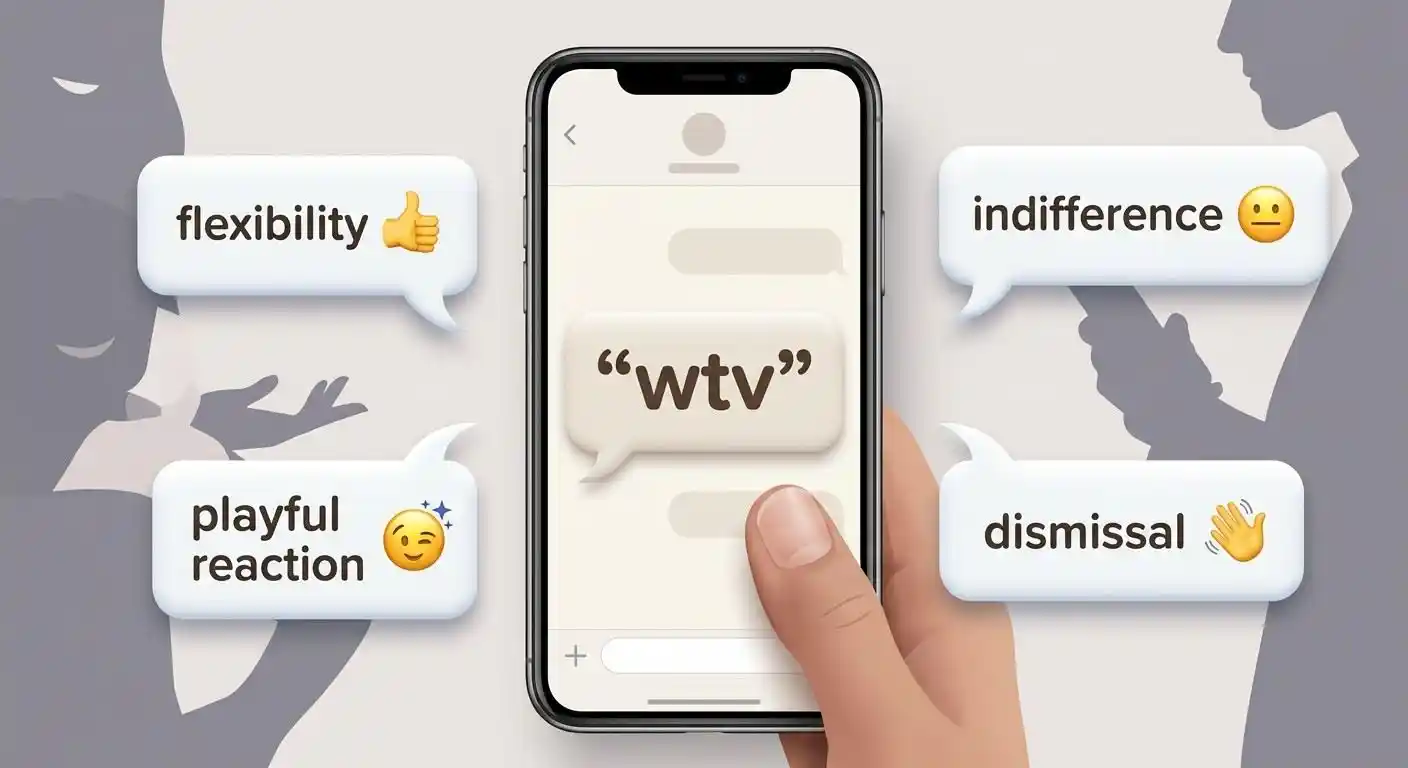
WTV usually means “whatever” in text messages and online conversations. It is an informal texting abbreviation used to show that someone does not mind, has no strong preference, or does not want to continue discussing something. Depending on context, it can sound casual, indifferent, playful, or dismissive.
You may see wtv in texts, DMs, group chats, comments, and other casual online conversations. The definition stays the same, but the tone can change considerably depending on the surrounding message, punctuation, emoji, and relationship between the people chatting.
Key Takeaways
- WTV means “whatever.”
- It is an informal texting abbreviation and messaging shorthand.
- It can express flexibility, indifference, resignation, or dismissal.
- “Wtv, you choose” can sound relaxed, while a standalone “wtv.” may sound annoyed or uninterested.
- WTV does not automatically mean someone is angry, rude, or flirting.
- It is best suited to casual conversations, not formal or professional communication.
WTV Meaning in Text
In text slang, WTV is a shortened form of “whatever.” It is used when someone wants to communicate that a choice does not matter much to them, they are willing to accept an option, or they do not want to spend more time discussing a subject.
For example:
“What should we watch tonight?”
“wtv you want.”
Here, wtv means “whatever,” with the sense of “anything you want is fine.”
But consider:
“You clearly don’t understand.”
“wtv.”
Here, the same abbreviation can sound dismissive or irritated because of the argument surrounding it.
That difference is important. The letters themselves do not determine the emotion. Context determines how WTV is likely to be interpreted.
What Does WTV Stand For?
WTV stands for “whatever.”
It is better described as an abbreviation or texting shorthand than a formal acronym. People shorten “whatever” to “wtv” because it is quicker and fits the informal style of online messaging.
The lowercase form wtv is common in casual messages, while WTV may simply reflect capitalization rather than a different meaning.
How Is WTV Used?
WTV can appear in several types of informal online communication.
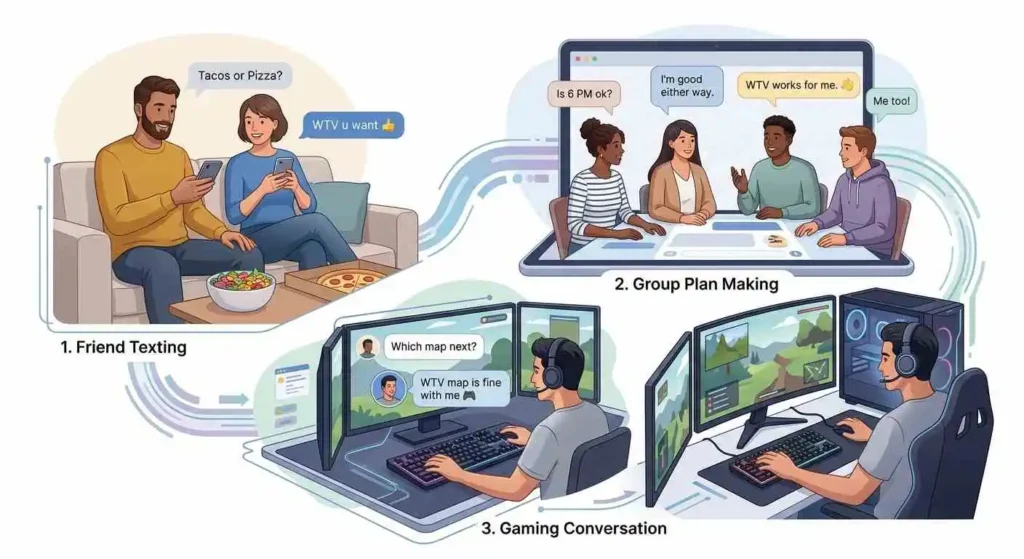
Text Messages
In ordinary texting, WTV can mean that the sender has no particular preference.
“Pizza or tacos?”
“wtv works.”
It can also communicate indifference:
“Are you still upset?”
“wtv.”
The first example is flexible and relaxed; the second can sound more detached.
DMs and Social Media
WTV can appear in direct messages, comments, and casual social-media conversations. Someone might use it when responding quickly or when they do not want to elaborate.
“Which outfit should I post?”
“wtv one you like 😂”
Group Chats
In a group chat, WTV can be a quick way of saying that the sender is happy to let everyone else decide.
“Movie at 7 or 8?”
“wtv, I’m free.”
Gaming Chats
In casual gaming conversations, someone might use WTV when they do not have a preference:
“Ranked or casual?”
“wtv.”
The meaning is still “whatever” rather than a special gaming term.
Real Chat Examples
Here are varied examples showing how WTV can work in different contexts:
- Friend: “Pizza or burgers?”
You: “wtv, both sound good.” - Friend: “Where should we meet?”
You: “wtv is easiest for everyone.” - Friend: “Do you want the blue one or black one?”
You: “wtv you think looks better.” - Friend: “Movie tonight?”
You: “wtv you want to watch.” - Friend: “Should I call you later?”
You: “wtv works.” - Group chat: “7 or 8?”
You: “wtv, I can make either.” - Friend: “Are you still coming?”
You: “Yeah, wtv.” - Friend: “Why did you delete it?”
You: “wtv, it didn’t matter.” - Friend: “Do you care which restaurant?”
You: “wtv tbh.” - Friend: “You always do this.”
You: “wtv 🙄” - Friend: “Pick a color.”
You: “wtv color you like.” - Friend: “Should we play now or later?”
You: “wtv, I’m around.” - Friend: “Are you mad?”
You: “wtv.” - Friend: “You decide what we eat.”
You: “wtv 😂” - Friend: “Do you want to go?”
You: “wtv, sure.” - Friend: “I think you’re wrong.”
You: “wtv.” - Friend: “Should I send it?”
You: “wtv you think.” - Friend: “Want to change plans?”
You: “wtv, I’m good either way.” - Friend: “Which song should I use?”
You: “wtv fits the video.” - Friend: “Are we meeting tomorrow?”
You: “wtv works for me.”
These examples show why WTV cannot always be translated simply as “I don’t care.” In some sentences, it means “anything is fine”; in others, it can signal that the sender is tired of the conversation or does not want to engage further.
How to Reply to WTV
The best response depends on what the sender appears to mean.
Casual Replies
If WTV seems relaxed:
- “Okay, you pick 😂”
- “Works for me.”
- “Cool, let’s do that.”
- “Fair enough.”
- “You decide then.”
Friendly Replies
If a friend is being flexible:
- “Okay, I’ll choose.”
- “Let’s go with the first option.”
- “Haha, deal.”
- “Sounds good!”
Funny Replies
If the conversation is playful:
- “Wow, such enthusiasm 😂”
- “The decision has officially been delegated.”
- “Fine, I’m choosing then 😭”
- “Very detailed answer lol.”
Neutral Replies
If you are unsure about the tone:
- “Do you mean either option is fine?”
- “Okay, what would you prefer?”
- “No worries.”
- “Got it.”
Flirty/Relationship Replies
WTV does not automatically indicate romantic interest. If someone you like sends it, look at the whole conversation rather than trying to decode the abbreviation alone.
For a light response, you could say:
- “I’ll choose, then 😉”
- “Okay, I’ll make the decision.”
- “You really don’t care? 😂”
- “I’ll pick something you’ll like.”
Context & Relationship Meaning
WTV has the same basic definition whether it comes from a guy, girl, friend, crush, or partner. Gender does not create a separate meaning for the abbreviation.
What changes is the surrounding context.
From a Friend
A friend might use WTV simply to say:
“Either option is fine with me.”
From a Crush
If a crush says “wtv,” it does not by itself prove they are interested or uninterested. Their previous messages, punctuation, emojis, and overall conversational behavior matter more than the abbreviation alone.
In Dating
During a disagreement, “wtv” can feel dismissive because “whatever” may signal that the person does not want to continue the discussion.
During casual planning, however, it may simply mean:
“Whatever you prefer is fine.”
In a Relationship
Partners may use WTV casually with each other, but a standalone “wtv” after an argument can sound colder than “whatever works.”
The safest approach is to read the conversation as a whole instead of assigning a romantic meaning to three letters.
What Tone Does WTV Have?
WTV can carry several tones:
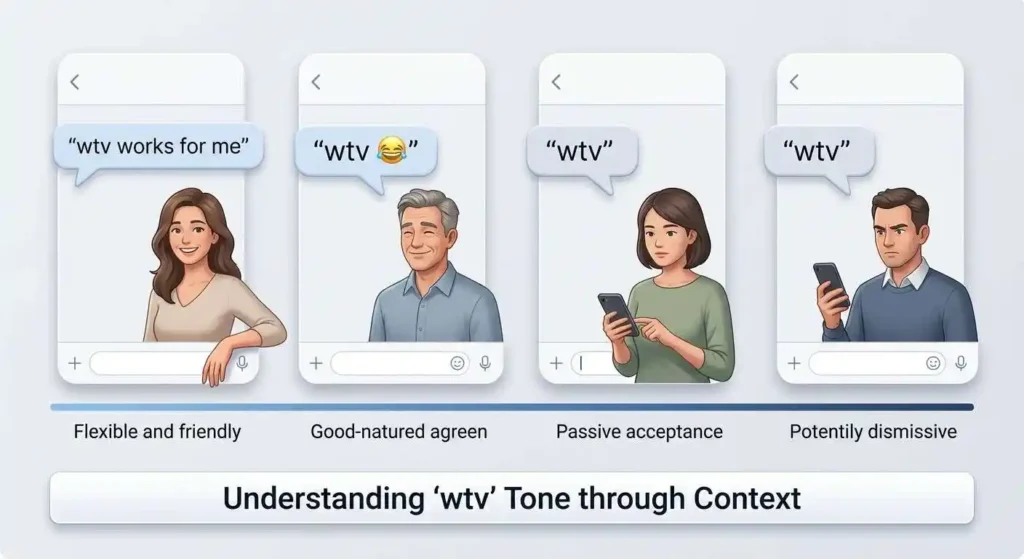
| Context | Possible tone |
| “wtv works for me” | Flexible |
| “wtv you want” | Casual |
| “wtv 😂” | Playful |
| “wtv lol” | Light or joking |
| “wtv.” | Potentially dismissive |
| “WTV” during an argument | Potentially irritated |
| “wtv, I don’t care” | Clearly indifferent |
Punctuation and emojis can influence how a short message feels. A playful emoji can soften the abbreviation, while a blunt standalone response may feel colder.
Is WTV Rude or Offensive?
WTV is not inherently rude or offensive. It is ordinary informal texting slang, but it can sound rude or dismissive when used in the wrong context.
It is generally fine in casual conversations with friends or people who understand your texting style. However, it is better to avoid WTV in formal emails, school assignments, job applications, professional messages, and other situations where standard language is expected.
For example, sending “wtv” to a friend about dinner is very different from using it when responding to a teacher, supervisor, or formal request.
Who Uses WTV?
WTV appears in informal digital communication, including texts, group chats, DMs, comments, and online conversations. It should not automatically be classified as exclusively Gen Z slang or associated with one particular age group.
The important distinction is context: WTV belongs to casual messaging shorthand, so people are more likely to use it when a relaxed communication style is appropriate.
Other Meanings of WTV
For the search phrase “WTV meaning in text,” the relevant meaning is “whatever.”
Outside texting slang, the letters WTV can appear as an abbreviation, name, identifier, or set of initials in unrelated contexts. Those meanings depend on the specific field or organization involved and should not be confused with the everyday texting abbreviation.
If WTV appears in a technical, professional, sports, or organizational context, use the surrounding information to determine whether it means something other than “whatever.”
WTV vs. Similar Slang
WTV is sometimes confused with other short texting expressions, but they are not interchangeable in every situation.
| Term | Meaning | Difference |
| WTV | Whatever | Can show flexibility or indifference |
| IDC | I don’t care | More directly expresses lack of concern |
| IDK | I don’t know | Shows uncertainty or lack of knowledge |
| NVM | Never mind | Usually withdraws or dismisses a previous question or thought |
| TBH | To be honest | Introduces an honest opinion or statement |
For example, “wtv works” usually means “whatever works,” while “idc” more directly says “I don’t care.”
Common Mistakes About WTV
Assuming WTV Always Means “I Don’t Care”
Not necessarily. It can mean “anything is fine” rather than complete indifference.
Assuming WTV Means Someone Is Angry
A standalone “wtv” can sound annoyed, but the abbreviation itself does not prove anger. Look at what happened before the message.
Assuming WTV Is Flirty
WTV is not inherently romantic or flirty. Any romantic interpretation comes from the broader conversation, not from the abbreviation itself.
Confusing WTV With IDK
WTV means “whatever,” while IDK means “I don’t know.” One expresses flexibility or indifference; the other expresses uncertainty.
Using WTV in Formal Communication
Because WTV is informal messaging shorthand, standard wording such as “whatever works” or “either option is fine” is safer in professional situations.
Related Internet Slang
| Term | Meaning | Common Use |
| IDC | I don’t care | Showing indifference |
| IDK | I don’t know | Showing uncertainty |
| NVM | Never mind | Dropping or withdrawing a point |
| TBH | To be honest | Giving an honest opinion |
| LOL | Laughing out loud | Showing amusement or softening a message |
These terms overlap with WTV because they are all common forms of messaging shorthand, but each communicates something different.
Real-World Conversation
Alex: “Do you want to eat at the pizza place or get burgers?”
Sam: “wtv works for you.”
Alex: “Let’s do burgers.”
Sam: “Sounds good.”
Here, wtv is completely neutral. Sam is saying that either option is acceptable rather than expressing annoyance or saying they do not care about Alex’s choice.
People Also Ask
What does WTV mean in texting?
WTV means “whatever.” It is an informal abbreviation used in texts and online chats to express flexibility, indifference, or dismissal depending on the context.
What does WTV stand for?
WTV stands for “whatever.” It is a shortened form used in casual digital communication.
Is WTV the same as IDC?
No. WTV means “whatever,” while IDC means “I don’t care.” They can express similar attitudes in some conversations, but IDC is more direct about not caring.
Does WTV mean someone is mad?
Not necessarily. A standalone “wtv” can sound annoyed or dismissive, especially after an argument, but it can also be a completely casual way of saying that any option is fine.
Is WTV rude in a text?
It depends on the context. WTV is not an offensive expression, but a short “wtv” can feel blunt when someone expects a thoughtful response.
Does WTV mean anything romantic?
No. WTV does not inherently mean flirting, attraction, love, or rejection. If it comes from a crush or partner, the surrounding conversation is needed to understand the person’s tone.
What does WTV mean on social media?
On social media and in DMs, WTV usually means “whatever.” It can be used in comments or messages to express indifference, flexibility, or a dismissive attitude.
Is WTV formal language?
No. WTV is informal texting shorthand. In school, work, professional communication, or formal writing, spelling out “whatever” is usually more appropriate.
Conclusion
WTV means “whatever” in text and online conversations. It is casual messaging shorthand that can communicate flexibility, indifference, resignation, or dismissal. The exact tone depends on the surrounding conversation, punctuation, emojis, and relationship between the people involved.
WTV is fine for casual chats but is better avoided in formal or professional communication. Most importantly, do not assume that WTV automatically means someone is angry, rude, or romantically interested—the context provides the real clue.

Michael Anderson is a writer focused on captions and quotes designed for different moments, moods, and social settings. Over three and a half years, he has created collections covering travel, lifestyle, relationships, events, social media, entertainment, and aesthetic themes. Michael studies tone, context, and phrasing to craft captions that match specific occasions and visual styles.