Short chat expressions are brief words, phrases, abbreviations, and reactions people use to communicate quickly in texts, DMs, comments, and online chats. Examples include “LOL,” “BRB,” “IDK,” “OMG,” “BTW,” “sure,” “yep,” “gotcha,” and “my bad.”
They make digital conversations faster and more natural, but their meaning and tone can change depending on the situation, punctuation, emoji, and relationship between the people chatting.
Key Takeaways
- Short chat expressions are brief forms of communication used in texting and online conversations.
- They can be complete phrases, abbreviations, acronyms, slang, or quick reactions.
- Common examples include LOL, IDK, BTW, BRB, OMG, FYI, TY, NP, and TTYL.
- Some expressions are casual and friendly, while others can sound dry, sarcastic, or dismissive depending on context.
- Short expressions are common in texts, DMs, group chats, comments, and gaming conversations.
- They are usually best for informal communication rather than formal school or professional writing.
Short Chat Expressions Meaning
The phrase short chat expressions refers to concise language used to communicate an idea, reaction, question, or feeling without writing a long sentence.
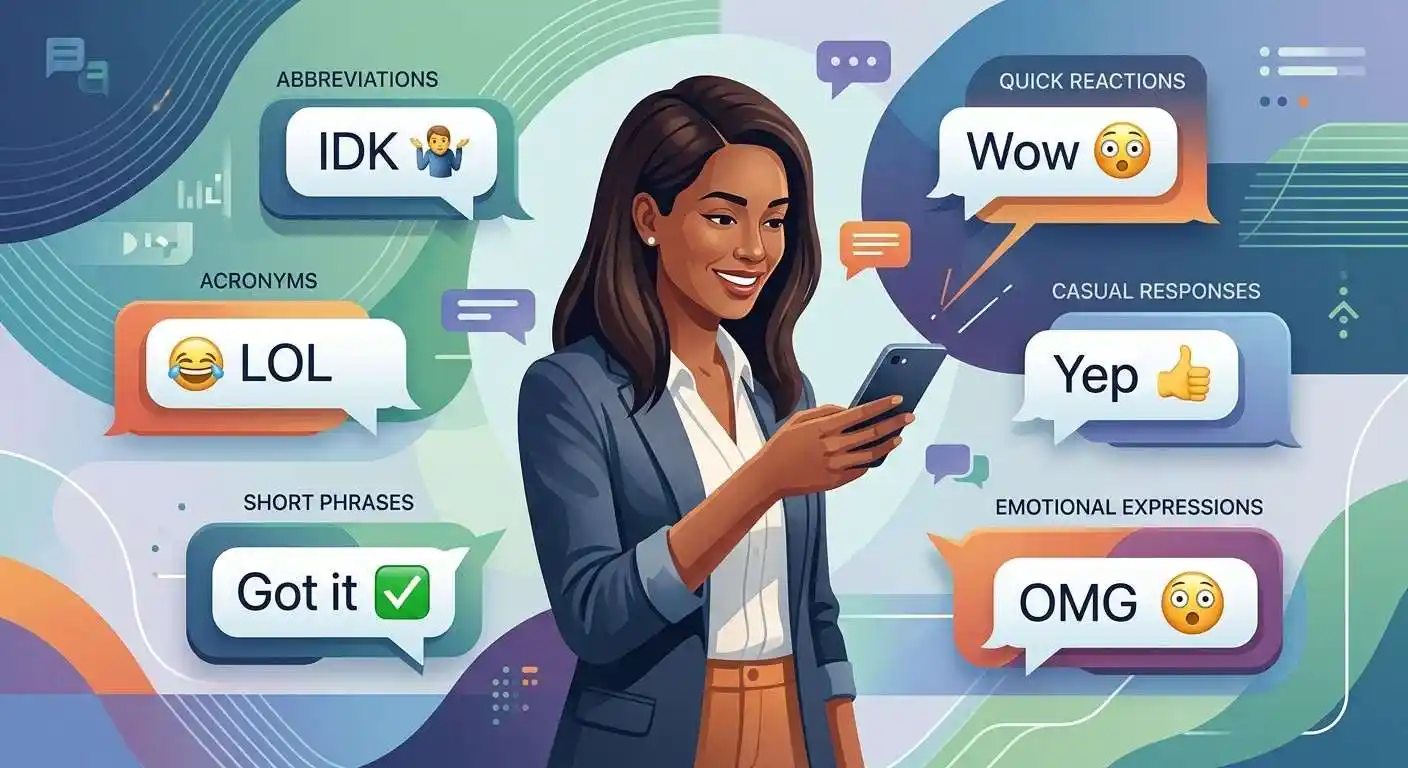
They can take several forms:
- Abbreviations: “IDK” for “I don’t know”
- Acronyms: “LOL” for “laughing out loud”
- Short phrases: “Got it,” “Sounds good,” or “My bad”
- Quick reactions: “Wow,” “Oof,” “Yikes,” or “Nice”
- Casual responses: “Yep,” “Nah,” “Sure,” or “Bet”
- Conversation shortcuts: “BRB” for “be right back”
- Emotional expressions: “OMG,” “Aww,” or “Haha”
The main purpose is speed and convenience. Instead of typing a complete sentence, someone can communicate the same basic idea in only a few characters or words.
Short chat expressions are part of text slang, internet slang, messaging shorthand, and everyday digital communication. Not every short expression is technically slang or an acronym, though. A phrase such as “sounds good” is simply a concise conversational response.
What Do Short Chat Expressions Stand For?
There is no single full form for “short chat expressions.” It is a general description rather than one specific texting abbreviation or acronym.
Some individual chat expressions do have full forms. For example:
| Expression | Full Form | Meaning |
|---|---|---|
| IDK | I Don’t Know | Uncertainty |
| BRB | Be Right Back | Temporarily leaving |
| BTW | By The Way | Introducing another point |
| OMG | Oh My God | Surprise or strong reaction |
| FYI | For Your Information | Sharing information |
| TTYL | Talk To You Later | Ending a conversation |
| TY | Thank You | Gratitude |
| NP | No Problem | Reassurance or acceptance |
Other short chat expressions do not have a hidden full form. For example, “yep,” “nah,” “okay,” “sure,” “oops,” and “gotcha” are simply shortened or informal conversational responses.
How Are Short Chat Expressions Used?
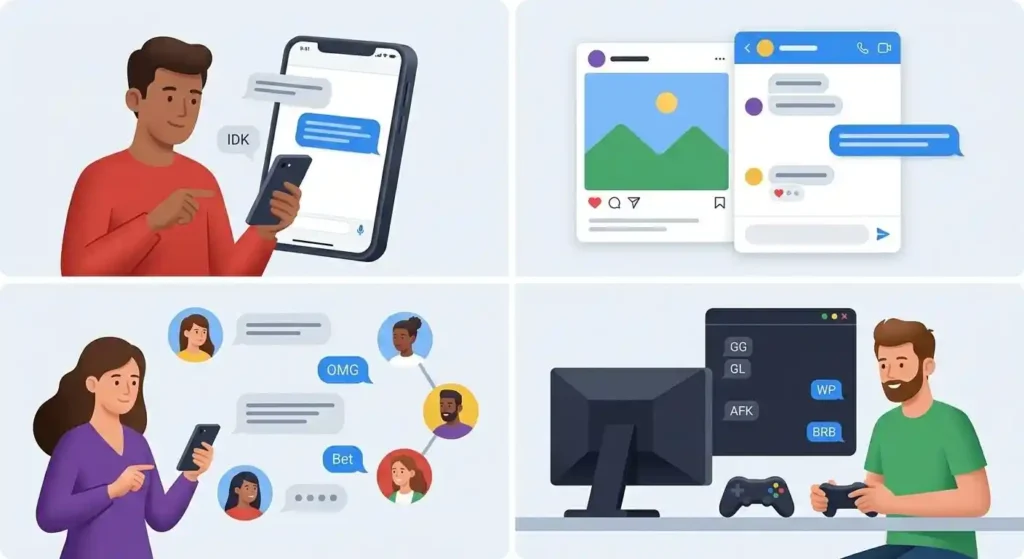
Short expressions appear whenever people want to keep a conversation quick and easy to follow.
Text Messages
In regular texting, short expressions can replace complete sentences.
- “IDK yet.”
- “BRB.”
- “Yep, sounds good.”
- “OMG 😂”
- “TY!”
- “No worries.”
The surrounding messages usually make the intended meaning clear.
DMs and Social Media
People commonly use short reactions in direct messages, comment replies, and social conversations.
For example:
“That outfit is so good.”
“FR 😭”
Here, FR means “for real” and emphasizes agreement.
Group Chats
Group chats often move quickly, so short responses can keep the conversation flowing.
“Movie at 8?”
“Bet.”
“I’m in.”
“Same.”
These expressions are useful because they communicate agreement without slowing down the conversation.
Gaming Chats
Fast-moving gaming conversations often favor extremely short messages.
Examples include:
- “GG” — good game
- “GL” — good luck
- “WP” — well played
- “AFK” — away from keyboard
- “BRB” — be right back
The exact terminology can vary between gaming communities, so context still matters.
Real Chat Examples
Here are varied examples of short chat expressions in everyday conversations:
- A: “Are you coming tonight?”
B: “Yep!” - A: “Do you know when the movie starts?”
B: “IDK, checking now.” - A: “I finally passed the test!”
B: “OMG congrats!” - A: “Can you wait five minutes?”
B: “Sure.” - A: “Sorry I forgot to text back.”
B: “NP.” - A: “That was actually hilarious 😂”
B: “LOL fr.” - A: “I need to grab something. BRB.”
B: “Okay.” - A: “Want to join us?”
B: “Bet.” - A: “Did you finish the assignment?”
B: “Not yet 😭” - A: “Thanks for helping!”
B: “Anytime.” - A: “I accidentally sent it to the wrong person.”
B: “Oof.” - A: “We got tickets!”
B: “Let’s gooo!” - A: “Are you serious?”
B: “Yep 😂” - A: “I thought you were already there.”
B: “My bad.” - A: “See you tomorrow?”
B: “Sounds good.” - A: “Did you understand what the teacher said?”
B: “Kinda.” - A: “I’m exhausted.”
B: “Same.” - A: “Should we order pizza?”
B: “Absolutely.” - A: “Can you send me the picture?”
B: “Sure, one sec.” - A: “I’ll talk to you later.”
B: “TTYL.”
How to Reply to Short Chat Expressions
The best response depends on the specific expression and the conversation around it. A short message does not automatically indicate a particular emotion.
Casual Replies
For simple everyday chats:
- “Yep!”
- “Sounds good.”
- “Same.”
- “Okay.”
- “Got it.”
- “For sure.”
Friendly Replies
When you want to keep the conversation warm:
- “Haha, exactly!”
- “Absolutely 😊”
- “No worries!”
- “Anytime!”
- “I know, right?”
Funny Replies
If the conversation is playful:
- “That’s what I’m saying 😂”
- “You already know.”
- “LOL, exactly.”
- “I can’t even 😭”
- “Well… that happened.”
Neutral Replies
For a straightforward response:
- “Okay.”
- “Understood.”
- “Got it.”
- “Thanks.”
- “I’ll check.”
Flirty or Relationship Replies
Only use a romantic tone when the surrounding conversation already has that kind of context. A short expression by itself does not prove that someone is flirting or interested.
For a playful conversation, responses might include:
- “Haha, you wish 😄”
- “Maybe 😉”
- “You’re funny.”
- “We’ll see.”
- “That sounds tempting.”
Context & Relationship Meaning
A short chat expression usually does not change its basic meaning based on whether it comes from a guy, girl, friend, crush, or partner.
What can change is the way the message feels.
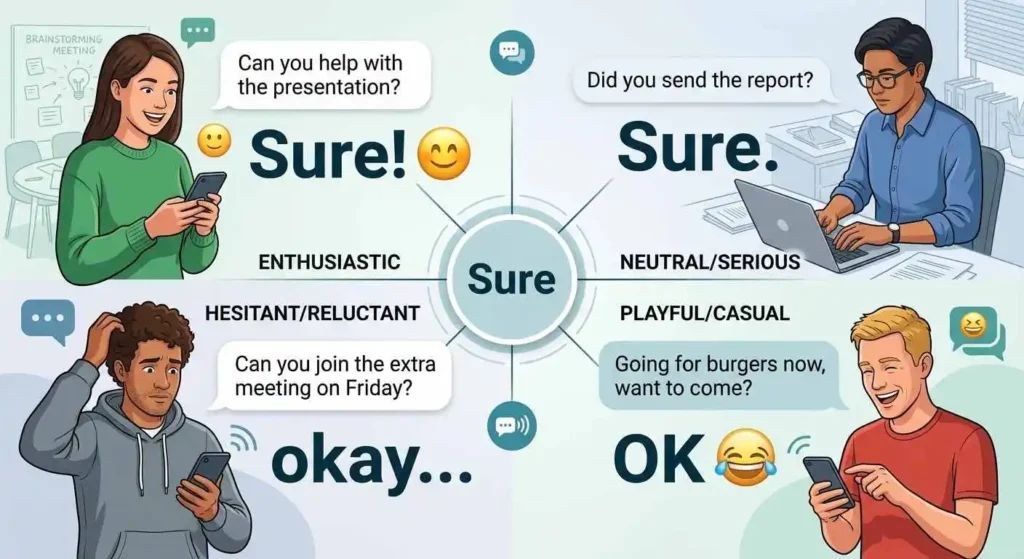
For example, “sure” can mean genuine agreement:
“Want to come with us?”
“Sure!”
But it could feel less enthusiastic in:
“Are you still coming?”
“Sure.”
Punctuation can also affect interpretation:
- “Okay!” → often enthusiastic or friendly
- “Okay.” → can feel more serious or final
- “okay…” → may suggest hesitation or uncertainty
- “OK 😂” → may be playful depending on the conversation
Emojis can soften or change the tone too. Therefore, interpreting a short message requires looking at the whole conversation, not just the expression.
What Tone Do Short Chat Expressions Have?
Short expressions can have many tones:
- Casual: “Yep,” “Sure,” “Cool”
- Friendly: “Aww,” “Thanks,” “Of course”
- Excited: “OMG!”, “Let’s go!”
- Playful: “Bet 😂”
- Uncertain: “IDK,” “Maybe”
- Surprised: “Wow,” “OMG”
- Apologetic: “My bad”
- Dry or brief: “K,” “Fine,” “Okay.”
- Dismissive: Sometimes a very short response can feel dismissive, but context is important.
A short answer is not automatically rude. Someone may simply be busy, distracted, or trying to respond quickly.
Are Short Chat Expressions Rude or Offensive?
Most everyday short chat expressions are not inherently rude or offensive. Their appropriateness depends on the expression, recipient, and situation.
They are generally suitable for:
- Casual texting
- Friend group chats
- Informal DMs
- Social media comments
- Gaming conversations
Use more care in:
- School assignments
- Messages to teachers
- Job applications
- Professional emails
- Formal business communication
For example, “TY” may be perfectly understandable in a casual text, while “Thank you” is usually a better choice in a formal message.
Some expressions may also contain profanity or insulting language. Those should be evaluated separately rather than treating all chat shorthand as offensive.
Who Uses Short Chat Expressions?
Short chat expressions are used by people across online conversations, including friends, classmates, family members, gaming communities, and social-media users.
There is no single age group that owns this style of communication. Different expressions can become more common in particular communities or periods, but it is inaccurate to assume that every abbreviation is automatically Gen Z slang.
The most important factor is usually whether the people in the conversation understand the expression.
Other Meanings of Short Chat Expressions
“Short chat expressions” is a broad language category rather than a specific acronym, so it does not have a separate technical meaning that needs to be distinguished.
However, individual expressions can have completely different meanings outside texting. For example, “GG” may mean “good game” in online conversations but can have other meanings in different fields.
That is why an unfamiliar abbreviation should always be interpreted according to its context.
Short Chat Expressions vs. Similar Terms
These terms overlap, but they are not exactly the same:
| Term | Meaning | Difference |
|---|---|---|
| Chat expressions | Short ways of communicating in chats | Broadest category |
| Text abbreviations | Words shortened for texting | Focuses on shortened words or phrases |
| Internet slang | Informal language used online | Includes slang that may not be short |
| Acronyms | Terms formed from initial letters | A specific type of abbreviation |
| Emojis | Visual symbols used in communication | Convey reactions or ideas visually |
| Texting shorthand | Condensed language for faster messaging | Emphasizes speed and convenience |
For example, “LOL” is an abbreviation/acronym used as internet slang, while “yep” is simply a short informal response.
Common Mistakes About Short Chat Expressions
Assuming every short expression has a full form
Not every short message is an acronym. “Sure,” “yep,” “okay,” and “oops” are ordinary conversational expressions.
Treating one interpretation as universal
A term can mean different things in different communities. Context should always be considered.
Assuming short means rude
A brief response may simply mean the person is busy or prefers concise messages.
Overreading romantic meaning
A message such as “hey,” “sure,” “lol,” or “okay” does not by itself prove romantic interest or rejection.
Using slang everywhere
An abbreviation that works with friends may be unclear in a formal or professional setting. When clarity matters, spelling out the message is usually safer.
Related Internet Slang
| Term | Meaning | Common Use |
|---|---|---|
| LOL | Laughing out loud | Showing amusement |
| IDK | I don’t know | Expressing uncertainty |
| BRB | Be right back | Temporarily leaving |
| BTW | By the way | Adding another point |
| OMG | Oh my God | Surprise or strong reaction |
| TBH | To be honest | Giving an honest opinion |
| FR | For real | Agreement or emphasis |
| NGL | Not gonna lie | Introducing an honest statement |
| RN | Right now | Referring to the present |
| TY | Thank you | Expressing thanks |
| NP | No problem | Reassuring someone |
| TTYL | Talk to you later | Ending a conversation |
Real-World Conversation
Imagine a friend asks about weekend plans:
Alex: “Movie Saturday?”
Sam: “Bet.”
Alex: “8 pm?”
Sam: “Yep.”
Alex: “Cool, see you then!”
Sam: “See ya!”
Here, the short expressions keep the conversation quick while still making the plan clear. None of the messages needs a long explanation because both people understand the context.
People Also Ask
What are short chat expressions?
Short chat expressions are brief words, phrases, abbreviations, or reactions used in digital conversations. They help people communicate quickly in texts, DMs, group chats, comments, and other informal online settings.
What are examples of short chat expressions?
Common examples include LOL, IDK, BRB, BTW, OMG, FYI, TY, NP, FR, and TTYL. Short phrases such as “got it,” “sure,” “my bad,” and “sounds good” also function as concise chat responses.
Why do people use short expressions in texting?
They make messages faster and easier to type. They can also make conversations feel relaxed and conversational rather than formal.
Are short chat expressions considered slang?
Some are slang, while others are simply abbreviations or ordinary short phrases. “LOL” is commonly treated as internet slang, whereas “sure” is an everyday word rather than slang.
Are short chat expressions appropriate for school or work?
It depends on the setting. Casual expressions may be fine in informal messages, but formal emails, assignments, and professional communication generally benefit from complete words and clear sentences.
Can a short text expression have multiple meanings?
Yes. Some abbreviations have different meanings in different communities or industries. The surrounding conversation usually provides the clues needed to understand which meaning applies.
Does a short reply mean someone is annoyed?
Not necessarily. A short response can result from being busy, distracted, tired, or simply preferring concise communication. Punctuation, emojis, and the previous conversation can help clarify tone.
Are short chat expressions the same as texting abbreviations?
Not exactly. Texting abbreviations are one type of short chat expression, while the broader category also includes quick phrases, reactions, slang, and ordinary conversational shortcuts.
Conclusion
Short chat expressions are concise forms of digital communication used to keep texts, DMs, comments, and group chats quick and natural. They include abbreviations such as IDK and BRB, reactions such as OMG and LOL, and simple phrases such as “sure,” “got it,” and “my bad.”
Their tone depends heavily on context, punctuation, emojis, and the relationship between the people chatting. Most are informal, so complete and professional wording is usually better when clarity or formality matters.

Charlotte Reed creates captions and quotes built around moments, moods, and personal expression. Over three and a half years, she has worked on content covering travel experiences, lifestyle themes, relationships, events, social media posts, entertainment topics, and aesthetic styles. Her process involves studying language patterns, refining caption structure, and adjusting wording to match different occasions and visual themes.