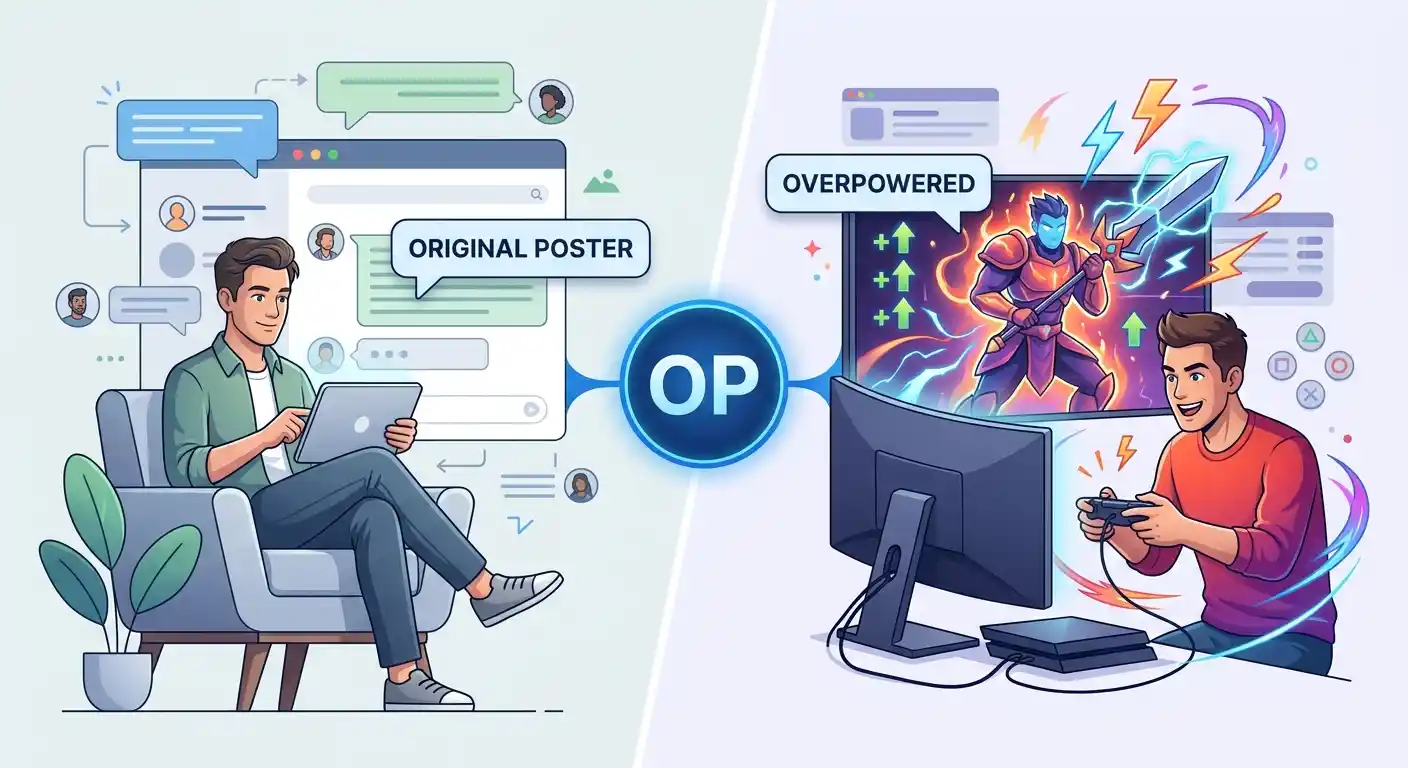
OP in text most commonly means “original poster,” the person who created a post or started a discussion. In gaming, OP usually means “overpowered,” describing something unusually strong or difficult to balance. Context determines which meaning applies.
Key Takeaways
- OP = Original Poster when referring to the person who created an online post or thread.
- OP = Overpowered when describing a very strong character, weapon, ability, or strategy, especially in gaming.
- Original Post can also be abbreviated as OP when someone is referring to the post itself rather than its author.
- The meaning depends heavily on the conversation and context.
- OP and “opp” are not automatically the same; “opp” is commonly used separately for an opponent or rival.
- OP is casual internet shorthand and is generally better suited to online conversations than formal writing.
OP Meaning in Text
OP is an internet abbreviation with more than one established meaning. The two most useful meanings to know are “original poster” and “overpowered.”
When someone says “OP said…” in a discussion, OP usually means original poster—the person who created the post or started the thread.
When someone says “That character is OP,” particularly in a gaming conversation, OP usually means overpowered. It means the character, weapon, ability, or strategy is unusually powerful, sometimes to the point that it feels unbalanced.
OP is therefore best understood as context-dependent internet shorthand, rather than a word with one fixed meaning.
What Does OP Stand For?
Original Poster
Original Poster refers to the person who created the original post or started a discussion thread.
Example:
“OP explained everything in the comments.”
Here, OP refers to the person who made the post.
Overpowered
Overpowered is primarily a gaming term for something that is too strong or unusually powerful compared with other options.
Example:
“That character is OP.”
The speaker is saying the character is extremely powerful or possibly difficult to balance.
Original Post
In some online discussions, OP can also refer to the original post itself, rather than the person who wrote it.
For example:
“Read OP before commenting.”
Here, the meaning is closer to “original post.”
How Is OP Used?
Text Messages
In ordinary texting, OP usually needs context. A person might use it when discussing an online post, a game, or something they saw online.
For example:
“OP already answered that.”
This refers to the original poster.
Social Media
OP can refer to the person who created a post or the content being discussed.
For example:
“OP made a good point.”
The writer is talking about the person who made the original post.
Group Chats
In a group chat where people are discussing a shared post or story, OP may be used as a quick way to identify the original poster.
Gaming
Gaming is where OP = overpowered becomes especially important.
Examples include:
- “That weapon is OP.”
- “This character is way too OP.”
- “The new ability is OP.”
- “They need to nerf that OP build.”
Here, OP describes power or game balance, not the person who posted something.
OP in Different Contexts
From a Friend
If a friend says:
“OP already explained it.”
and you’re discussing an online post, OP probably means original poster.
If they say:
“That character is OP.”
during a gaming conversation, it probably means overpowered.
In a Group Chat
The subject of the conversation is the biggest clue. If everyone is discussing a Reddit-style post, OP may refer to its creator. If everyone is discussing a game, OP may describe something powerful.
In Dating or Relationship Discussions
If you’re reading an online relationship discussion, OP often refers to the person who created the post.
For example:
“OP should talk to their partner.”
That means the person who wrote the original story or question.
OP by itself does not indicate flirting, attraction, or romantic interest.
On Social Media
In a discussion about someone’s post, OP generally points to the original creator.
For example:
“OP answered this in another comment.”
In Gaming
In gaming, OP commonly means overpowered.
The surrounding nouns make this easy to recognize:
- OP character → very powerful character
- OP weapon → very powerful weapon
- OP ability → very powerful ability
- OP build → unusually powerful setup
Real Chat Examples
- “OP already answered this.”
→ Original poster already answered it. - “Ask OP what happened.”
→ Ask the person who made the post. - “I agree with OP.”
→ I agree with the original poster. - “OP explained it really well.”
→ The original poster explained it well. - “Did OP ever respond?”
→ Did the original poster respond? - “OP left out an important detail.”
→ The person who created the post left something out. - “Read OP before replying.”
→ Read the original post before replying. - “That character is OP.”
→ That character is overpowered. - “This weapon is so OP.”
→ This weapon is extremely powerful. - “That ability feels OP.”
→ That ability seems too powerful or unbalanced. - “They need to nerf this OP character.”
→ The character is too powerful and may need to be weakened. - “That build is completely OP.”
→ That setup is extremely powerful. - “The new update made this weapon OP.”
→ The update made the weapon unusually powerful. - “OP is getting roasted in the comments.”
→ The original poster is being criticized or teased. - “Why is everyone defending OP?”
→ Why is everyone defending the original poster? - “OP made a good point.”
→ The person who created the post made a good point. - “This boss is OP.”
→ The boss is extremely powerful. - “OP already posted the answer.”
→ The original poster already provided the answer.
How to Reply to OP
There is no special reply required for OP. Your response depends on what the abbreviation means.
Casual Replies
If someone says “OP already explained it,” you could reply:
- “Oh, I missed that.”
- “Got it.”
- “Makes sense.”
- “I’ll check the post.”
Friendly Replies
If someone says:
“I agree with OP.”
You could respond:
- “Same here.”
- “Yeah, good point.”
- “I thought so too.”
Funny Replies
If OP is being discussed casually:
- “OP really started something 😂”
- “The comments are wild.”
- “That post turned into a whole debate.”
Neutral Replies
If you’re unsure what OP means:
- “Do you mean the original poster?”
- “Do you mean overpowered?”
- “Which OP do you mean?”
Flirty/Relationship Replies
A special flirty response isn’t necessary. OP doesn’t inherently have a romantic meaning. If you’re discussing someone’s relationship post, treat OP as “original poster” unless the surrounding context clearly indicates another meaning.
What Tone Does OP Have?
OP is generally casual and neutral when it means original poster.
For example:
“OP explained this already.”
The abbreviation simply identifies the person who created the post.
When OP means overpowered, the tone can vary. It may be:
- Neutral: describing a game’s balance
- Positive: praising something’s strength
- Critical: saying something is unfairly powerful
- Playful: exaggerating how strong something seems
The surrounding sentence determines the tone.
Is OP Rude or Offensive?
OP itself is not inherently rude or offensive. It is ordinary internet shorthand.
It’s fine for many casual online conversations, including discussions, comments, and gaming chats.
For school assignments, professional emails, business communication, or formal writing, spelling out “original poster” or “overpowered” is usually clearer.
The same principle applies when communicating with someone who may not know internet abbreviations.
Other Meanings of OP
OP in Internet Discussions
Original Poster is the person who created a post or started a discussion. This is a well-established internet meaning.
OP in Gaming
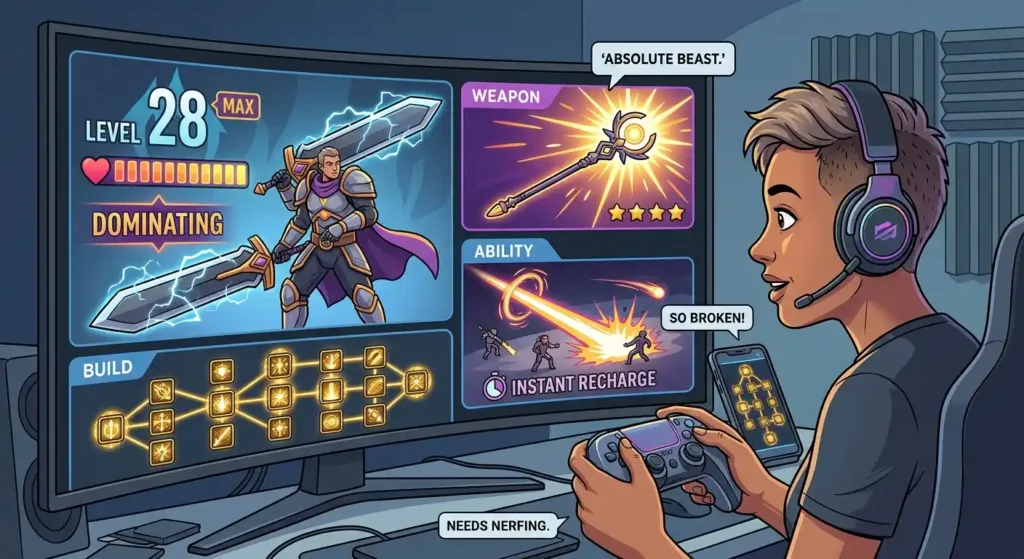
Overpowered describes something unusually strong, especially a game character, weapon, ability, or strategy.
OP as Original Post
In some discussions, OP can refer to the original post rather than its author. The sentence usually makes the distinction clear.
OP in Other Abbreviations
Outside internet slang, OP can have unrelated meanings in different fields. For example, dictionaries also record meanings such as “observation post” and abbreviations related to operations. These meanings should be interpreted from the subject of the conversation rather than assumed to be texting slang.
Common Mistakes About OP
Assuming OP Always Means “Original Poster”
Not always. In gaming, OP commonly means “overpowered.”
Assuming OP Always Means “Overpowered”
If someone says “OP replied to my comment,” they are probably talking about the original poster, not a powerful character.
Confusing OP With Opp
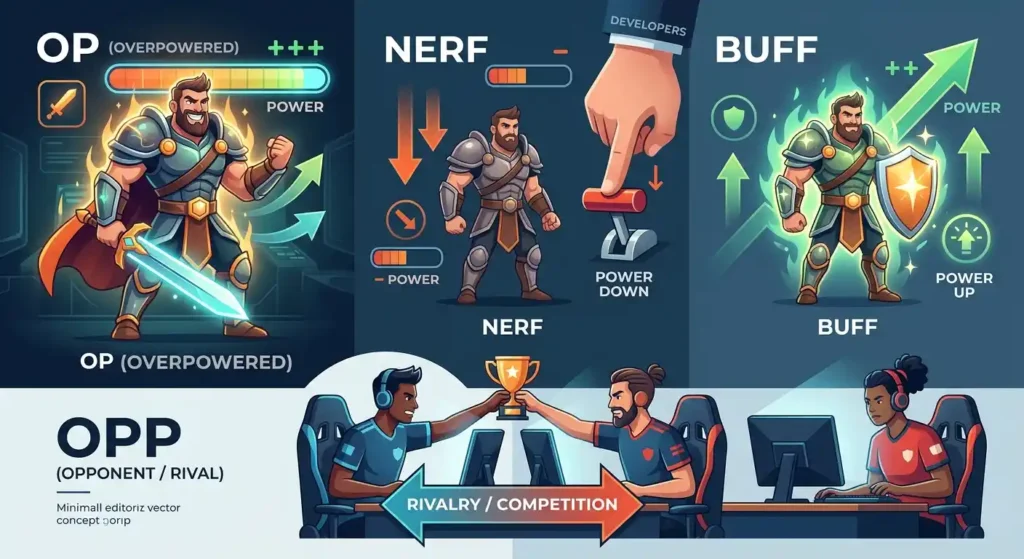
OP and opp can look similar, but they are not automatically interchangeable. Opp is commonly used as slang for an opponent or rival, while OP has established meanings such as “original poster” and “overpowered.”
Assuming OP Means “Really Good”
“Overpowered” can be positive when someone is impressed, but it doesn’t literally mean “really good.” It specifically relates to unusually high power or strength, especially in gaming.
Assuming OP Has a Romantic Meaning
It doesn’t. If OP appears in a relationship discussion, it usually refers to the person who created the post.
Ignoring Context
Compare:
- “OP replied.” → likely original poster
- “That sword is OP.” → likely overpowered
- “Read OP.” → likely original post
The words around OP provide the clue.
OP and Related Slang
| Term | Meaning | Common Use |
|---|---|---|
| OP | Original Poster | Online discussions |
| OP | Overpowered | Gaming |
| OC | Original Content | Social media and online posts |
| OG | Original / original gangster | Informal slang |
| nerf | Make something weaker | Gaming |
| buff | Make something stronger | Gaming |
| opp | Opponent or rival | Certain slang contexts |
These terms aren’t interchangeable. For example, nerf and buff describe changes to game power, while OP describes something that is already considered unusually powerful.
People Also Ask About OP
What does OP mean on social media?
On social media and discussion platforms, OP usually means “original poster,” referring to the person who created the post being discussed. In gaming-related content, it can instead mean “overpowered.”
What does OP mean in gaming?
In gaming, OP usually means “overpowered.” It describes a character, weapon, ability, strategy, or other game element that is considered unusually strong or difficult to balance.
Does OP mean original post or original poster?
It can mean either, depending on the sentence. Original poster refers to the person, while original post refers to the content they created.
Is OP a compliment?
It can be, but not always. Calling something OP may praise its strength, or it may criticize it for being so powerful that the game feels unbalanced.
What is the difference between OP and opp?
OP commonly means original poster or overpowered. Opp is a separate slang spelling generally referring to an opponent or rival, so the two should not automatically be treated as the same term.
Why does OP have multiple meanings?
Internet abbreviations are often reused across different communities. OP developed established meanings in online discussions and gaming, so the subject of the conversation determines which interpretation makes sense.
Can OP be used in formal writing?
It is better to avoid slang abbreviations such as OP in formal writing unless the abbreviation is specifically relevant to the subject. Writing “original poster,” “original post,” or “overpowered” makes the meaning clearer.
Conclusion
OP in text most commonly means “original poster” or “overpowered,” while “original post” is another relevant online use. In discussion threads, OP usually identifies the person who created the post. In gaming, OP usually describes something unusually powerful.
The key is context. “OP replied” points toward the original poster, while “that weapon is OP” points toward overpowered. Understanding the surrounding words makes the intended meaning much easier to identify.

Charlotte Reed creates captions and quotes built around moments, moods, and personal expression. Over three and a half years, she has worked on content covering travel experiences, lifestyle themes, relationships, events, social media posts, entertainment topics, and aesthetic styles. Her process involves studying language patterns, refining caption structure, and adjusting wording to match different occasions and visual themes.