
JS in text usually means “just saying.” It is a casual texting abbreviation people use to add an opinion, observation, suggestion, or mild criticism without making it sound overly serious. In some messages, js can also mean “just,” while JS commonly means JavaScript in technology and programming contexts.
Key Takeaways
- JS most commonly means “just saying” in casual texts and online conversations.
- It can make an opinion or comment sound more casual or less forceful.
- In phrases such as “I js wanted to ask,” js can mean “just.”
- In programming, JS means JavaScript, so context matters.
- JS does not automatically indicate flirting, anger, sarcasm, or criticism.
- It is informal internet slang and is generally better suited to casual messaging than formal communication.
JS Meaning in Text
In everyday texting, JS usually means “just saying.” It is a form of messaging shorthand used when someone wants to express a thought without presenting it as a formal argument or strong demand.
For example:
“I think you should tell her, js.”
Here, js means “just saying.” The person is offering their opinion rather than insisting that the other person follow their advice.
The abbreviation can appear at the end of a sentence, but context can change how it functions. A message such as “That movie was overrated js” uses it as a conversational tag, while “I js wanted to ask” uses js as a shortened form of “just.”
Because text messages do not have facial expressions or voice tone, the surrounding words, punctuation, emojis, and relationship between the people can influence how JS feels.
What Does JS Stand For?
In casual texting, JS stands for “just saying.”
It is an informal abbreviation formed from the first letters of Just Saying. People use it because short forms make casual online communication quicker and more conversational.
However, JS does not have only one meaning everywhere:
- JS = just saying — common in casual texting and social media.
- js = just — sometimes used as an informal shortening inside a sentence.
- JS = JavaScript — common in programming and technology.
- JS = initials — can refer to a person’s initials or another context-specific name.
The sentence and conversation usually make the intended meaning clear.
How Is JS Used?
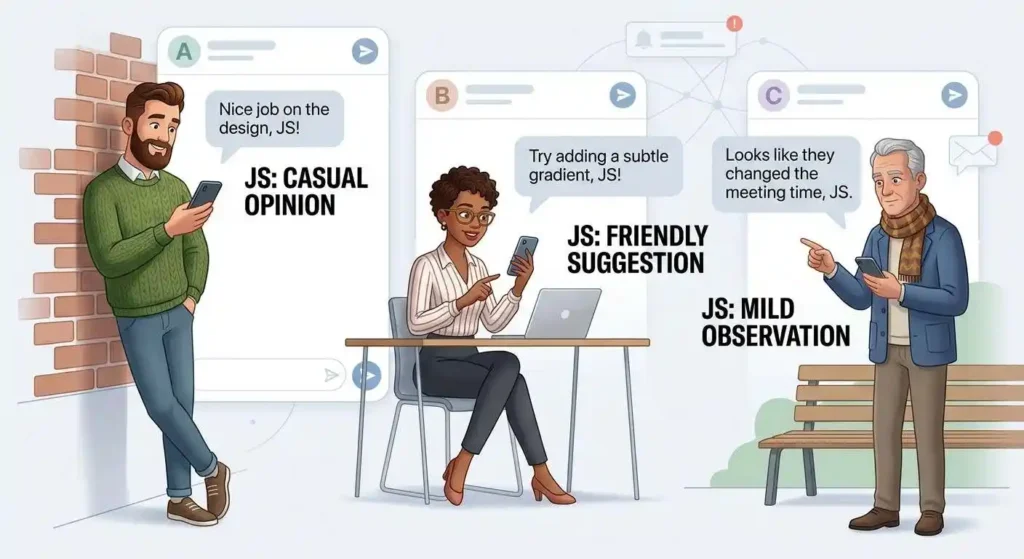
JS is mainly used in texts, DMs, group chats, comments, and other informal online conversations.
At the End of an Opinion
This is one of the clearest uses:
“I think the first one looks better, js.”
The sender is simply sharing their opinion.
With Advice
“You should probably leave earlier next time, js.”
The phrase makes the advice sound less like an order.
With an Observation
“You two talk a lot lately, js.”
The sender is pointing something out without necessarily making a serious accusation.
With Mild Criticism
“That was probably not the best idea, js.”
Here, JS can soften the wording, although the overall message may still sound critical.
In Short Messages
People may also shorten just to js:
“I js got home.”
In this construction, JS does not mean “just saying.” It means “just.”
On Social Media
The same conversational uses can appear in DMs, comments, and casual posts. There is no special universal definition of JS that changes from one social platform to another; the surrounding sentence is more important than the app itself.
Real Chat Examples
Here are varied examples showing how JS can work in actual conversations:
- Friend: “I think you should text him back, js.”
Meaning: I’m just saying; that’s my opinion. - Friend: “That restaurant is way too expensive, js.”
Meaning: I’m only pointing out what I think. - Friend: “You could’ve told me earlier, js.”
Meaning: I’m making a mild complaint. - Friend: “I think the blue one looks better, js.”
Meaning: That is simply my preference. - Friend: “You two would actually look cute together, js.”
Meaning: I’m suggesting my opinion, possibly playfully. - Friend: “Maybe get some sleep tonight, js.”
Meaning: I’m giving you a casual suggestion. - Friend: “That movie was kinda overrated js.”
Meaning: That is my personal opinion. - Friend: “You were definitely late again, js.”
Meaning: I’m pointing out what happened. - Friend: “I think you should wait before buying it, js.”
Meaning: I’m offering advice without demanding anything. - Friend: “She seems really nice, js.”
Meaning: I’m simply sharing an observation. - Friend: “You could’ve asked me first, js.”
Meaning: I’m expressing mild annoyance or criticism. - Friend: “That outfit actually works really well, js.”
Meaning: I’m casually giving you a compliment. - Friend: “I think you’re overthinking it, js.”
Meaning: That is my opinion; take it as you wish. - Friend: “You might want to check the time, js.”
Meaning: I’m casually pointing something out. - Friend: “I think we should leave now, js.”
Meaning: I’m suggesting that we go. - Friend: “You really love that song, js 😂.”
Meaning: A playful observation. - Friend: “I js wanted to ask if you’re coming.”
Meaning: Here, js = just, not “just saying.” - Friend: “I js got back home.”
Meaning: Here, js = just. - Friend: “I js saw your message.”
Meaning: “I just saw your message.” - Developer: “I’m learning JS this semester.”
Meaning: In this context, JS = JavaScript.
The last three examples show why the surrounding words matter. JS does not automatically mean “just saying” every time it appears.
How to Reply to JS
There is no single correct response to JS. First, look at the sentence around it and decide whether the person is offering an opinion, making a joke, giving advice, or simply using js to mean “just.”
Casual Replies
- “Yeah, I get you.”
- “Fair enough.”
- “I know what you mean.”
- “True 😂”
Friendly Replies
- “Haha, I appreciate the honesty.”
- “Good point.”
- “You might be right.”
- “I’ll think about it.”
Funny Replies
- “And you just had to say it 😂”
- “Okay, noted.”
- “You really couldn’t keep that to yourself 😭”
- “JS has been officially received.”
Neutral Replies
- “Got it.”
- “I understand.”
- “That makes sense.”
- “Thanks for the opinion.”
Flirty/Relationship Replies
If the surrounding message is already playful or romantic, you can respond to that context rather than assuming JS itself is flirty:
- “Oh, so you’re just saying? 👀”
- “Noted… interesting opinion.”
- “Haha, I’ll remember that.”
- “You sure that’s all you wanted to say?”
The abbreviation itself does not prove romantic interest. The rest of the conversation matters much more.
Context & Relationship Meaning
JS has the same basic meaning whether it comes from a guy, girl, friend, crush, or partner. Gender does not create a different definition.
What can change is the tone.
For example:
“You look really good today, js.”
A friend might be making a casual compliment. Someone you’re dating might be teasing or flirting. But the letters JS alone cannot establish the sender’s intention.
Pay attention to:
- What was said before JS
- Whether there is an emoji
- Punctuation such as “js…” or “JS!”
- Whether the conversation is serious or playful
- Your relationship with the sender
- Whether JS means “just saying” or “just” in that sentence
From a Guy
If a guy sends “you should text me more, js,” he is expressing an opinion or preference. It may carry personal or playful meaning depending on the conversation, but JS itself does not prove romantic interest.
From a Girl
The same applies when a girl uses JS. The abbreviation does not acquire a different meaning based on the sender’s gender.
From a Friend
Between friends, JS can introduce an honest observation, suggestion, compliment, joke, or mild criticism.
From a Crush
If a crush writes something ending in JS, look at the whole message, not the abbreviation alone. For example, “you looked really good today, js” may be playful, but the surrounding relationship and conversation determine whether it is actually flirtatious.
What Tone Does JS Have?
JS is usually casual and conversational, but its exact tone depends on what comes before it.
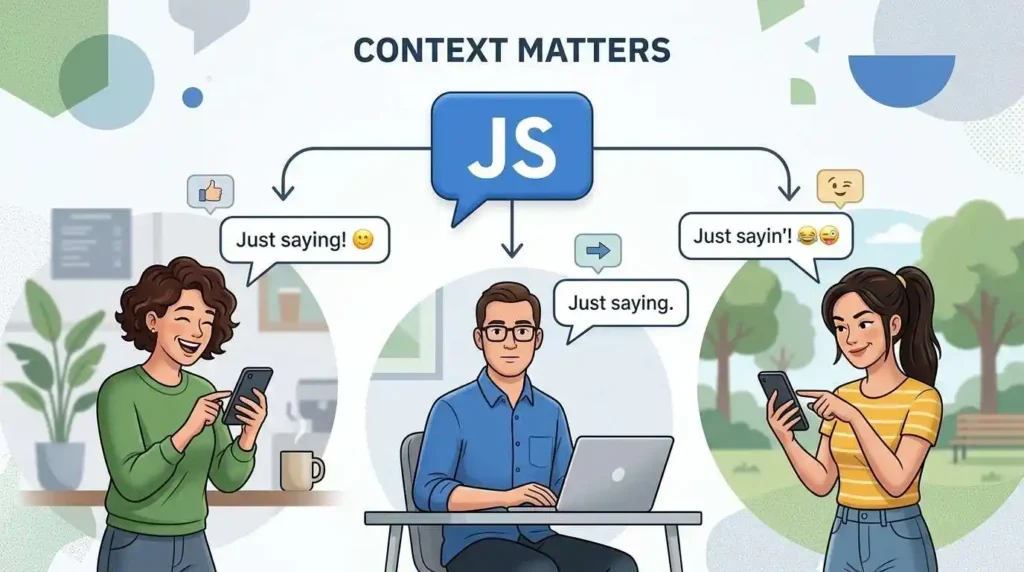
It can sound:
- Casual: “I think you should go, js.”
- Friendly: “You did really well, js.”
- Playful: “You’re obsessed with that game, js 😂.”
- Blunt: “That wasn’t your best idea, js.”
- Teasing: “You clearly missed me, js.”
- Defensive: “I was only trying to help, js.”
- Dismissive or sarcastic: possible when the preceding statement is already sharp.
Adding JS does not automatically make a message polite. A harsh statement can still sound harsh even when followed by “just saying.”
Is JS Rude or Offensive?
JS is not inherently rude or offensive.
- Casual texts
- Friend group chats
- DMs
- Informal social media conversations
- Casual online communities
It may be less appropriate in:
- Formal emails
- Professional messages
- School assignments
- Official requests
- Important workplace communication
In formal writing, spelling out the idea is clearer. Instead of:
“You should reconsider it, js.”
you could write:
“I think you may want to reconsider it.”
The bigger issue is often tone rather than the abbreviation itself. Someone may interpret JS as passive-aggressive if the sentence before it sounds critical.
Who Uses JS?
JS appears in informal digital communication, but it is not necessary to assign it to one particular age group.
People can encounter it in text messages, social media conversations, group chats, comments, and online communities. Its meaning is more strongly determined by the context than by the age or identity of the person using it.
It is best understood as internet slang and messaging shorthand, rather than assuming that everyone who uses it belongs to a specific generation.
Other Meanings of JS
The meaning of JS changes significantly outside casual texting.
JS Meaning “Just”
In highly informal messages, js can be used as a shortened form of just.
For example:
“I js wanted to ask something.”
means:
“I just wanted to ask something.”
This use is especially easy to identify because “just saying” would not make grammatical sense in that sentence.
JS Meaning “JavaScript”
In programming and technology, JS commonly means JavaScript, a programming language used extensively in web development.
For example:
“I’m learning JS and working with React.”
Here, JS clearly refers to JavaScript, not “just saying.”
The presence of words such as code, programming, website, developer, function, browser, React, Node, or JavaScript can make the technical meaning obvious.
JS as Initials
JS can also simply be someone’s initials.
For example:
“JS sent the document.”
In that context, JS may refer to a person’s name rather than slang.
These meanings should not be mixed together. The surrounding conversation determines which interpretation makes sense.
JS vs. Similar Slang
Some abbreviations can look similar or serve a similar conversational purpose.
| Term | Meaning | Difference |
|---|---|---|
| JS | Just saying | Adds a casual opinion or observation |
| JK | Just kidding | Signals that something was a joke |
| TBH | To be honest | Introduces an honest opinion or statement |
| IMO | In my opinion | Directly identifies something as a personal opinion |
| NGL | Not gonna lie | Often introduces an honest or candid reaction |
| FR | For real | Used to emphasize agreement or sincerity |
These terms are related because they can affect how a message sounds, but they are not interchangeable.
For example, “That was funny, JS” and “That was funny, JK” communicate very different ideas.
Common Mistakes About JS
Assuming JS Always Means “Just Saying”
Not every instance of JS means “just saying.” In a phrase such as “I js got home,” it means “just.”
Assuming JS Always Means Something Sarcastic
JS can accompany sarcasm, but sarcasm comes from the whole message and situation, not from the abbreviation itself.
Assuming JS Is Always Flirty
A message such as “you look good, js” might feel flirtatious in some situations, but JS itself is not a romantic signal.
Confusing JS With JavaScript
If someone is discussing coding, websites, or programming, JS probably means JavaScript rather than “just saying.”
Treating JS as Formal Language
JS is informal messaging shorthand. It is usually unnecessary in professional or academic writing.
Real-World Conversation
Alex: “Are you coming to the party tonight?”
Sam: “Probably. I think you should come too, js.”
Alex: “Haha, okay. I’ll think about it.”
Here, js means “just saying.” Sam is giving an opinion without making it sound like a serious demand.
People Also Ask
What does JS mean in a text message?
In casual text messages, JS most commonly means “just saying.” It is often added to an opinion, observation, suggestion, or comment to make the statement feel more casual.
Does JS mean “just”?
Yes, js can mean “just” when it appears inside a phrase such as “I js wanted to ask.” The grammar and surrounding words usually make this meaning clear.
Does JS mean “just saying”?
Yes. “Just saying” is the main conversational meaning of JS when it appears as a tag after an opinion or observation.
Does JS mean JavaScript?
Yes. In programming and technology conversations, JS commonly means JavaScript. A coding-related context is the clearest clue that the technical meaning is intended.
Is JS a slang word?
JS is better described as an abbreviation or messaging shorthand. In casual conversations, it functions as internet slang when it means “just saying.”
Is JS rude in texting?
Not by itself. JS is generally casual, but it can sound blunt, dismissive, or passive-aggressive depending on the statement surrounding it.
Does JS mean “just joking”?
Some people may use abbreviations in flexible ways, but “just saying” is the clearer and more established interpretation for JS in ordinary texting. If someone means “just kidding,” JK is the more recognizable abbreviation.
How can I tell what JS means?
Read the entire sentence. If JS follows an opinion or observation, “just saying” is likely; if it appears in a phrase like “I js wanted,” it likely means “just”; and if the conversation is about programming, it likely means JavaScript.
Conclusion
In casual texting, JS most commonly means “just saying.” It is used to express an opinion, observation, suggestion, or comment in a relaxed way. Its tone can be friendly, playful, blunt, or teasing depending on the surrounding message.
Context is the key. JS can also mean “just” or “JavaScript,” so look at the sentence, conversation, and subject before interpreting it. For formal communication, spelling out the words is usually clearer than using the abbreviation.

Michael Anderson is a writer focused on captions and quotes designed for different moments, moods, and social settings. Over three and a half years, he has created collections covering travel, lifestyle, relationships, events, social media, entertainment, and aesthetic themes. Michael studies tone, context, and phrasing to craft captions that match specific occasions and visual styles.