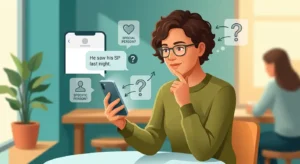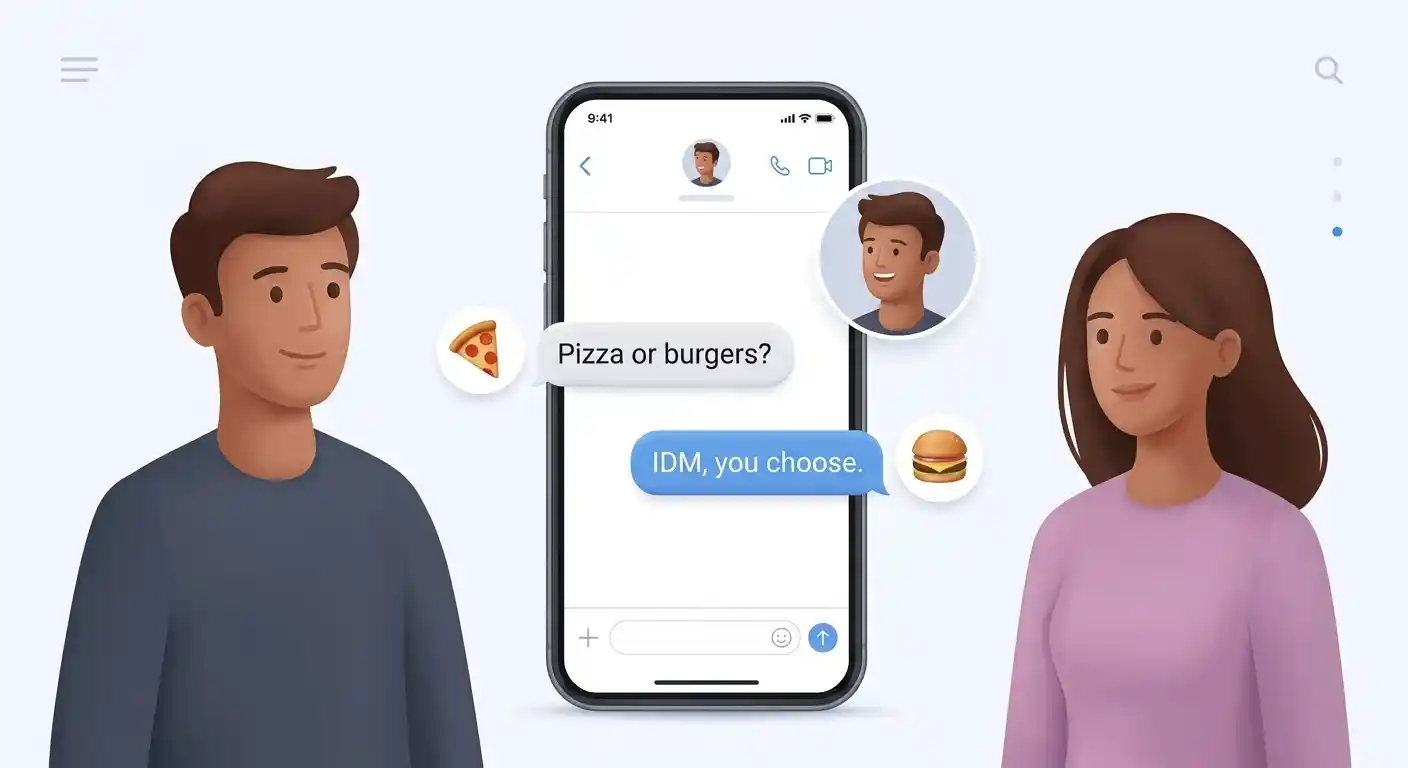
IDM usually means “I Don’t Mind” in text messages and online chats. It tells someone that you are okay with a suggestion, have no strong preference, or are happy to let them choose. The abbreviation is casual and is commonly used in everyday digital communication.
Quick Answer
In texting, IDM means “I Don’t Mind.” It is a messaging abbreviation used to show that something is acceptable or that the person has no particular preference. For example, “Where should we eat?” → “IDM, you choose.” The exact tone can range from relaxed and friendly to neutral depending on context.
Key Takeaways
- IDM = “I Don’t Mind.”
- It usually means “I’m okay with it” or “either option is fine.”
- IDM is an informal texting abbreviation and internet slang term.
- It can appear in texts, DMs, group chats, comments, and other casual online conversations.
- A short “idm” may sound neutral, while “idm 😊” or “idm, you choose” can sound warmer.
- IDM does not automatically indicate romantic interest, annoyance, or rejection.
- In other contexts, IDM can have completely different meanings, including Intelligent Dance Music and Internet Download Manager.
IDM Meaning in Text
The main IDM meaning in text is “I Don’t Mind.”
It is a form of text slang, internet slang, and messaging shorthand. Someone may use IDM when they do not have a strong preference and are comfortable with another person’s choice.
For example:
“Do you want pizza or burgers?”
“idm, you pick.”
Here, IDM essentially means “I’m fine with either one.”
It can also communicate:
- “I’m okay with that.”
- “Either is fine.”
- “You can decide.”
- “It doesn’t bother me.”
- “I have no preference.”
IDM is usually informal, so it fits casual digital communication much better than formal writing.
What Does IDM Stand For?
In texting, IDM stands for “I Don’t Mind.”
It is technically an initialism, because the letters represent the beginning of the words in the phrase.
People shorten “I Don’t Mind” to IDM because texting and online messaging often favor brief expressions. The abbreviation allows someone to communicate the same idea with only three letters.
For example:
“I don’t mind, you choose.”
becomes
“IDM, you choose.”
How Is IDM Used?
IDM is generally used when someone wants to communicate flexibility or a lack of preference.
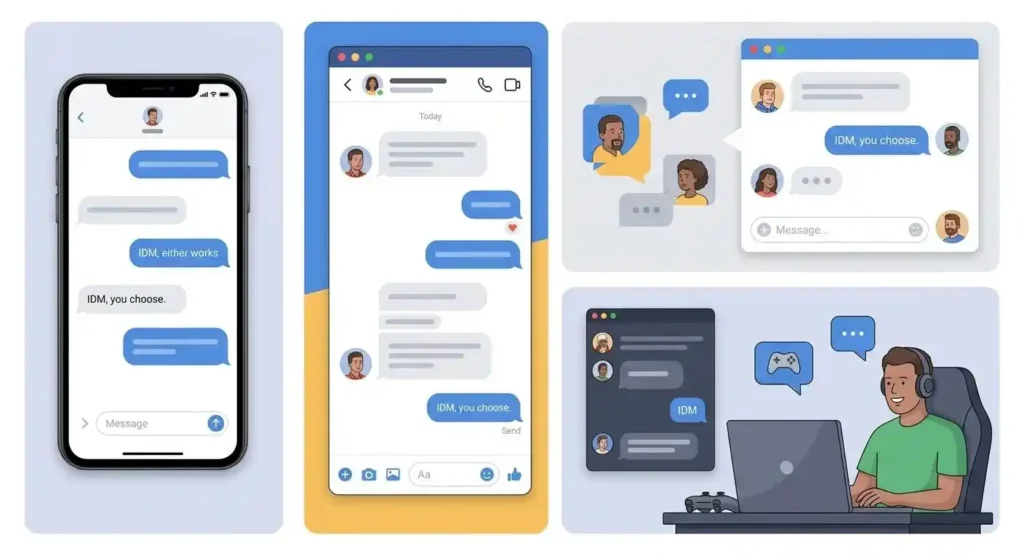
Text Messages
A person might use IDM when making plans:
“6 or 7?”
“IDM.”
The person is saying that either time works.
Instagram and Social DMs
In a direct message, IDM can be a quick response to a suggestion:
“Want to post it tomorrow instead?”
“idm”
It keeps the conversation casual and brief.
Snapchat
IDM can similarly appear when friends are deciding what to do:
“Movie or game night?”
“IDM 😂”
The emoji can make the response feel more playful or relaxed.
Group Chats
In a group conversation, IDM can signal that someone is leaving the decision to everyone else:
“Beach Saturday or Sunday?”
“idm, whichever works for everyone.”
Gaming Chats
A player might use IDM when they do not care which option the group selects:
“Ranked or casual?”
“IDM.”
The surrounding conversation determines exactly how the message should be interpreted.
Real Chat Examples
Here are varied examples of how IDM can naturally appear:
- Friend: “Pizza or tacos?”
You: “IDM, you choose.” - Friend: “Should we meet at 5?”
You: “idm.” - Friend: “Is it okay if I bring Sam?”
You: “IDM.” - Friend: “Want to watch a movie tonight?”
You: “IDM 😊” - Friend: “Blue or black?”
You: “IDM, both look good.” - Friend: “Saturday or Sunday?”
You: “idm, either works.” - Friend: “Should I call you later?”
You: “IDM.” - Friend: “Do you want to sit inside?”
You: “idm, wherever.” - Friend: “Want to play another round?”
You: “IDM lol.” - Friend: “Should we order now?”
You: “IDM.” - Friend: “Do you mind if we change the plan?”
You: “IDM.” - Friend: “Which song should I play?”
You: “IDM, pick one.” - Friend: “Want to go out or stay home?”
You: “idm honestly.” - Friend: “Can we move it to tomorrow?”
You: “IDM.” - Friend: “Tea or coffee?”
You: “IDM 😂” - Friend: “Should I send it now?”
You: “IDM.” - Friend: “Do you want to choose the restaurant?”
You: “idm, you can choose.” - Friend: “Is 8 PM okay?”
You: “IDM.” - Friend: “Want to join us?”
You: “idm, sure.” - Friend: “Which one do you prefer?”
You: “IDM, honestly.”
The important point is that IDM normally communicates lack of preference, rather than a strong yes or no.
How to Reply to IDM
Your reply depends on what the person was responding to. If they say IDM while making a decision, you can simply choose an option and continue the conversation.
Casual Replies
- “Cool, let’s do 7.”
- “Okay, pizza it is.”
- “Sounds good.”
- “Alright, I’ll choose.”
- “Perfect.”
Friendly Replies
- “Cool! I’ll pick something.”
- “Okay, thanks!”
- “Works for me too.”
- “Nice, let’s go with that.”
- “Haha, I’ll decide then.”
Funny Replies
- “So I have all the power? 😂”
- “You just made me responsible for the decision 😭”
- “Fine, boss. I’ll choose.”
- “No preference? Interesting 😂”
Neutral Replies
- “Okay.”
- “Sure.”
- “That works.”
- “Got it.”
- “No problem.”
Flirty/Relationship Replies
If IDM appears in a conversation with someone you like, the surrounding message matters more than the abbreviation itself.
You could respond naturally with:
- “Then I’m choosing 😊”
- “Okay, I’ll surprise you.”
- “Sounds good to me.”
- “Then let’s go with my pick.”
IDM by itself does not prove that someone is flirting or interested in you. It simply communicates that they do not mind the option being discussed.
Context & Relationship Meaning
IDM has the same basic meaning whether it comes from a guy, girl, friend, crush, or partner.
What changes is the context around it.
For example:
“Do you mind if I sit here?”
“IDM.”
This means the person is okay with you sitting there.
But:
“Do you want to go out tonight?”
“IDM.”
This may mean they are flexible, but it does not necessarily mean they are especially excited.
When interpreting a message, consider:
- The question that came before IDM
- The person’s usual texting style
- Emojis
- Punctuation
- Additional words
- Your relationship with the person
- The overall conversation
A message such as “idm 😊” may feel warmer than a bare “idm.”, but punctuation and emojis do not have universal meanings. Context matters most.
What Tone Does IDM Have?
IDM is generally casual and neutral-to-friendly.
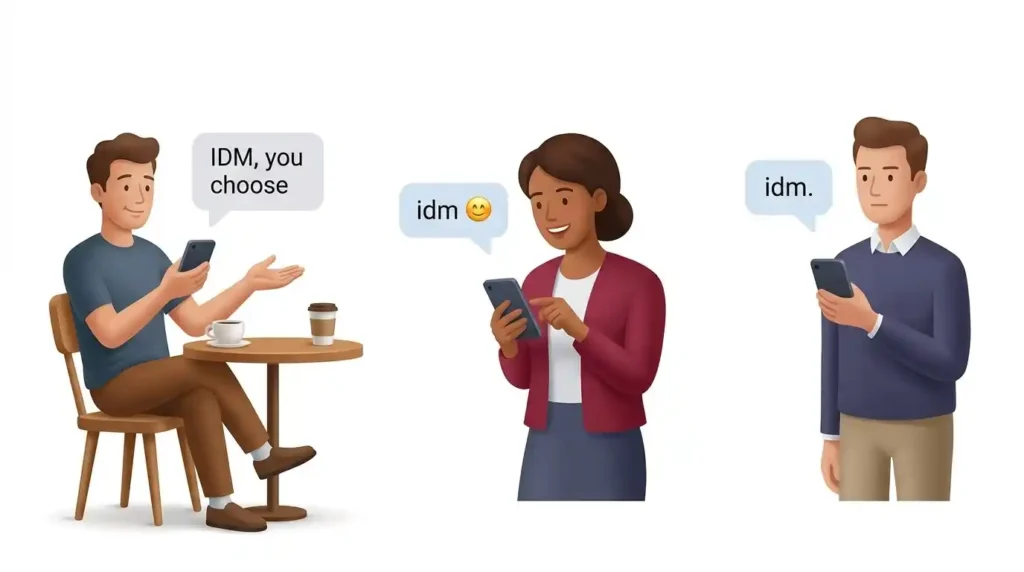
Depending on the conversation, it can sound:
- Relaxed: “IDM, you choose.”
- Flexible: “idm, either works.”
- Friendly: “IDM 😊”
- Playful: “idm lol”
- Neutral: “IDM.”
- Potentially uninterested: “idm.”
A standalone abbreviation can sometimes feel brief or emotionally flat, but that does not necessarily mean the person is annoyed. Some people simply text very briefly.
Is IDM Rude or Offensive?
IDM is not normally rude or offensive. It is a casual abbreviation for “I Don’t Mind.”
It works well in:
- Casual texts
- Friend group chats
- DMs
- Social media conversations
- Informal online discussions
For school assignments, professional messages, applications, or formal communication, spelling out “I don’t mind” is usually clearer and more appropriate.
Also, IDM can occasionally sound dismissive if someone expects you to give an actual preference.
For example:
“Where should we go for dinner?”
“IDM.”
This may simply mean “you choose,” but if the other person has asked several times, they might interpret it as a lack of engagement. The context determines the impression.
Who Uses IDM?
IDM is an informal internet and texting abbreviation rather than a term that should automatically be assigned to one particular generation.
People familiar with online messaging may encounter it in casual conversations, including texts, DMs, group chats, and social media.
Its meaning is generally straightforward once the surrounding conversation makes the context clear.
Other Meanings of IDM
Although “I Don’t Mind” is the main meaning when IDM appears in a casual text, the abbreviation can refer to different things in other contexts.
IDM as “It Doesn’t Matter”
Some abbreviation references also use IDM for “It Doesn’t Matter.” This is close in meaning to “I Don’t Mind,” which can make the two interpretations difficult to separate without context.
For example:
“Which color should we use?”
“IDM.”
Depending on the conversation, the person may mean either “I don’t mind” or “It doesn’t matter.”
IDM in Music
In music discussions, IDM can mean Intelligent Dance Music, a term associated with an electronic music genre. This is unrelated to the texting abbreviation.
IDM as Internet Download Manager
In software-related conversations, IDM can refer to Internet Download Manager, a download-management application. If the conversation discusses software, downloading, or computer tools, this meaning is more likely than the texting interpretation.
So context is important:
| Context | Possible meaning |
|---|---|
| Texting/chat | I Don’t Mind |
| Casual abbreviation | It Doesn’t Matter |
| Music | Intelligent Dance Music |
| Software | Internet Download Manager |
IDM vs. Similar Slang
IDM can be confused with other short expressions, especially when someone is trying to understand whether a person is agreeing or simply showing no preference.
| Term | Meaning | Difference |
|---|---|---|
| IDM | I Don’t Mind | Shows flexibility or no strong preference |
| IDC | I Don’t Care | Often emphasizes lack of concern or interest |
| IDK | I Don’t Know | Shows uncertainty or lack of knowledge |
| NVM | Never Mind | Usually withdraws or dismisses a previous point |
| IDTS | I Don’t Think So | Usually expresses disagreement or doubt |
The difference between IDM and IDC is particularly important. “I don’t mind” usually means something is acceptable, while “I don’t care” can sound more indifferent depending on context.
Common Mistakes About IDM
Assuming IDM always means “I don’t care”
IDM usually means “I Don’t Mind,” not necessarily “I don’t care.” The person may actually be happy with either choice.
Assuming IDM means the person is annoyed
A short “idm” can look cold, but the abbreviation alone does not establish annoyance. Their normal texting style and the rest of the conversation matter.
Assuming IDM means romantic interest
If a crush sends IDM, it does not automatically indicate flirting or attraction. The phrase itself only communicates flexibility or acceptance.
Confusing IDM with IDC
IDM and IDC are not interchangeable in every situation. IDM generally communicates acceptance, while IDC can communicate stronger indifference.
Assuming every IDM has the same meaning
The texting meaning is usually “I Don’t Mind,” but IDM can refer to unrelated concepts in music and software. Context helps identify the intended meaning.
Related Internet Slang
| Term | Meaning | Common Use |
|---|---|---|
| IDC | I Don’t Care | Showing indifference |
| IDK | I Don’t Know | Expressing uncertainty |
| NVM | Never Mind | Dropping or correcting a previous point |
| IKR | I Know, Right? | Strong agreement |
| TBH | To Be Honest | Introducing an honest opinion |
| WDYM | What Do You Mean? | Asking for clarification |
Real-World Conversation
Imagine two friends planning dinner:
Alex: “Should we get pizza or burgers?”
Sam: “IDM, you choose.”
Alex: “Pizza then?”
Sam: “Yep, sounds good.”
Here, IDM clearly means “I Don’t Mind.” Sam has no strong preference and is happy for Alex to make the decision.
People Also Ask
What does IDM mean in texting?
IDM usually means “I Don’t Mind.” It is used when someone is okay with an option or does not have a strong preference.
Does IDM mean “I don’t care”?
Not exactly. “I Don’t Mind” usually sounds more accepting or flexible, while “I don’t care” can sound more indifferent. Context can make the two seem similar.
Is IDM a slang word?
IDM is better described as a texting abbreviation or initialism rather than a traditional slang word. It is used as informal messaging shorthand for “I Don’t Mind.”
What does IDM mean from a girl?
If a girl texts “IDM,” it normally means “I Don’t Mind,” just as it would from anyone else. Gender does not change the standard meaning.
What does IDM mean from a guy?
A guy using IDM generally means “I Don’t Mind.” The surrounding conversation may reveal whether he sounds enthusiastic, neutral, or simply flexible.
Does IDM mean they like you?
Not by itself. IDM does not prove romantic interest, flirting, or attraction; you would need to consider the broader conversation and behavior.
Is IDM rude in a text?
Usually not. However, a very short “idm” can sometimes feel dismissive if the conversation calls for a more specific response.
What does IDM mean on social media?
On social media and in DMs, IDM generally has the same casual meaning: “I Don’t Mind.” Other meanings are possible when the conversation is about music, software, or another specialized topic.
Conclusion
In texting, IDM most commonly means “I Don’t Mind.” It is a casual messaging abbreviation used to show that someone is okay with an option, has no strong preference, or is comfortable letting someone else decide.
Its tone can be neutral, relaxed, or friendly depending on the wording and context. While IDM is appropriate for casual digital communication, spelling out “I don’t mind” is better for formal situations. In specialized contexts, IDM can also mean things such as Intelligent Dance Music or Internet Download Manager, so the surrounding conversation is important

Charlotte Reed creates captions and quotes built around moments, moods, and personal expression. Over three and a half years, she has worked on content covering travel experiences, lifestyle themes, relationships, events, social media posts, entertainment topics, and aesthetic styles. Her process involves studying language patterns, refining caption structure, and adjusting wording to match different occasions and visual themes.