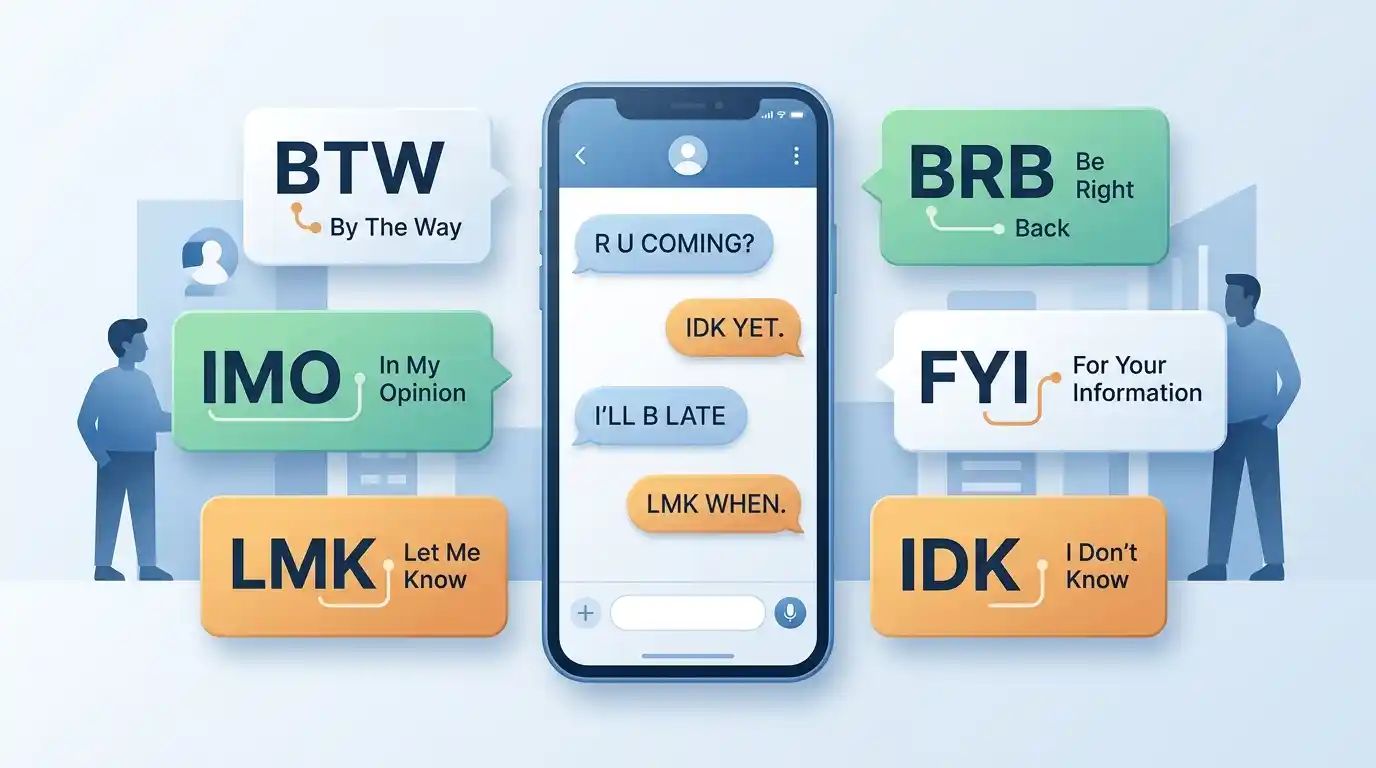
Common initialisms are shortened forms made from the first letters of words in a phrase, with the letters usually pronounced individually. In texting and online communication, examples include BTW, IDK, IMO, IRL, and LMK.
Key Takeaways
- An initialism is a type of abbreviation formed from the initial letters of words.
- Initialisms are often spoken letter by letter, such as “F-B-I” or “I-D-K.”
- In texting, initialisms can make messages shorter and faster to type.
- Common examples include BRB, BTW, FYI, IDK, IMO, IRL, LMK, and TTYL.
- An initialism is closely related to an acronym, but the terms are not always used in exactly the same way.
- Context matters because some short forms can have more than one meaning.
Common Initialisms Meaning in Text
In texting, common initialisms are messaging shortcuts created from the first letters of a phrase. They are widely used in informal digital communication, including texts, chats, DMs, comments, and other online conversations.
For example:
- IDK = I don’t know
- BTW = by the way
- IMO = in my opinion
- IRL = in real life
- LMK = let me know
- BRB = be right back
- TTYL = talk to you later
- FYI = for your information
- OMG = oh my God
- SMH = shaking my head
The exact boundary between an initialism and an acronym can vary. In the more precise distinction, an initialism is read as individual letters, while an acronym is generally pronounced as a word. However, acronym is also commonly used as a broader label for both.
What Do Common Initialisms Stand For?
Here are some useful initialisms you may see in everyday texting and online communication:
| Initialism | Meaning | Common Use |
|---|---|---|
| ASAP | As soon as possible | Requests and timing |
| BRB | Be right back | Temporary absence |
| BTW | By the way | Adding information |
| FYI | For your information | Sharing information |
| IDK | I don’t know | Uncertainty |
| IMO | In my opinion | Giving an opinion |
| IRL | In real life | Talking about offline life |
| LMK | Let me know | Asking for a response |
| OMG | Oh my God | Surprise or strong reaction |
| SMH | Shaking my head | Disapproval or disbelief |
| TBH | To be honest | Introducing an honest opinion |
| TMI | Too much information | Reacting to oversharing |
| TTYL | Talk to you later | Ending a conversation |
| WYD | What are you doing? | Asking what someone is doing |
| WYA | Where you at? | Asking someone’s location |
These examples reflect the kinds of abbreviations commonly included in current guides to internet and texting shorthand.
How Are Common Initialisms Used?
Initialisms can appear wherever people communicate informally online.
Text Messages
In regular texting, initialisms can shorten longer phrases:
“IDK what time we’re leaving.”
“LMK when you get home.”
“BTW, don’t forget your charger.”
DMs and Online Chats
People also use them in private messages and casual online conversations:
“OMG that was funny.”
“TBH, I liked the first one better.”
Group Chats
Initialisms can make quick group conversations easier to follow:
“BRB, grabbing food.”
“FYI, we’re meeting at 7.”
Comments and Social Posts
Some initialisms are also used as short reactions:
“OMG 😂”
“TBH, this is really good.”
The main purpose is usually brevity and convenience, although shorthand can also reflect the informal style of an online conversation.
Common Initialisms in Different Contexts
The same letters can sometimes mean different things depending on the conversation.
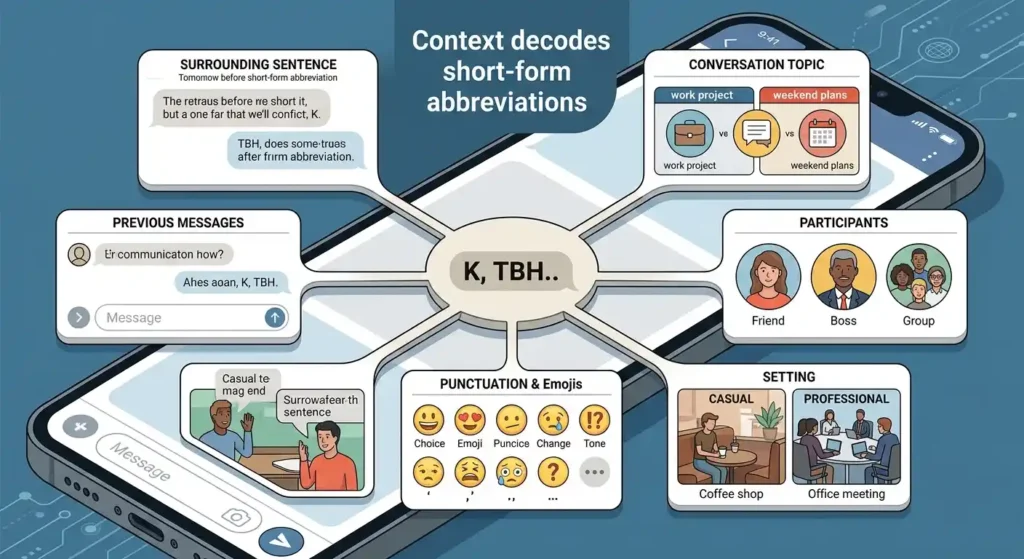
For example, IRL usually means “in real life” in an online conversation, while another abbreviation could have a specialized meaning in gaming, school, work, or technology.
Context can be especially important when an abbreviation has multiple possible expansions. Look at:
- The sentence around the abbreviation
- The topic being discussed
- Previous messages
- The people involved
- Punctuation and emojis
- Whether the conversation is casual or professional
A short abbreviation by itself does not always reveal someone’s attitude or intention. A brief IDK, for example, could simply mean the person does not know; the surrounding conversation helps determine whether it sounds neutral, dismissive, or playful.
Real Chat Examples
Here are realistic examples showing how common initialisms can appear naturally:
- “IDK, I’ll have to check.”
- “BTW, are you still coming?”
- “LMK when you’re free.”
- “BRB, my food just arrived.”
- “IMO, the second movie was better.”
- “FYI, the meeting starts at 3.”
- “OMG, I can’t believe you did that 😂”
- “TBH, I’m pretty tired today.”
- “TTYL! I have to go.”
- “WYD after school?”
- “WYA? We’re already here.”
- “IRL, it’s way smaller than I expected.”
- “SMH, I forgot my keys again.”
- “TMI 😂 I did not need to know that.”
- “ASAP would be great if you can.”
- “IDK what to watch tonight.”
- “BTW, thanks for helping me.”
- “LMK if you want to join us.”
- “BRB, my phone is about to die.”
- “FYI, I already sent the file.”
These examples show that initialisms can express opinions, reactions, questions, timing, information, and simple conversation management.
How to Reply to Common Initialisms
Your reply usually depends on what the initialism means in the sentence, not simply on the letters themselves.
Casual Replies
If someone says:
“WYD?”
You could reply:
- “Just chilling.”
- “Doing homework.”
- “Not much. You?”
Friendly Replies
For something like:
“LMK if you want to come.”
You might say:
- “Sure, I’ll let you know.”
- “Sounds good!”
- “Yeah, I’ll check.”
Funny Replies
If someone sends:
“IDK 😂”
A playful response could be:
- “That was extremely helpful 😂”
- “Okay, mystery solved.”
- “Guess we’re both figuring it out.”
Neutral Replies
For an informational message such as:
“FYI, the time changed.”
A simple response works:
- “Thanks for letting me know.”
- “Got it.”
- “Okay, thanks.”
Flirty or Relationship Replies
An initialism by itself does not automatically make a message romantic. If the conversation is already clearly personal, you can respond according to the broader conversation rather than reading romantic meaning into the abbreviation alone.
What Tone Do Common Initialisms Have?
The tone depends on the specific initialism and the surrounding message.
Common possibilities include:
- Casual: “BTW, are you coming?”
- Friendly: “LMK when you’re free.”
- Neutral: “FYI, the schedule changed.”
- Playful: “OMG 😂”
- Direct: “ASAP, please.”
- Informal: “IDK what happened.”
- Context-dependent: “SMH” can express mild disbelief, frustration, or disapproval depending on the conversation.
Capitalization usually does not automatically create a different meaning. For example, IDK, idk, and Idk can represent the same initialism; the surrounding wording is more useful for understanding tone.
Are Common Initialisms Rude or Offensive?
Most everyday initialisms are not inherently rude or offensive. Their appropriateness depends on the abbreviation, the audience, and the situation.
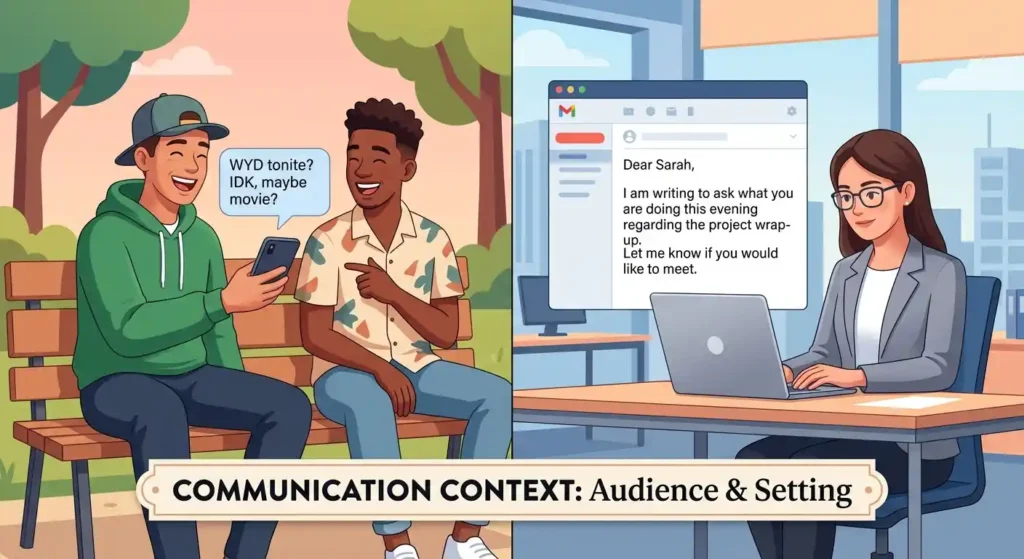
They generally fit casual communication such as:
- Texting friends
- Group chats
- Informal DMs
- Casual online conversations
- Social media comments
Professional or formal communication is different. If you’re writing to a teacher, employer, client, or other professional audience, spelling out an unfamiliar abbreviation can make the message clearer and more appropriate.
Some abbreviations can also sound abrupt in certain situations. For example, a one-word IDK may feel less conversational than “I’m not sure,” but that does not automatically mean the sender is being rude.
Other Meanings of Common Initialisms
“Common initialisms” is a broad language category rather than one individual abbreviation, so there is no single alternative meaning.
Initialisms appear across many areas:
Technology
Examples include CPU, GPU, API, and URL. These are technical initialisms rather than texting slang.
Business
Examples include CEO, HR, and PR. These are commonly used in professional settings.
Education
Examples include GPA, SAT, and ESL. Their meanings depend on the educational context.
Internet and Social Media
Examples include DM, IRL, TBH, FYI, and IMO. These are especially relevant to online communication.
Gaming
Gaming communities use specialized abbreviations and shorthand, so the same letters may have a different meaning from their general texting use.
The key point is that an initialism’s category does not automatically tell you its meaning. The surrounding subject and sentence matter.
Common Mistakes About Common Initialisms
Calling Every Initialism an Acronym
In everyday conversation, people often use acronym broadly. Technically, however, an initialism is typically pronounced by saying its letters individually, while an acronym is commonly pronounced as a word.
Assuming Every Short Form Is an Initialism
Not every abbreviation is made from initial letters. For example, appt. is a shortened form of “appointment,” while an initialism is formed from the initial letters of a phrase.
Ignoring Context
A string of letters can have different meanings in different conversations. Always read the complete sentence before choosing an expansion.
Assuming Short Means Rude
A brief reply may simply reflect convenience or the communication style of the conversation. It should not automatically be interpreted as anger or disinterest.
Using Informal Initialisms Everywhere
Texting shorthand may be perfectly natural with friends but less suitable in formal writing. When clarity matters, spelling out the phrase is often the safer choice.
Common Initialisms and Related Slang
| Term | Meaning | Common Use |
|---|---|---|
| IDK | I don’t know | Uncertainty |
| IMO | In my opinion | Opinions |
| TBH | To be honest | Honest reactions |
| NGL | Not gonna lie | Informal statements |
| FR | For real | Agreement or emphasis |
| LMK | Let me know | Requests |
| WYD | What are you doing? | Casual questions |
| WYA | Where you at? | Asking where someone is |
| BRB | Be right back | Temporary absence |
| TTYL | Talk to you later | Ending a chat |
Initialisms such as IDK, LMK, and NGL are often treated as texting shorthand, while newer or more context-dependent expressions may function more like internet slang.
People Also Ask About Common Initialisms
What is the difference between an acronym and an initialism?
An initialism is formed from the first letters of words and is traditionally pronounced letter by letter, such as FBI. An acronym is traditionally a combination of initial letters pronounced as a word, such as NASA. In everyday English, however, acronym is also commonly used for both categories.
What is the difference between an abbreviation and an initialism?
An abbreviation is the broader category for shortened forms of words or phrases. An initialism is a specific type of abbreviation created from initial letters.
Are texting abbreviations the same as internet slang?
Not exactly. Texting abbreviations are shortened forms used in digital communication, while internet slang is a broader category that can include abbreviations, shortened expressions, slang words, and other online language.
Why do people use initialisms in texts?
Initialisms can make messages quicker and shorter to type. They can also make communication feel more informal and familiar within a group that understands the shorthand.
Can one initialism have multiple meanings?
Yes. Some abbreviations have different meanings depending on the topic, audience, or sentence. When you’re unsure, the surrounding message is usually the best clue.
Are initialisms only used online?
No. Initialisms are also common in everyday language, organizations, education, technology, business, government, and other fields. Texting is simply one area where they are especially noticeable.
Should I use initialisms in professional messages?
Use familiar professional abbreviations when your audience is likely to understand them. For casual texting shorthand such as IDK or WYD, spelling out the phrase is usually clearer in formal communication.
Conclusion
Common initialisms are abbreviations built from the initial letters of words or phrases. In texting and online communication, examples such as IDK, BTW, IMO, LMK, BRB, FYI, and TTYL help keep informal messages concise.
The important distinction is that initialisms are traditionally pronounced letter by letter, although acronym is often used more broadly. Because abbreviations can vary by context, always consider the complete message, topic, and audience before deciding what a short form means.

Charlotte Reed creates captions and quotes built around moments, moods, and personal expression. Over three and a half years, she has worked on content covering travel experiences, lifestyle themes, relationships, events, social media posts, entertainment topics, and aesthetic styles. Her process involves studying language patterns, refining caption structure, and adjusting wording to match different occasions and visual themes.