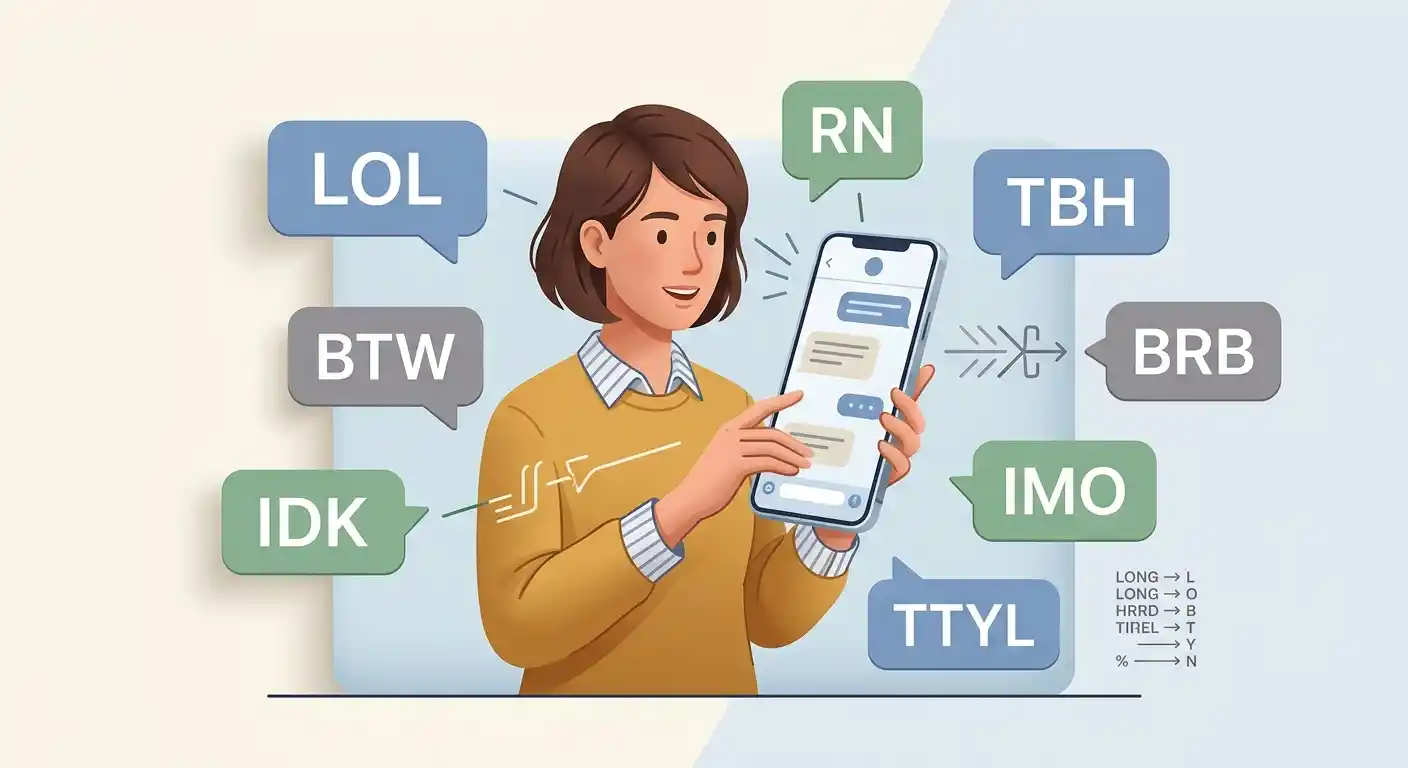
General internet abbreviations are shortened forms of words or phrases used in texts, chats, social media, comments, forums, and other online communication. Examples include LOL, BRB, IDK, BTW, TBH, IMO, and FYI. They make casual digital conversations quicker and more compact.
Key Takeaways
- Internet abbreviations are shortened forms of words or phrases used online.
- They appear in text messages, DMs, group chats, social media, gaming, and online communities.
- Some are used mainly to save typing time, while others also communicate tone, reaction, or attitude.
- Common examples include LOL, IDK, BRB, BTW, TBH, IMO, RN, and TTYL.
- Not every abbreviation is slang; some are technical, workplace, or general English abbreviations.
- Context matters because the same abbreviation can have more than one meaning.
General Internet Abbreviations Meaning in Text
“General internet abbreviations” is a broad category, not one specific abbreviation with a single full form.
It refers to shortened words, phrases, acronyms, initialisms, and other forms of messaging shorthand used in online communication. Some are traditional abbreviations, while others developed specifically through texting and internet culture.
For example:
- LOL = laughing out loud
- IDK = I don’t know
- BRB = be right back
- BTW = by the way
- TBH = to be honest
- IMO = in my opinion
- RN = right now
- TTYL = talk to you later
Internet abbreviations can be casual, informal, humorous, expressive, or neutral, depending on the specific term and how it is used.
Some abbreviations also help communicate emotion or attitude. For example, TBH can introduce an honest opinion, while LOL can indicate laughter or soften the feel of a message.
What Do General Internet Abbreviations Stand For?
There is no single full form for “general internet abbreviations.” The phrase describes a category rather than one acronym.
Each individual abbreviation has its own expansion. For example:
| Abbreviation | Full Form |
|---|---|
| LOL | Laughing out loud |
| BRB | Be right back |
| IDK | I don’t know |
| BTW | By the way |
| TBH | To be honest |
| IMO | In my opinion |
| FYI | For your information |
| RN | Right now |
| OMW | On my way |
| TTYL | Talk to you later |
It is also useful to distinguish acronyms from initialisms. In everyday conversation, people often use “acronym” loosely for both, but technically they are not always the same thing.
How Are General Internet Abbreviations Used?
Internet abbreviations are mainly used in informal digital communication.
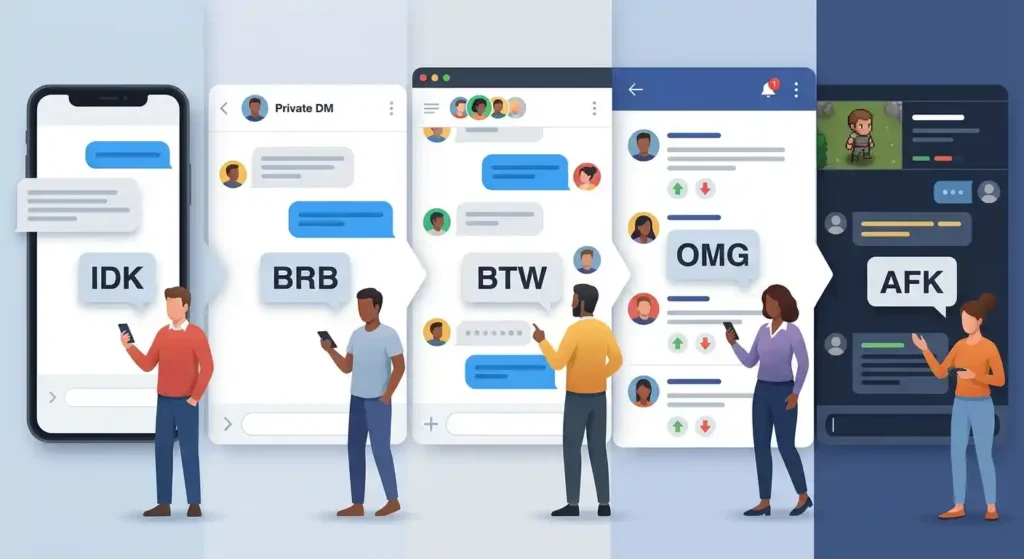
Text Messages
People often use short forms to keep everyday texts brief:
“IDK what time we’re leaving.”
“BRB, grabbing some food.”
“TBH, I liked the first one better.”
DMs and Private Messages
Abbreviations can make direct messages feel more conversational:
“BTW, are you coming tomorrow?”
“LMK when you get there.”
Group Chats
Group conversations often use shorthand because messages move quickly:
“OMG, did you see that?”
“RN everyone is talking about it.”
Social Media
Comments, captions, replies, and posts can contain common abbreviations such as LOL, TBH, IMO, FR, NGL, and IDK.
Gaming and Online Communities
Gaming and other fast-moving online conversations can also use shorthand. Terms such as AFK (“away from keyboard”) are especially connected with online activity.
Online Discussions
Abbreviations can also appear in forums, comments, and casual online discussions:
“IMO, that’s the better option.”
“ICYMI, the event was moved.”
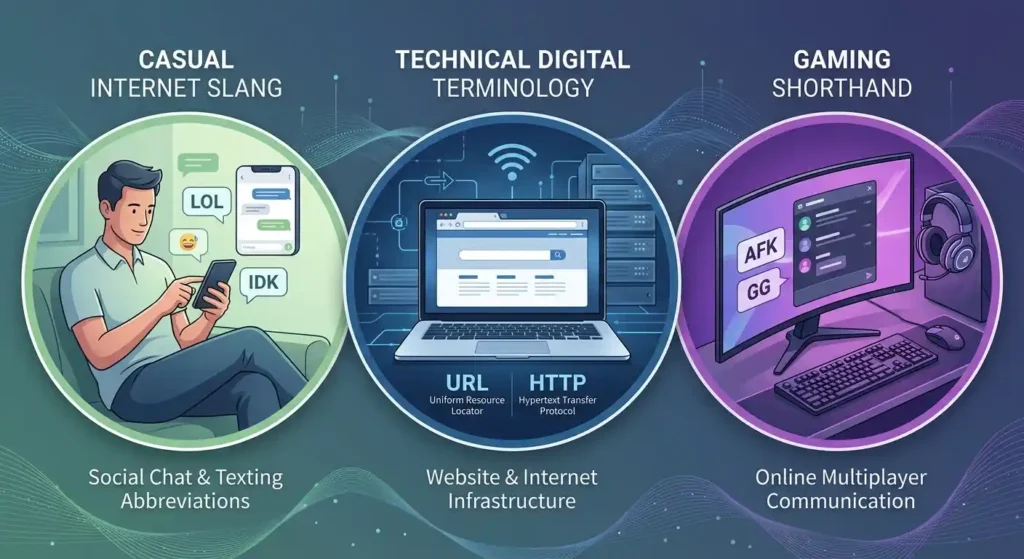
Not every online abbreviation is slang. Terms such as URL, FAQ, and HTTP, for example, belong more to technology or general digital vocabulary.
General Internet Abbreviations in Different Contexts
The meaning and tone of an abbreviation depend heavily on where and how it appears.
From a Friend
A friend might write:
“IDK lol”
This combines uncertainty with a casual expression of laughter.
From a Classmate
A classmate might say:
“BTW, did the teacher post the assignment?”
Here, BTW simply means “by the way.”
From a Crush
If someone you like writes:
“TBH, that was really funny 😂”
TBH still means “to be honest.” The abbreviation alone does not prove flirting or romantic interest.
In Dating
A message such as:
“NGL, I had a great time.”
uses NGL (“not gonna lie”) to introduce an honest-sounding statement. The romantic meaning, if any, comes from the wider conversation rather than the abbreviation itself.
In a Group Chat
A fast-moving group chat might contain:
“BRB”
“LOL”
“IDK”
“RN”
The intended meaning is usually clear from the surrounding conversation.
On Social Media
Some abbreviations can take on platform-specific meanings. For example, FYP can refer to TikTok’s “For You Page,” while DM means “direct message.”
The same letters can sometimes have different meanings in different communities, so context is important.
Real Chat Examples
Here are realistic examples of common internet abbreviations:
- Alex: “IDK what we should watch tonight.”
Mia: “Let’s pick something funny.” - Jordan: “BRB, my food just arrived.”
Sam: “No worries.” - Taylor: “TBH, I really liked that movie.”
Chris: “Same!” - Mia: “BTW, are we still meeting at six?”
Alex: “Yep.” - Sam: “IMO, the second option is better.”
Jordan: “I agree.” - Chris: “LOL that was hilarious.”
Taylor: “I know 😂” - Alex: “RN I’m just relaxing.”
Mia: “Sounds nice.” - Jordan: “OMW!”
Sam: “Okay, see you soon.” - Taylor: “TTYL, I have to go.”
Chris: “Talk later.” - Mia: “FYI, the meeting starts at three.”
Alex: “Thanks!” - Sam: “NGL, I was nervous.”
Jordan: “I couldn’t tell.” - Chris: “IKR? That ending was wild.”
Taylor: “Seriously!” - Alex: “LMK if you need anything.”
Mia: “Will do.” - Jordan: “ICYMI, the schedule changed.”
Sam: “Good to know.” - Taylor: “AFK for a few minutes.”
Chris: “Okay.” - Mia: “IDK, maybe we should wait.”
Alex: “That works.” - Sam: “LOL I completely forgot.”
Jordan: “It happens.” - Chris: “TBH, I’d rather stay home.”
Taylor: “Fair enough.” - Alex: “FR, that was the best part.”
Mia: “Absolutely.” - Jordan: “NVM, I figured it out.”
Sam: “Perfect.”
These examples show that abbreviations can express information, reactions, opinions, timing, uncertainty, humor, and conversational transitions.
How to Reply to General Internet Abbreviations
There is no single response because each abbreviation communicates something different.
Casual Replies
If someone says:
“IDK what to do.”
You might reply:
- “Same 😂”
- “Let’s figure it out.”
- “We can decide together.”
Friendly Replies
If someone says:
“LMK when you’re free.”
You could say:
- “Sure, I’ll let you know.”
- “I’ll text you later.”
- “Sounds good!”
Funny Replies
If someone writes:
“LOL I forgot.”
You could respond:
- “Classic 😂”
- “You’re not alone.”
- “That makes two of us.”
Neutral Replies
If you don’t understand an abbreviation, simply ask:
- “What does that mean?”
- “What does that abbreviation stand for?”
- “Do you mean ___?”
Asking is better than guessing when the context is unclear.
Flirty or Relationship Replies
If an abbreviation appears in a romantic conversation, respond to the actual message, not the abbreviation alone.
For example, if someone says:
“NGL, I had a really good time.”
A natural response could be:
- “Me too 😊”
- “I’m glad you enjoyed it.”
- “Same here!”
The abbreviation does not by itself establish romantic intent.
What Tone Do General Internet Abbreviations Have?
There is no single tone for all internet abbreviations.
Depending on the term, they can be:
- Casual
- Friendly
- Neutral
- Playful
- Informal
- Direct
- Humorous
- Context-dependent
For example, LOL often adds a casual or playful feel, while FYI can simply provide information.
Capitalization can also affect presentation, but it does not create a universal rule. The meaning and tone should be interpreted from the complete message.
Are General Internet Abbreviations Rude or Offensive?
Most everyday internet abbreviations are not inherently rude or offensive.
However, some abbreviations contain profanity or can communicate insults, anger, or strong reactions. Those should be interpreted according to their specific meaning rather than treating all internet shorthand as harmless.
For ordinary abbreviations such as BTW, IDK, FYI, IMO, BRB, and TTYL, casual use is generally more appropriate than formal writing.
For:
- Casual texts: abbreviations are often suitable.
- Friends and group chats: common shorthand can work naturally.
- Social media: many abbreviations are used informally.
- School assignments: standard formal English is usually better.
- Work communication: use judgment based on the setting and audience.
- Formal writing: spell out less familiar abbreviations when clarity matters.
Other Meanings of General Internet Abbreviations
Because “internet abbreviations” describes a broad category, individual abbreviations can belong to several areas.
Internet Abbreviations in Technology
Some are technical terms rather than slang:
- URL — Uniform Resource Locator
- HTTP — Hypertext Transfer Protocol
- HTML — HyperText Markup Language
- FAQ — Frequently Asked Questions
These may appear online every day but are not necessarily examples of texting slang.
Internet Abbreviations in Gaming
Online gaming has its own shorthand.
- AFK — Away from keyboard
- GG — Good game
- GLHF — Good luck, have fun
Their meaning is strongly connected to gaming or online play.
Internet Abbreviations in Social Media
Social platforms have produced or popularized terms such as:
- DM — Direct message
- FYP — For You Page
- POV — Point of view
The exact meaning can depend on how the term is being used.
Internet Abbreviations in Business
Some digital communication uses workplace shorthand:
- FYI — For your information
- EOD — End of day
- OOO — Out of office
These are not necessarily slang, even though they frequently appear in digital communication.
Common Mistakes About General Internet Abbreviations
Assuming Every Abbreviation Is Slang
An abbreviation can be technical, professional, social, or informal. “Internet abbreviation” is a broad category.
Assuming Every Acronym Has Only One Meaning
Some combinations of letters have multiple meanings. Always consider the topic and surrounding words.
Treating All Abbreviations as Modern Slang
Terms such as FAQ, URL, and HTML are not simply trendy texting expressions. Some have been established parts of digital vocabulary for years.
Assuming an Abbreviation Proves Romantic Interest
A message containing TBH, LOL, FR, or another abbreviation does not automatically indicate flirting or attraction.
Using Every Abbreviation Everywhere
An abbreviation that feels natural in a group chat may look out of place in a formal email, school paper, or professional document.
General Internet Abbreviations and Related Slang
| Term | Meaning | Common Use |
|---|---|---|
| LOL | Laughing out loud | Reactions and humor |
| IDK | I don’t know | Uncertainty |
| BRB | Be right back | Temporary absence |
| TBH | To be honest | Honest opinions |
| IMO | In my opinion | Sharing opinions |
| BTW | By the way | Introducing another point |
| RN | Right now | Current situations |
| NGL | Not gonna lie | Candid statements |
| FR | For real | Agreement or emphasis |
| LMK | Let me know | Requests for information |
| TTYL | Talk to you later | Ending a conversation |
| ICYMI | In case you missed it | Sharing information |
| AFK | Away from keyboard | Gaming or online status |
| OMW | On my way | Travel or arrival updates |
People Also Ask About General Internet Abbreviations
What are internet abbreviations?
Internet abbreviations are shortened forms used in online communication. They include texting shorthand, acronyms, initialisms, and shortened words used in messages, chats, comments, and social media.
What is the difference between an abbreviation and an acronym?
An abbreviation is a broad term for a shortened form. An acronym is a type of abbreviation formed from parts of a longer expression and commonly used as a word, although everyday usage often applies “acronym” more loosely to initial-letter shortcuts.
What are the most common internet abbreviations?
Common examples include LOL, IDK, BRB, BTW, TBH, IMO, FYI, RN, OMW, and TTYL. Which abbreviations are familiar can vary by context and online community.
Are internet abbreviations appropriate for school?
They are generally better suited to informal communication than formal school writing. In assignments or academic work, writing the full phrase is usually clearer unless the abbreviation is an accepted term in the subject.
Are internet abbreviations appropriate at work?
It depends on the workplace and the specific abbreviation. Familiar workplace terms such as FYI or OOO may be normal in professional communication, while highly informal slang may not fit every setting.
Why do people use internet abbreviations?
They provide a quick way to express common words or phrases and can also add a particular conversational tone. Some abbreviations are simply convenient, while others communicate reactions, opinions, or social cues.
Can an internet abbreviation have multiple meanings?
Yes. Some abbreviations have different meanings depending on the subject or community. Looking at the surrounding sentence and conversation is usually the best way to determine the intended meaning.
Are internet abbreviations the same as texting slang?
They overlap, but they are not identical. Internet abbreviations are shortened forms used online, while texting slang is a broader category that can include abbreviations, slang words, altered spellings, and other informal expressions.
Conclusion
General internet abbreviations are shortened forms used in texts, chats, social media, gaming, forums, and other digital communication. They include familiar terms such as LOL, IDK, BRB, TBH, IMO, BTW, and RN.
There is no single full form because the phrase describes a category rather than one abbreviation. Individual terms can be casual, humorous, neutral, technical, or professional, and their meanings can change with context. For formal communication, spelling out unfamiliar shorthand is usually the clearest choice.

Michael Anderson is a writer focused on captions and quotes designed for different moments, moods, and social settings. Over three and a half years, he has created collections covering travel, lifestyle, relationships, events, social media, entertainment, and aesthetic themes. Michael studies tone, context, and phrasing to craft captions that match specific occasions and visual styles.