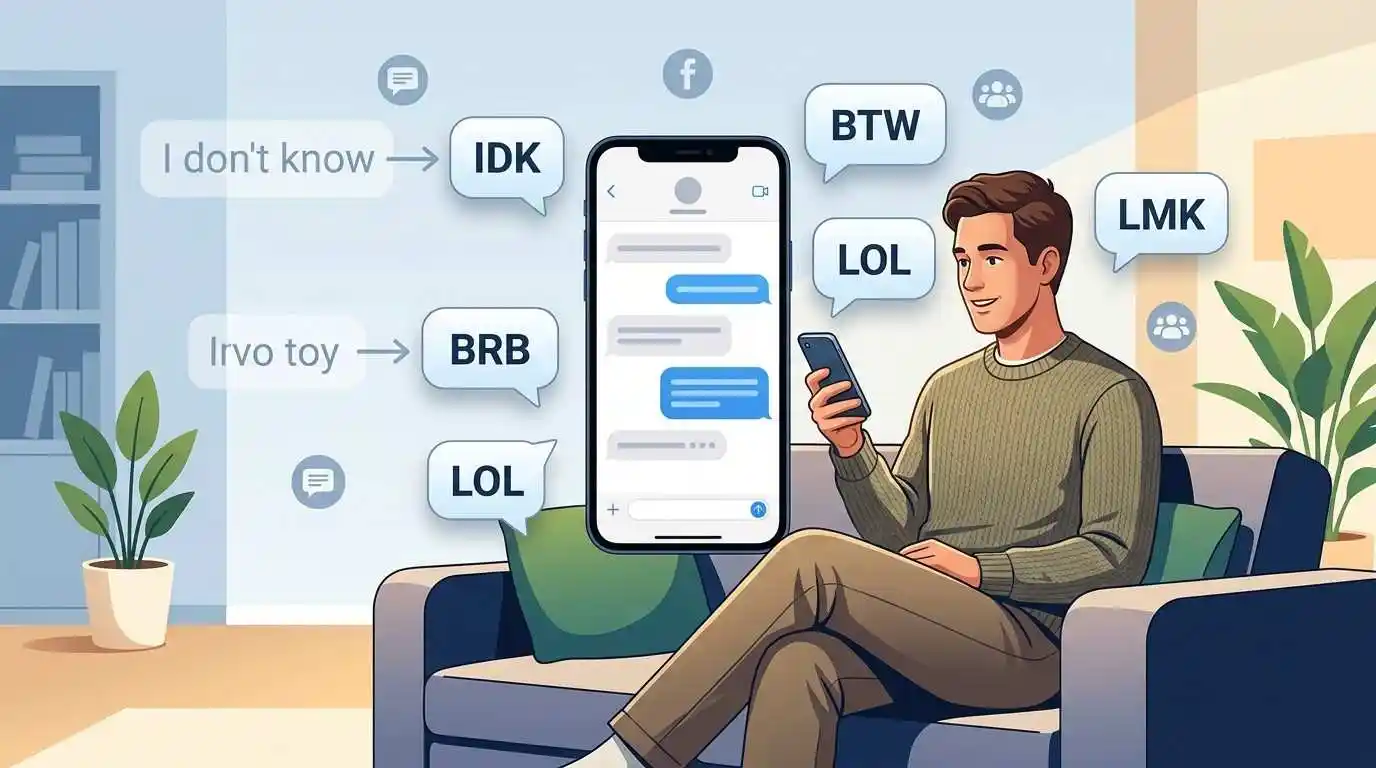
Basic conversation abbreviations are shortened forms of common words and phrases used in texts, DMs, group chats, comments, and online conversations. Examples include IDK (“I don’t know”), BRB (“be right back”), BTW (“by the way”), and LOL (“laugh out loud”). They make casual digital communication quicker and more concise.
Key Takeaways
- Conversation abbreviations shorten common phrases, reactions, questions, and updates.
- Popular examples include IDK, LOL, BRB, BTW, OMG, TTYL, LMK, FYI, IMO, and TBH.
- Most are designed for casual or informal communication, not formal writing.
- Context matters because some abbreviations can have more than one meaning.
- Abbreviations such as WYD, HMU, ILY, and WBU can appear in friendly or relationship-related conversations.
- You do not need to memorize every abbreviation; learning the most common ones is enough to understand everyday messaging.
Basic Conversation Abbreviations Meaning
Basic conversation abbreviations are forms of messaging shorthand that reduce longer words or phrases to a few letters. Many are formed from the first letters of each word, while others shorten individual words, such as pls for “please” or thx for “thanks.”
They are common in text messages, instant messaging, social media conversations, and other forms of digital communication. Some abbreviations express emotion, while others help people ask questions, give updates, change topics, or end a conversation.
For example:
- IDK = I don’t know
- BRB = Be right back
- BTW = By the way
- LMK = Let me know
- TTYL = Talk to you later
- OMG = Oh my God / Oh my gosh
- TBH = To be honest
- IMO = In my opinion
The meaning is usually straightforward once you know the phrase behind the letters.
What Do Basic Conversation Abbreviations Stand For?
There is no single full form for “basic conversation abbreviations” because it describes a category rather than one particular abbreviation.
Here are some of the most useful everyday examples:
| Abbreviation | Meaning | Common Use |
| ASAP | As soon as possible | Urgent requests |
| BRB | Be right back | Temporarily leaving |
| BTW | By the way | Adding a side note |
| FYI | For your information | Sharing information |
| GTG / G2G | Got to go | Ending a chat |
| HMU | Hit me up | Asking someone to contact you |
| IDK | I don’t know | Showing uncertainty |
| IDC | I don’t care | Expressing indifference |
| IKR | I know, right? | Agreeing with someone |
| IMO | In my opinion | Giving a personal view |
| JK | Just kidding | Showing a joke |
| LMK | Let me know | Requesting a response |
| LOL | Laugh out loud | Showing amusement |
| NGL | Not gonna lie | Introducing an honest thought |
| NVM | Never mind | Dropping or correcting a topic |
| OMG | Oh my God / Oh my gosh | Surprise or excitement |
| OMW | On my way | Giving a travel update |
| RN | Right now | Referring to the present |
| SMH | Shaking my head | Disbelief or disappointment |
| TBH | To be honest | Introducing a candid opinion |
| TMI | Too much information | Reacting to oversharing |
| TTYL | Talk to you later | Ending a conversation |
| WBU | What about you? | Returning a question |
| WYD | What are you doing? | Asking what someone is doing |
| WYA | Where you at? | Asking someone’s location |
| YW | You’re welcome | Replying to thanks |
These examples represent the kinds of abbreviations commonly found in texting and instant messaging.
How Are Basic Conversation Abbreviations Used?
Conversation abbreviations can serve different purposes depending on what someone wants to communicate.
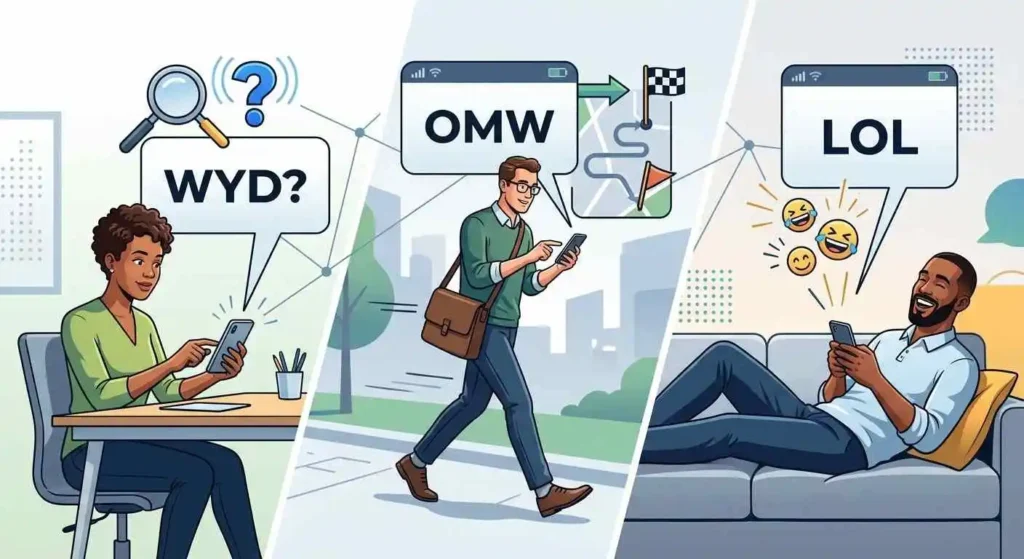
For Quick Questions
Some abbreviations make everyday questions shorter.
- WYD? — What are you doing?
- WYA? — Where are you?
- WBU? — What about you?
- HRU? — How are you?
- WDYT? — What do you think?
For Giving Updates
Abbreviations can make status updates quick and easy.
- BRB — Be right back.
- OMW — On my way.
- RN — Right now.
- GTG — Got to go.
- TTYL — Talk to you later.
For Reactions and Emotions
Other terms communicate a reaction without a long explanation.
- LOL — Laugh out loud.
- OMG — Oh my God / Oh my gosh.
- SMH — Shaking my head.
- IKR — I know, right?
- NGL — Not gonna lie.
For Opinions and Honesty
Some abbreviations signal that a person is giving an opinion or being direct.
- IMO — In my opinion.
- IMHO — In my humble opinion.
- TBH — To be honest.
- FWIW — For what it’s worth.
- AFAIK — As far as I know.
These terms help readers understand whether a statement is an opinion, personal reaction, or qualification rather than an absolute fact.
Real Chat Examples
Here are realistic examples showing how basic conversation abbreviations work naturally:
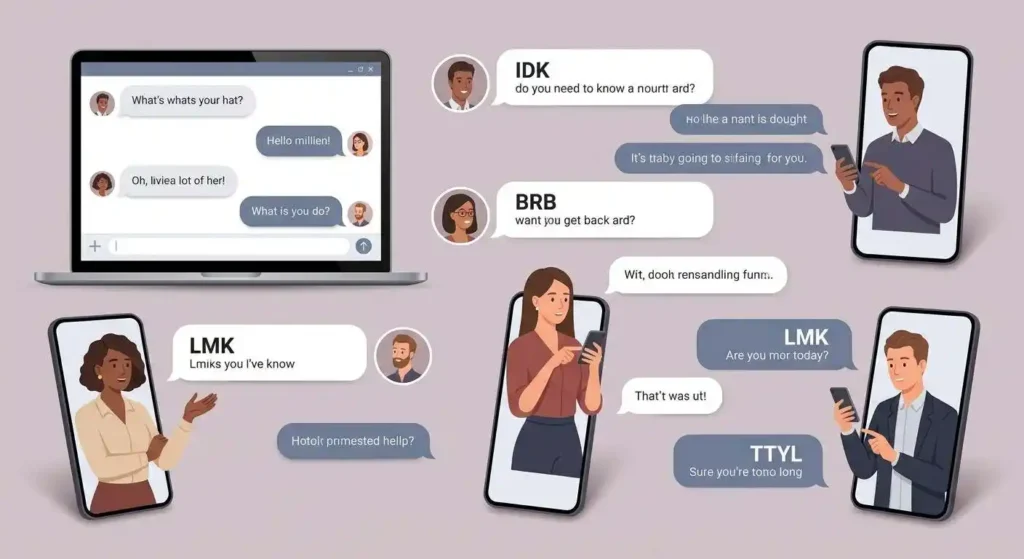
- A: “Are you coming tonight?”
B: “IDK yet. I’ll let you know.” - A: “Can you wait a minute?”
B: “BRB, getting some water.” - A: “BTW, the meeting starts at 3.”
- A: “OMG, did you see that?”
- A: “LMK when you get home.”
- A: “I have to go now.”
B: “Okay, TTYL!” - A: “WYD?”
B: “Just watching a movie.” - A: “WYA?”
B: “I’m outside.” - A: “TBH, I liked the first one better.”
- A: “IMO, that was the best option.”
- A: “Are you still coming?”
B: “OMW!” - A: “Thanks for helping!”
B: “YW!” - A: “That was hilarious LOL.”
- A: “NVM, I found my keys.”
- A: “Can you send it ASAP?”
- A: “I’m tired RN.”
- A: “I know, right?”
B: “IKR 😂” - A: “I’m not sure what happened.”
B: “IDK either.” - A: “That joke was terrible.”
B: “JK, it was actually funny.” - A: “I’ll be there soon.”
B: “NP, take your time.” - A: “WBU? Are you going?”
- A: “NGL, I was nervous.”
- A: “That is TMI 😂.”
- A: “GTG, talk later.”
These examples show that abbreviations usually replace phrases rather than changing the basic meaning of the conversation.
How to Reply to Basic Conversation Abbreviations
The best response depends on which abbreviation was used and what the surrounding conversation says.
Casual Replies
For a simple abbreviation such as IDK, BTW, or RN, answer normally:
- “Okay, no worries.”
- “Got it.”
- “Same here.”
- “That makes sense.”
- “Thanks for letting me know.”
Friendly Replies
For friendly questions such as WYD, WBU, or WYA, you can respond directly:
- “Just relaxing. WBU?”
- “I’m at home.”
- “Heading out soon.”
- “Not much, what’s up?”
Funny Replies
When the conversation is playful, a light response can match the tone:
- “LOL, seriously?”
- “You’re too funny 😂”
- “I knew you’d say that.”
- “Okay, fair enough.”
Neutral Replies
If you are unsure about the sender’s tone, keep your answer simple:
- “Sure.”
- “Okay.”
- “I understand.”
- “I’ll let you know.”
- “Thanks.”
Flirty or Relationship Replies
Some abbreviations appear in conversations between people who like each other, especially WYD, HMU, ILY, and WYA. However, an abbreviation by itself does not prove romantic interest. The surrounding conversation and existing relationship matter more.
For example:
- “WYD?” → “Just hanging out. You?”
- “HMU later.” → “Sure, I will.”
- “ILY.” → “Love you too.”
Context & Relationship Meaning
Basic conversation abbreviations generally do not have different definitions depending on whether they come from a guy or a girl.
For example, WYD means “what are you doing?” regardless of who sends it. What can change is the reason for sending it. A friend may use it to make plans, while someone you are dating might use the same abbreviation to start a conversation.
Consider:
- From a friend: “WYD?” may simply mean they want to chat.
- From a crush: “WYD?” could be an attempt to start a conversation, but the abbreviation alone does not prove romantic interest.
- In dating: “LMK” may be used to coordinate plans.
- In a relationship: “TTYL” can simply mean the person is temporarily ending the conversation.
Punctuation, emojis, previous messages, and the relationship between the people can all affect how a short message feels.
What Tone Do Basic Conversation Abbreviations Have?
The tone depends on the particular abbreviation and the surrounding message.
- Casual: IDK, BTW, RN, TTYL
- Friendly: WBU, LMK, HMU
- Playful: LOL, JK, OMG
- Direct: ASAP, GTG, IDC
- Opinion-based: IMO, IMHO, FWIW
- Potentially blunt: K, IDC, NVM
Lowercase or uppercase can also affect how a message feels to some readers, but there is no universal rule that one capitalization style always means a particular emotion.
Are Basic Conversation Abbreviations Rude or Offensive?
Most common conversation abbreviations are not inherently rude or offensive. Their appropriateness depends on the specific abbreviation, audience, and setting.
They are generally comfortable in casual texts, group chats, and informal social media conversations. In school assignments, formal emails, applications, or professional communication, spelling out the phrase is often clearer unless the abbreviation is widely accepted in that setting.
A term such as LOL is casual, while ASAP and FYI can also appear in more practical or workplace-oriented communication.
Some abbreviations can sound blunt depending on context. For example, IDC literally communicates indifference, so sending only “IDC” may feel dismissive even though the abbreviation itself is not a slur or offensive expression.
Who Uses Basic Conversation Abbreviations?
People use abbreviations across many forms of digital communication, including texting, instant messaging, social media, and group chats. The exact abbreviations a person knows or prefers can vary by community, context, and personal style.
It is better to think of these as digital communication shorthand rather than assigning every abbreviation to a particular generation.
Some abbreviations have also become familiar outside casual texting. Terms such as ASAP, FYI, ETA, and FAQ can appear in practical, business, or informational communication.
Other Meanings of Basic Conversation Abbreviations
Because this is a category rather than one specific abbreviation, individual terms can sometimes have meanings outside casual conversation.
For example:
- ATM can mean “at the moment” in texting, but it also commonly refers to an automated teller machine.
- DM can mean “direct message,” but “DM” can have other specialized meanings in different fields.
- IG can refer to Instagram, while in some texting contexts it can mean “I guess.”
- ETA commonly means “estimated time of arrival,” but the abbreviation can have other specialized uses.
- AFK usually means “away from keyboard” in online communication and gaming.
The safest approach is to interpret an abbreviation based on the sentence and conversation around it, rather than assuming one meaning every time.
Basic Conversation Abbreviations vs. Similar Terms
Several categories of shortened digital language are easy to mix together.
| Type | Example | What It Does |
| Acronym | LOL | Uses initial letters from a phrase |
| Abbreviation | ASAP | Shortens a longer expression |
| Shortened word | pls | Shortens an individual word |
| Texting shorthand | u | Replaces a word with a shorter form |
| Internet slang | NGL | Combines shorthand with informal language |
| Emoji | 😂 | Communicates a reaction visually rather than through letters |
The categories can overlap. For everyday users, the important point is understanding what the short form means in context.
Common Mistakes About Basic Conversation Abbreviations
Assuming every abbreviation has only one meaning
Some abbreviations are context-dependent. ATM, for example, can mean “at the moment” or refer to a cash machine.
Treating every abbreviation as slang
Not every abbreviation is slang. ASAP, FYI, ETA, and FAQ are widely recognized shortened forms that can appear in practical or professional contexts.
Assuming an abbreviation proves someone’s feelings
A message such as WYD, HMU, or ILY should be interpreted alongside the rest of the conversation. A short form alone cannot reliably establish someone’s romantic intentions.
Using every abbreviation in formal writing
Heavy texting shorthand can make a school or professional message harder to understand. When in doubt, use the complete phrase.
Confusing similar abbreviations
IMO means “in my opinion,” while IDK means “I don’t know.” Both are common, but they communicate very different things.
Related Internet Slang
| Term | Meaning | Common Use |
| IDK | I don’t know | Uncertainty |
| LOL | Laugh out loud | Amusement |
| BRB | Be right back | Temporary absence |
| BTW | By the way | Changing or adding a point |
| TBH | To be honest | Candid statement |
| NGL | Not gonna lie | Honest reaction |
| LMK | Let me know | Asking for an update |
| TTYL | Talk to you later | Ending a chat |
| WYD | What are you doing? | Casual question |
| WBU | What about you? | Returning a question |
| SMH | Shaking my head | Disbelief or disappointment |
| NVM | Never mind | Dropping a subject |
| OMW | On my way | Travel/status update |
| HMU | Hit me up | Asking someone to contact you |
| FYI | For your information | Sharing information |
These terms cover several common functions: questions, reactions, opinions, updates, and conversation endings.
Real-World Conversation
Imagine two friends making plans:
Alex: “WYD tonight?”
Sam: “Not much. WBU?”
Alex: “I’m OMW to the mall. HMU if you wanna come.”
Sam: “Sure! LMK when you get there.”
Alex: “NP. TTYL.”
Here, the abbreviations make the exchange shorter without changing the basic meaning.
People Also Ask
What are the most common conversation abbreviations?
Some widely recognized examples include LOL, IDK, BRB, BTW, OMG, TTYL, LMK, FYI, IMO, TBH, and NVM. They cover common reactions, questions, opinions, updates, and conversation endings.
What does IDK mean in texting?
IDK means “I don’t know.” It is used when someone does not know an answer, is uncertain, or does not have enough information to respond confidently.
What does BRB mean in a chat?
BRB means “be right back.” It tells the other person that the sender is temporarily stepping away but expects to return to the conversation.
What does BTW mean in a text?
BTW means “by the way.” It is commonly used to introduce an additional detail, side note, or related thought.
What does LMK mean in texting?
LMK means “let me know.” It is usually used when someone wants another person to provide an answer, decision, update, or opinion later.
What does TTYL mean?
TTYL means “talk to you later.” It is a casual way to end a conversation when the sender expects to communicate again later.
Are texting abbreviations okay in school or work?
It depends on the situation. Common abbreviations such as ASAP or FYI may be acceptable in some professional contexts, but informal terms such as LOL or WYD are usually better suited to casual communication.
Do texting abbreviations have the same meaning everywhere?
No. Some are context-dependent, and certain abbreviations can have specialized meanings outside texting. Check the surrounding words and subject before deciding what an unfamiliar abbreviation means.
Conclusion
Basic conversation abbreviations are shortcuts that make texts, chats, DMs, and other online conversations faster and more concise. Learning common terms such as IDK, LOL, BRB, BTW, LMK, TTYL, IMO, and TBH can make digital communication much easier to understand.
Most are informal, but some shortened forms are also used in practical or professional communication. When an abbreviation seems unclear, always consider the context, tone, platform, and surrounding message before interpreting it.

Michael Anderson is a writer focused on captions and quotes designed for different moments, moods, and social settings. Over three and a half years, he has created collections covering travel, lifestyle, relationships, events, social media, entertainment, and aesthetic themes. Michael studies tone, context, and phrasing to craft captions that match specific occasions and visual styles.