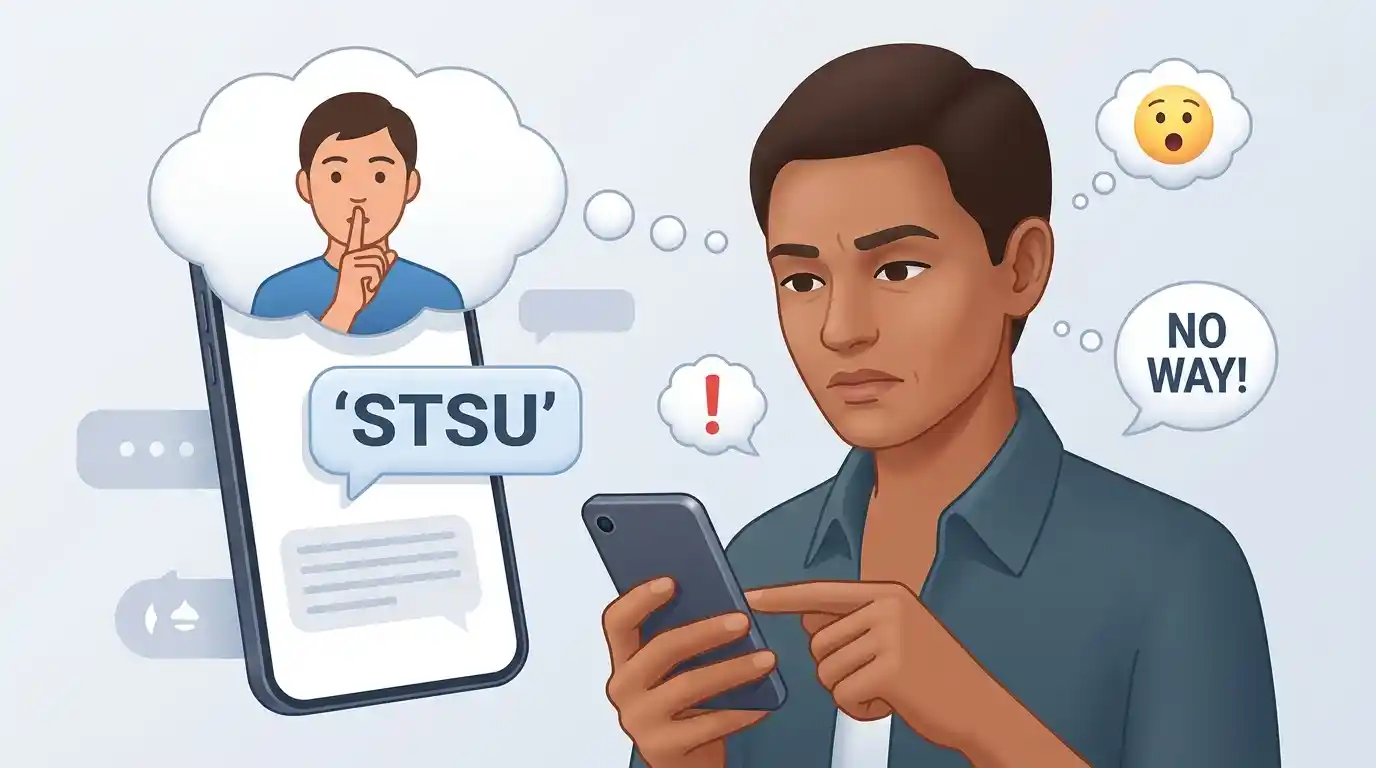
STSU in text usually refers to a “shut up” expression, commonly interpreted as “Shut That Sh*t Up” or a softened “Shut The Stuff Up.” It can be playful, surprised, teasing, or genuinely rude depending on the conversation and relationship. Because STSU is not a fully standardized texting abbreviation, context matters.
Key Takeaways
- STSU is informal internet slang rather than a standard English abbreviation.
- In casual texting, its main interpretation is a variation of “shut up.”
- The phrase can express surprise or disbelief rather than literally telling someone to stop talking.
- With friends, STSU can sound playful or teasing; during an argument, it can sound harsh.
- The exact expansion can vary, including a softer “Shut The Stuff Up” interpretation.
- If the context does not make the meaning clear, asking the sender what they meant is safer than assuming.
STSU Meaning in Text
STSU is a short form used in informal online communication. In texting, it is commonly associated with a phrase meaning “shut up,” with one frequently reported expansion being “Shut That Sh*t Up.” A cleaner version is sometimes written as “Shut The Stuff Up.”
The meaning is not always literal. A friend might say “STSU 😂” after hearing something unbelievable. In that situation, the message can mean something closer to “No way!”, “You’re kidding!”, or “I can’t believe that!”
STSU can therefore function as an emotional reaction as well as a command to stop talking. The surrounding words, punctuation, emojis, and relationship between the people chatting help determine which interpretation makes sense.
Because STSU is less standardized than familiar texting abbreviations such as LOL or BRB, it should not automatically be interpreted one way in every conversation. Some users may use it as personal or group-specific shorthand.
What Does STSU Stand For?
In slang and texting contexts, STSU is commonly interpreted as “Shut That Sh*t Up.” Some people soften the phrase to “Shut The Stuff Up” while keeping the same initials.
The difference matters because the first version contains profanity, while the second replaces the stronger word with “stuff.” Both can communicate the basic idea of telling someone to stop talking or reacting strongly to what they said.
STSU is often casually called an acronym, although technically it is better described as an initialism when the letters are pronounced separately.
There is no single universally accepted expansion that applies to every use of STSU. If the conversation is clearly motivational, professional, or unrelated to “shut up,” another meaning may be intended.
How Is STSU Used?
STSU is mainly relevant to casual digital communication. It can appear when someone wants to react quickly without typing a complete sentence.
Text Messages
A person may use STSU after hearing surprising, funny, embarrassing, or unbelievable news.
Example:
“I just got backstage passes.”
“STSU 😂”
Here, the sender may be expressing disbelief or excitement rather than seriously demanding silence.
Group Chats
In a group chat, STSU can be used as playful teasing between people who already understand each other’s communication style.
Example:
“I’m definitely the best cook here.”
“STSU, you burned the pizza last time 😭”
Social Media Comments
STSU can also appear as a short reaction to a surprising post, joke, story, or claim. The surrounding comment and emojis are especially important because a four-letter response alone provides little emotional information.
DMs
In a private message, STSU can be either playful or serious. The relationship between the two people matters more than the abbreviation itself.
Gaming and Online Communities
Some online communities use short expressions like STSU as quick reactions. However, because STSU is not standardized, you should not assume every gaming or online community gives it exactly the same meaning.
STSU in Different Contexts
The same four letters can feel very different depending on what happened immediately before them.
From a Friend
If a friend responds with “STSU 😂” after you share surprising news, it may be playful disbelief.
For example:
“I accidentally met my favorite actor yesterday.”
“STSU 😂 That actually happened?”
The reaction is closer to “No way!” than a serious command.
From a Crush
If someone you like sends STSU, the abbreviation alone does not prove flirting or romantic interest. It may simply be their reaction to something you said.
Look at the complete conversation, not just the acronym. Their wording, emojis, previous messages, and overall tone provide more useful context.
In Dating
STSU can appear during playful teasing, but it can also be used seriously. If the conversation is tense and the message is simply “STSU.”, it is more likely to feel dismissive than playful.
In a Relationship
Partners may use strong slang jokingly if that fits their normal communication style. However, the same expression can feel disrespectful if it appears during an argument.
In a Group Chat
A message such as “STSU 😭” can be a dramatic reaction to something funny or unbelievable. A message such as “STSU already.” is more likely to mean that the sender wants the conversation to stop.
In Social Media Comments
Short comments provide less context than private conversations. If you see STSU under a post, look at the original post and nearby comments before deciding whether it is playful, surprised, or hostile.
Gender does not automatically change the meaning. STSU does not have one special definition “from a guy” or “from a girl.” Context determines how the sender intends it.
Real Chat Examples
Here are realistic ways STSU can appear in casual conversations:
- Friend: “I just saw your ex at the mall.”
You: “STSU 😭” - Friend: “I won the concert tickets!”
Reply: “STSU!! No way 😂” - Friend: “I ate the whole cake.”
Reply: “STSU 💀” - Friend: “I actually finished the project early.”
Reply: “STSU, seriously?” - Friend: “Guess who followed me.”
Reply: “STSU 👀 Who?” - Friend: “I met my favorite singer yesterday.”
Reply: “STSU! You’re so lucky.” - Friend: “I told everyone I could cook.”
Reply: “STSU 😂” - Friend: “He said he remembers me from high school.”
Reply: “STSU, what happened next?” - Friend: “I accidentally sent the message to the wrong person.”
Reply: “STSU 😭 That’s rough.” - Friend: “I’m dropping the class tomorrow.”
Reply: “STSU. Wait, why?” - Friend: “You keep making the same joke.”
Reply: “STSU 😂” - Friend: “Stop telling everyone my embarrassing stories.”
Reply: “STSU 😭 Fine, fine.” - Friend: “You really think you can beat me?”
Reply: “STSU, absolutely.” - Friend: “I just found $20 in my old jacket.”
Reply: “STSU 😂” - Friend: “I forgot we had a test today.”
Reply: “STSU 😭 Me too.” - Friend: “I’m never ordering from that place again.”
Reply: “STSU. What did they do?” - Friend: “I told Mom what happened.”
Reply: “STSU 💀 You did not.” - Friend: “You have to stop exaggerating everything.”
Reply: “STSU, I’m being serious.” - Friend: “I’m telling the story again.”
Reply: “STSU already 😂” - Friend: “Wait until you hear what happened.”
Reply: “STSU 😭 Tell me!”
These examples show why the same abbreviation can range from humorous disbelief to a more direct request for someone to stop talking.
How to Reply to STSU
Your best response depends on what the sender appears to mean.
Casual Replies
If it seems playful, you can keep the conversation light:
- “😂 What?”
- “I’m serious!”
- “You heard me!”
- “No, really!”
- “I knew you’d say that.”
Friendly Replies
If a friend is reacting dramatically:
- “Okay, okay 😂”
- “I’m just telling you what happened.”
- “Wait until you hear the rest.”
- “I swear it’s true.”
- “You know I’m not making this up.”
Funny Replies
If the conversation is clearly joking:
- “Too late, I already said it.”
- “You can’t silence me 😂”
- “But I have more details.”
- “I regret nothing.”
- “You asked!”
Neutral Replies
If you are unsure whether STSU was serious:
- “What do you mean?”
- “Are you joking?”
- “Wait, are you serious?”
- “Did I say something wrong?”
- “Can you clarify?”
A neutral question is especially useful when the abbreviation could have more than one interpretation.
Flirty/Relationship Replies
Only use a flirty response if the surrounding conversation is already clearly playful or romantic. STSU itself does not establish romantic intent.
Possible replies include:
- “Make me 😂”
- “You’re dramatic.”
- “You know you want the full story.”
- “I’m not stopping anytime soon 😌”
The safest choice is to match the tone that was already present rather than assuming STSU is flirting.
What Tone Does STSU Have?
STSU is context-dependent, but its texting interpretation can carry several tones.
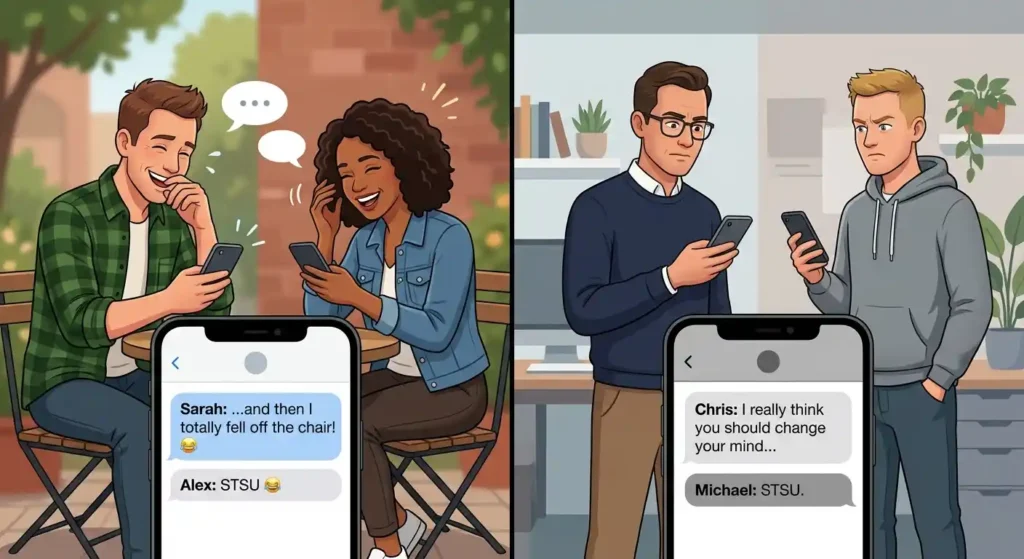
Playful
Between friends, it can be exaggerated teasing.
“STSU 😂”
This may simply mean, “You cannot be serious.”
Surprised
It can react to unexpected information:
“STSU! You actually did it?”
Here, the sender is expressing disbelief.
Sarcastic
Someone may use it jokingly after an exaggerated claim or dramatic statement.
Annoyed
If the conversation is tense, STSU may be a direct way of telling someone to stop talking.
Rude or Harsh
A standalone “STSU.” with no friendly context can sound dismissive or hostile.
The abbreviation itself does not determine the tone. Context does.
Is STSU Rude or Offensive?
STSU can be rude because its main slang interpretation is connected to a blunt “shut up” expression. The phrase may be harmless teasing between close friends, but another person could interpret it as disrespectful.
For casual conversations with friends, it may fit if that style of joking is already normal between you.
For school, work, customer communication, or professional messages, it is better to avoid STSU. A clear phrase such as “Could you please stop?” is much safer when you genuinely need someone to stop talking.
It is also better to avoid using STSU when you do not know the recipient well. Without shared context, the playful interpretation may not be obvious.
Other Meanings of STSU
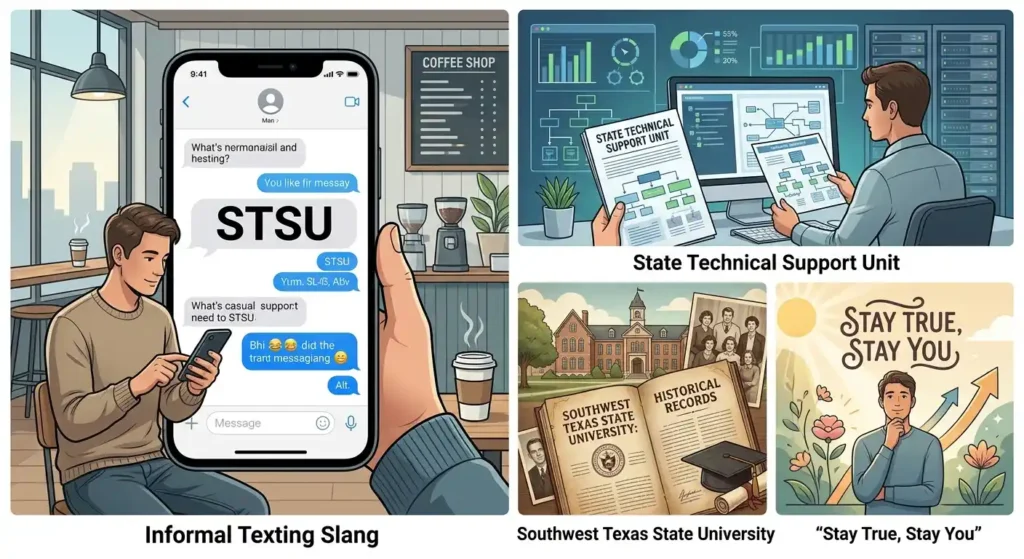
STSU does not have one universal meaning outside slang either. Acronym references list several non-texting expansions, including State Technical Support Unit and the former Southwest Texas State University. The university used that name until 2003, so an older document may use STSU in that historical context.
These meanings are different from the casual texting use. If STSU appears in a technical, academic, or organizational document, do not automatically interpret it as internet slang.
Common Mistakes About STSU
Assuming STSU Always Means “Shut Up”
The “shut up” interpretation is important in casual texting, but STSU is not standardized. A different community or document may use the letters differently.
Assuming It Is Always Rude
Not necessarily. “STSU 😂” after surprising news can be playful, while “STSU already.” during an argument can be much harsher.
Assuming It Is Flirty
STSU alone does not prove attraction or romantic interest. If someone you like sends it, judge the message from the entire conversation.
Confusing STSU With STFU
The two abbreviations are related in tone, but they are not identical. STFU is a well-established vulgar expression, while STSU has more variable interpretations and is often presented as a variation or softened alternative.
Ignoring the Surrounding Message
A single abbreviation is difficult to interpret without context. Read the sentence before it, check punctuation and emojis, and consider what the conversation was about.
STSU and Related Slang
| Term | Meaning | Common Use |
|---|---|---|
| STFU | A vulgar “shut up” expression | Strong or confrontational reactions |
| STHU | “Shut the heck up” or similar softened wording | Informal requests or reactions |
| SMH | Shaking my head | Disbelief, disappointment, or frustration |
| OMG | Oh my God | Surprise, excitement, or shock |
| WTF | A vulgar expression of surprise or confusion | Strong reaction to something unexpected |
| LOL | Laughing out loud | Showing amusement |
The closest comparison is STFU, but STSU should not automatically be treated as an exact substitute because its expansion and tone are less standardized.
People Also Ask About STSU
What does STSU mean in texting?
STSU is commonly used as a slang variation of a “shut up” expression. Depending on the conversation, it may be playful disbelief, teasing, or a genuine request for someone to stop talking.
Is STSU the same as STFU?
Not exactly. STSU is commonly associated with a variation such as “Shut That Sh*t Up” or “Shut The Stuff Up,” while STFU has its own established vulgar expansion. STSU can also be more ambiguous because different users may interpret the letters differently.
What does STSU mean from a girl or guy?
The basic slang meaning does not change based on gender. Whether it is playful, annoyed, or serious depends on the conversation, wording, relationship, and tone—not simply whether the sender is a guy or girl.
Can STSU be used jokingly?
Yes. In a friendly conversation, someone may use STSU as an exaggerated reaction to surprising or funny information. Emojis such as laughing or shocked expressions can help show that the message is playful, although emojis are not a guarantee of intent.
Is STSU appropriate at work?
Generally, it is better avoided in professional communication. Because the slang can sound rude and its meaning is not completely standardized, a clear and polite sentence is more appropriate.
Can STSU have a positive meaning?
Some online sources use STSU for positive phrases such as “Stay True, Stay You,” particularly in motivational contexts. However, this is not the safest interpretation when you encounter STSU in an ordinary casual conversation; the surrounding message should determine which meaning fits.
What should I do if I do not understand STSU?
Look at the surrounding conversation first. If the intended meaning is still unclear, simply ask, “What do you mean by STSU?” rather than guessing and potentially misunderstanding the sender.
Conclusion
STSU is an informal texting abbreviation most commonly associated with a “shut up” expression, including interpretations such as “Shut That Sh*t Up” and the softer “Shut The Stuff Up.” It can express surprise, disbelief, teasing, annoyance, or a direct request to stop talking.
Because STSU is not fully standardized, context is essential. It may be playful between friends but rude in a tense conversation, and alternative expansions can appear in other settings. When in doubt, read the surrounding messages or ask the sender what they meant

Michael Anderson is a writer focused on captions and quotes designed for different moments, moods, and social settings. Over three and a half years, he has created collections covering travel, lifestyle, relationships, events, social media, entertainment, and aesthetic themes. Michael studies tone, context, and phrasing to craft captions that match specific occasions and visual styles.