
TTYL means “Talk To You Later.” It is a casual texting abbreviation people use to end a conversation for now while indicating they expect to talk again later. It is common in informal digital communication, including texts, chats, DMs, and social media.
Key Takeaways
- TTYL = “Talk To You Later.”
- It is an informal texting abbreviation and internet slang initialism.
- People usually use it when they are leaving a conversation temporarily.
- TTYL is generally casual, friendly, and not offensive.
- The abbreviation does not automatically indicate flirting, romantic interest, or rejection.
- It works well in casual chats but is usually better replaced with a standard closing in formal or professional communication.
TTYL Meaning in Text
In text messages, TTYL is a short form of “Talk To You Later.” It works as a casual sign-off when someone needs to leave the conversation, becomes busy, or simply wants to continue chatting another time.
The word “later” does not necessarily identify a specific time. It generally communicates that the current conversation is ending or pausing and that another conversation may happen afterward.
For example:
“I have class now, ttyl!”
This means:
“I have class now, so I’ll talk to you later.”
TTYL is best understood as messaging shorthand rather than a special code or hidden expression. Its meaning normally stays the same across everyday online conversations.
What Does TTYL Stand For?
TTYL stands for “Talk To You Later.”
Each letter represents a word:
- T = Talk
- T = To
- Y = You
- L = Later
It is commonly described as an initialism because the letters come from the first letters of the words and are normally read individually as “T-T-Y-L.”
The shortened form makes a casual message quicker to type:
“I have to go. Talk to you later!”
becomes:
“I have to go. TTYL!”
How Is TTYL Used?
TTYL usually appears near the end of a message or conversation. Someone might use it because they have to leave, have another task to handle, are going offline, or simply want to pause the chat.
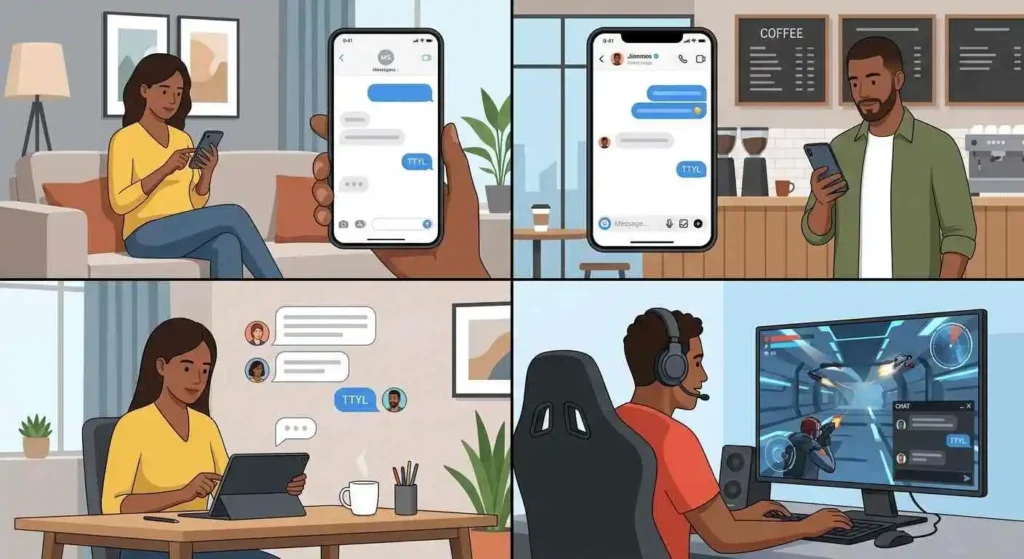
Text Messages
“My ride is here. TTYL!”
“I need to finish my homework, ttyl.”
DMs and Social Media
TTYL can appear naturally in casual direct messages and online conversations.
“That story was hilarious 😂 ttyl!”
Group Chats
Someone leaving a group conversation temporarily might write:
“Gotta go eat. TTYL everyone!”
Gaming Chats
A player who is logging off may use it as a quick sign-off:
“I have to log off now. TTYL!”
The exact platform does not normally change the meaning. Whether it appears in a text, DM, gaming chat, or another online conversation, TTYL generally means “Talk To You Later.”
Real Chat Examples
Here are varied examples showing how TTYL can sound in everyday conversations:
- Friend: “Are you still coming over?”
You: “Yeah, just finishing something. TTYL!” - Friend: “I have to leave for practice.”
You: “Okay, ttyl!” - Classmate: “Did you finish the assignment?”
You: “Almost. I’ll text you after. TTYL.” - Friend: “Want to keep talking tonight?”
You: “Sure! I have to go now though. TTYL.” - Sibling: “Dinner’s ready.”
You: “Coming! TTYL.” - Friend: “I’m heading out.”
You: “Okay, talk later!” - Gaming friend: “I’m getting off for tonight.”
You: “GG! TTYL.” - Friend: “Can I tell you the rest tomorrow?”
You: “Of course. TTYL!” - Classmate: “I have another class.”
You: “No worries, ttyl.” - Friend: “My phone is about to die.”
You: “Charge it and ttyl!” - Friend: “I have to help my family with something.”
You: “All good. TTYL!” - Friend: “I’m going offline for a while.”
You: “Okay, talk to you later.” - Friend: “This conversation was fun 😂”
You: “Same! TTYL.” - Friend: “I have an early morning tomorrow.”
You: “Get some rest. TTYL!” - Classmate: “I’ll send you the notes later.”
You: “Thanks! TTYL.” - Friend: “I need to finish this project.”
You: “Good luck! TTYL.” - Gaming friend: “Mom’s calling me.”
You: “Go! TTYL 😂” - Friend: “I’ll tell you what happened tomorrow.”
You: “Deal. TTYL!” - Friend: “I have to run.”
You: “No problem. TTYL!” - Friend: “Goodnight!”
You: “Goodnight, ttyl!”
How to Reply to TTYL
You do not always need to reply to TTYL because it already works as a conversation-ending message. However, a short response can keep the exchange friendly.
Casual Replies
- “Ttyl!”
- “Talk later!”
- “Okay, ttyl.”
- “Catch you later!”
- “Sure!”
Friendly Replies
- “Sounds good!”
- “Talk soon!”
- “Take care!”
- “See you later!”
- “Have a good one!”
Funny Replies
- “Don’t disappear 😂”
- “Later, alligator!”
- “Go do your thing 😂”
- “Catch you later!”
- “Alright, bye for now!”
Neutral Replies
- “Okay.”
- “Sure, talk later.”
- “No problem.”
- “Sounds good.”
- “Talk later.”
Flirty/Relationship Replies
If the conversation is already romantic or playful, the reply can match that existing tone:
- “Talk later 😊”
- “Okay, talk soon.”
- “I’ll be here.”
- “Catch you later!”
- “Talk to you soon 💛”
The important point is that TTYL itself does not prove romantic interest. The surrounding conversation and relationship matter more than the abbreviation.
Context & Relationship Meaning
TTYL From a Guy
If a guy sends TTYL, the normal meaning is simply “Talk To You Later.” He may be leaving because he is busy, going somewhere, or ending the conversation for now.
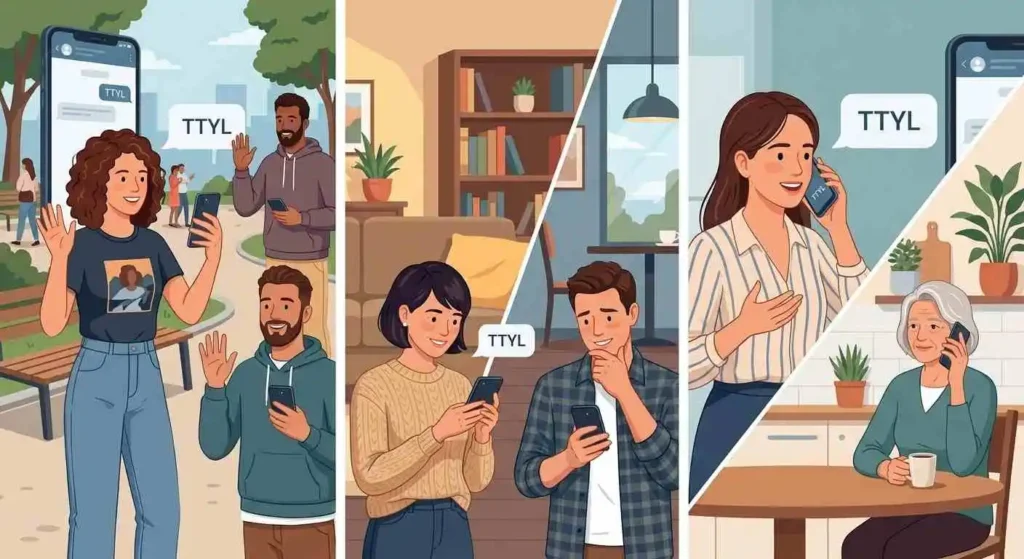
The abbreviation by itself does not prove that he is interested in you or trying to avoid you.
TTYL From a Girl
If a girl sends TTYL, the meaning is generally the same: she is saying that she will talk to you later or is ending the conversation for now.
Gender does not give TTYL a different dictionary meaning.
TTYL From a Friend
Between friends, TTYL is a natural casual sign-off:
“I have to go study. TTYL!”
It usually sounds relaxed and familiar.
TTYL From a Crush
If a crush sends TTYL, the message still means “Talk To You Later.” Whether the person is flirting, interested, simply being friendly, or just busy cannot be determined from TTYL alone.
Look at the broader conversation rather than treating the abbreviation as a hidden romantic signal.
TTYL in Dating or a Relationship
People can use TTYL in dating conversations or relationships just as they do with friends.
For example:
“I have to finish something. TTYL ❤️”
The emoji and previous conversation may make the message feel warmer, but TTYL itself remains a casual sign-off.
What Tone Does TTYL Have?
TTYL is generally:
- Casual
- Informal
- Friendly
- Relaxed
- Conversational
The surrounding message can change how it feels.
For example:
“Okayyy ttyl 😊” may sound warm or playful.
“ttyl” by itself may feel more brief or neutral.
“Fine. TTYL.” could feel colder because of the surrounding wording and situation.
So, punctuation, emojis, previous messages, and the overall conversation can affect the perceived tone. The abbreviation itself does not automatically mean someone is being dismissive or upset.
Is TTYL Rude or Offensive?
No, TTYL is generally not rude or offensive. It is an ordinary informal way to end a casual digital conversation.
It is appropriate for situations such as:
- Texting friends
- Casual group chats
- Informal DMs
- Conversations with family
- Casual online chats
For school or professional communication, the situation matters. TTYL may sound too informal in a formal email, application, official message, or communication with someone you do not know well. A phrase such as “Talk to you later” or “I’ll follow up later” is clearer and more professional.
Who Uses TTYL?
TTYL is an established form of internet and texting shorthand rather than a term that belongs exclusively to one age group. It can be understood across different types of digital conversations.
Because slang changes over time, some people may prefer newer or simpler alternatives such as “talk later,” “talk soon,” or “bye.” That does not change the meaning of TTYL.
It is better to describe TTYL as casual texting slang than to assume that only Gen Z, Millennials, or another specific generation uses it.
TTYL vs. Similar Slang
Some texting abbreviations look similar but communicate slightly different ideas.
| Term | Meaning | Difference |
| TTYL | Talk To You Later | Ends the current conversation with an expectation of talking later |
| TTYS | Talk To You Soon | Emphasizes talking again soon |
| BRB | Be Right Back | Usually means the person plans to return shortly |
| GTG | Got To Go | Focuses on needing to leave |
| BBL | Be Back Later | Indicates returning later, often to the same conversation or activity |
| CYA | See You | Casual farewell that focuses on seeing or talking again |
The closest alternatives are not always interchangeable. BRB, for example, usually suggests a shorter absence, while TTYL is commonly used to close the current conversation for now.
Common Mistakes About TTYL
Assuming TTYL Is Romantic
TTYL does not automatically mean someone likes you romantically. The relationship and surrounding conversation provide much more information.
Thinking “Later” Means a Specific Time
TTYL does not promise a particular time. “Later” can mean later that day, another day, or simply another time.
Treating TTYL as Rude
A short message can sometimes feel abrupt, but TTYL itself is normally a friendly or neutral sign-off.
Confusing TTYL With BRB
BRB usually means “Be Right Back,” suggesting the person plans to return soon. TTYL normally closes the current conversation with the idea of talking again later.
Using It in Every Situation
TTYL is designed for informal communication. A formal email or professional message usually benefits from clearer, conventional wording.
TTYL and Related Internet Slang
| Term | Meaning | Common Use |
| BRB | Be Right Back | Temporarily leaving a chat |
| GTG | Got To Go | Saying you need to leave |
| TTYS | Talk To You Soon | Ending a chat while suggesting a soon return |
| BBL | Be Back Later | Saying you will return later |
| CYA | See You | Casual goodbye |
| LOL | Laughing Out Loud | Showing amusement |
| BTW | By The Way | Introducing an additional point |
| IDK | I Don’t Know | Saying you are uncertain or do not know |
Real-World Conversation
Alex: “Are you free to keep chatting?”
Sam: “I wish 😂 I have to finish my homework.”
Alex: “No worries!”
Sam: “I’ll message you later. TTYL!”
Alex: “Sounds good. Talk later!”
Here, TTYL simply closes the conversation temporarily. There is no need to interpret it as a negative response or a hidden message.
People Also Ask
What does TTYL mean in texting?
TTYL means “Talk To You Later.” It is a casual abbreviation used when someone is ending a conversation for now and expects to communicate again later.
What does TTYL mean from a girl?
It means “Talk To You Later.” A girl using TTYL does not give the abbreviation a special meaning; the surrounding conversation determines whether the interaction is friendly, casual, or romantic.
What does TTYL mean from a guy?
It normally means “Talk To You Later.” It does not automatically indicate attraction, rejection, or disinterest.
Is TTYL a good thing?
Usually, yes. TTYL is generally a neutral-to-friendly way of ending an informal conversation and leaving the possibility of talking again later.
Is TTYL rude?
TTYL is generally not rude or offensive. However, a very short message can feel abrupt depending on the situation and the wording around it.
What is the difference between TTYL and BRB?
TTYL means “Talk To You Later” and commonly closes the current conversation. BRB means “Be Right Back” and usually suggests that the person intends to return shortly.
What is the difference between TTYL and TTYS?
TTYL means “Talk To You Later,” while TTYS means “Talk To You Soon.” TTYS places more emphasis on reconnecting soon.
Can I use TTYL in a professional message?
It is better suited to informal communication. In a professional email or formal message, use a clearer phrase such as “Talk to you later,” “I’ll follow up later,” or another appropriate closing.
Conclusion
TTYL means “Talk To You Later.” It is casual internet slang and a texting abbreviation used to pause or end a conversation while indicating that communication can continue later.
Its tone is usually friendly, informal, and relaxed, although the surrounding words, punctuation, and emojis can affect how it feels. TTYL does not automatically signal flirting, rejection, or any particular relationship meaning.
For casual texts, DMs, and chats, TTYL is perfectly natural. For formal or professional communication, a standard phrase is usually a better choice.

Amelia Foster is a writer focused on captions and quotes that capture moments, moods, and personal expression. Over four years, she has worked across travel, lifestyle, relationships, events, social media, entertainment, and aesthetic themes. Amelia studies caption styles, refines wording choices, and structures short-form phrases to create clear, relevant expressions suited to different occasions.