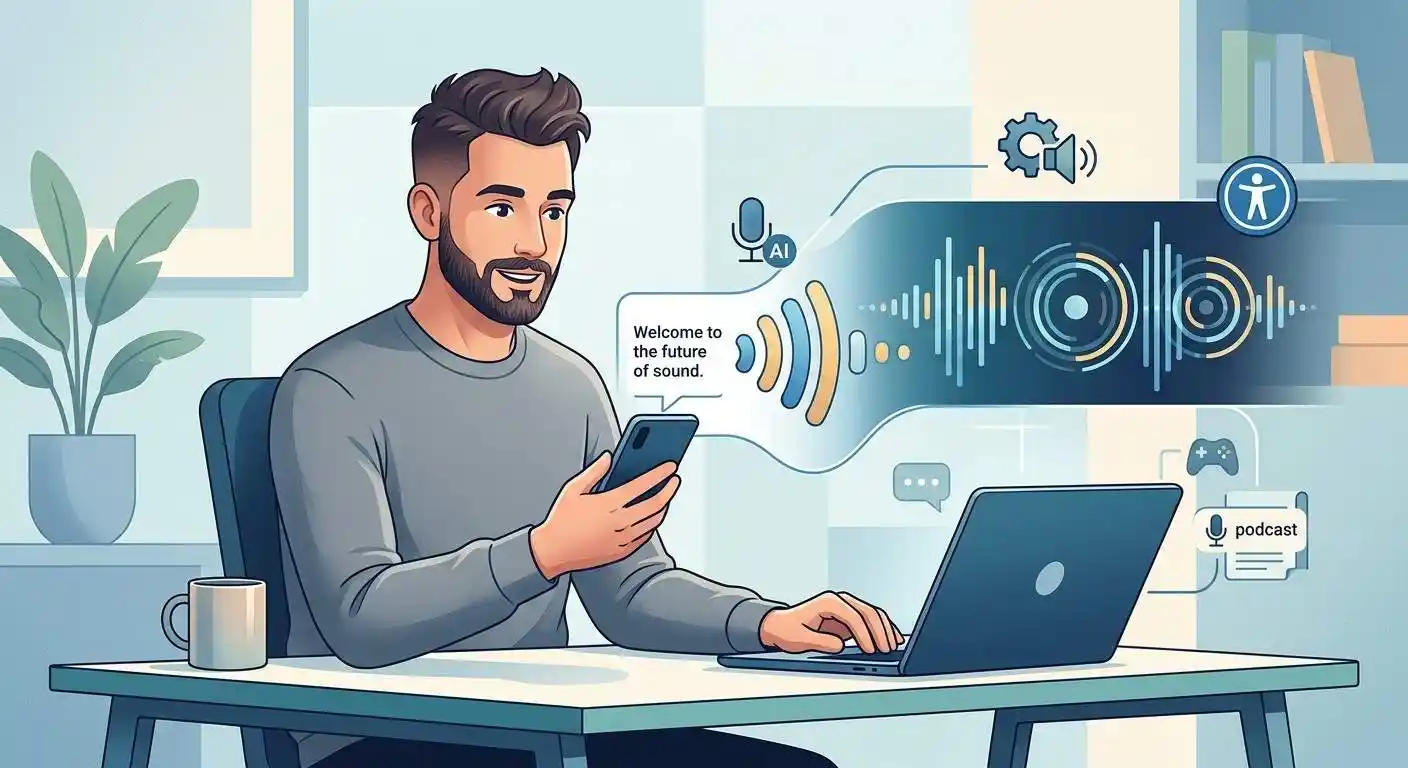
TTS in text usually means “text-to-speech,” a technology that converts written words into spoken audio. In chats, social media, gaming, and content creation, people may use TTS when talking about computer-generated voices, voiceovers, accessibility tools, or messages being read aloud.
The meaning can depend on context, however. In conversations about shoes or clothing, TTS can also mean “true to size,” while “talk to soon” appears in some informal sources but is not as established as the text-to-speech meaning.
Key Takeaways
- TTS most commonly means “text-to-speech” in technology-related online conversations.
- Text-to-speech turns written text into spoken audio, often using a computer-generated voice.
- You may see TTS mentioned when people discuss voiceovers, accessibility, gaming, streaming, or AI-generated voices.
- In clothing or sneaker discussions, TTS can mean “true to size.”
- Context is important because the same abbreviation can have different meanings.
- TTS is generally neutral and informal, rather than rude or offensive.
TTS Meaning in Text
In digital communication, TTS usually stands for “text-to-speech.” It is an abbreviation for technology that converts written words into spoken language.
For example, someone might say:
“I used TTS for the video.”
Here, they mean they used a text-to-speech system to turn written words into a computer-generated voice.
TTS is not really traditional internet slang in the same way as “LOL” or “BRB.” It is primarily a technology abbreviation that people commonly use in online conversations.
You might encounter it when discussing:
- Computer-generated voices
- Automated narration
- Accessibility features
- AI voice tools
- Gaming
- Livestreams
- Video editing
- Voiceovers
- Apps that read text aloud
So if someone sends “TTS” in a technology-related conversation, the safest interpretation is usually text-to-speech.
What Does TTS Stand For?
TTS stands for “text-to-speech.”
Text-to-speech describes a system that takes written text and produces spoken audio. It can be used by computers, phones, apps, websites, games, and other digital tools.
For example:
Written text: “Welcome to my channel.”
TTS output: A computer-generated voice reads the sentence aloud.
This is why you may see TTS mentioned in conversations about videos, voice generation, accessibility, or gaming.
How Is TTS Used?
TTS is usually used as a noun or shorthand for a feature, tool, system, or generated voice.
Someone might write:
- “Can you turn on TTS?”
- “I used TTS for the narration.”
- “That sounds like TTS.”
- “The game has TTS.”
- “Does this app support TTS?”
- “The messages are being read through TTS.”
The exact wording tells you whether someone means the technology itself, the voice it produces, or a feature that uses it.
TTS in Social Media
On social media, TTS often appears when people discuss automated narration or computer-generated voices used in videos.
For example:
“How did you make that voice?”
“It’s TTS.”
Here, TTS refers to the system that reads written text aloud.
TTS in Gaming and Online Communities
Gaming and online communities can use TTS for reading messages aloud, automated narration, or accessibility features.
If someone says:
“Send it through TTS.”
they are probably referring to a system that will read the text using a synthesized voice.
TTS in Videos
Content creators may use TTS to narrate written scripts without recording their own voice.
A message such as:
“This video uses TTS.”
means the narration was generated from written text rather than being a traditional recorded voice.
Real Chat Examples
Here are realistic examples showing how TTS can appear in different contexts:
- Friend: “How did you make the robot voice?”
You: “I used TTS.” - Friend: “Can this app read my messages?”
You: “Yeah, it has TTS.” - Creator: “What voice did you use?”
Reply: “Just a TTS voice.” - Gamer: “Why is the message talking?”
Friend: “TTS is turned on.” - Friend: “Can TTS read this paragraph?”
You: “It should.” - Creator: “I don’t want to record narration.”
Friend: “Use TTS.” - Friend: “That sounds computer-generated.”
You: “Yeah, it’s TTS.” - Gamer: “How are the messages being read aloud?”
Friend: “The server has TTS.” - Friend: “Does your phone have TTS?”
You: “Yes.” - Creator: “I typed the script and used TTS for the voice.”
- Friend: “Is that your actual voice?”
You: “No, it’s TTS.” - Gamer: “Turn off TTS; it’s distracting.”
- Friend: “Can you make the caption play as audio?”
You: “You’ll need a TTS feature.” - Creator: “The narration is generated with TTS.”
- Friend: “What does TTS mean?”
You: “Usually text-to-speech.” - Friend: “This sounds like one of those automated voices.”
You: “Exactly—it uses TTS.” - Gamer: “Why did my message get read aloud?”
Friend: “TTS was enabled.” - Friend: “Does TTS work offline?”
You: “That depends on the app or device.”
How to Reply to TTS
The best reply depends on what the person means by TTS. If they are talking about technology, respond to the specific feature or voice they mentioned.
Casual Replies
- “Oh, got it.”
- “Yeah, I know what you mean.”
- “That makes sense.”
- “Nice, I didn’t know it had that feature.”
Friendly Replies
- “That voice actually sounds pretty good.”
- “Cool, how did you set it up?”
- “I might try that too.”
- “That’s pretty useful.”
Funny Replies
If the conversation is already playful, you could say:
- “The robot has entered the chat 😂”
- “Okay, computer voice activated.”
- “That voice is definitely not human.”
Neutral Replies
If you are unsure what the abbreviation means:
- “Do you mean text-to-speech?”
- “What do you mean by TTS here?”
- “Is that the text-to-speech feature?”
Flirty/Relationship Replies
There is no special romantic meaning built into TTS. If someone you like uses it, reply based on the actual conversation rather than assuming the abbreviation signals flirting.
For example:
- “Oh, you mean text-to-speech?”
- “Haha, that explains the voice.”
- “Which TTS voice did you use?”
Context & Relationship Meaning
TTS does not have a different definition simply because it comes from a guy, girl, friend, crush, or partner.
If someone sends you:
“I used TTS for this.”
the relationship between you does not change what TTS means.
Context matters much more. Look at the words surrounding the abbreviation, the topic being discussed, punctuation, emojis, and what happened immediately before the message.
For example:
“I used TTS for my video 😂”
→ Almost certainly refers to text-to-speech.
“Are these shoes TTS?”
→ Likely means true to size, not text-to-speech.
This is why interpreting an abbreviation from the three letters alone can sometimes lead to confusion.
What Tone Does TTS Have?
When TTS means text-to-speech, the abbreviation is generally neutral and casual.
Its tone comes from the surrounding message.
For example:
- “I used TTS for my video.” → Informative
- “Turn on TTS.” → Direct
- “That voice sounds like TTS 😂” → Playful
- “Does this support TTS?” → Technical
- “TTS makes this easier for me.” → Practical
The abbreviation itself does not automatically indicate sarcasm, anger, flirting, or friendliness.
Is TTS Rude or Offensive?
No. TTS is not inherently rude or offensive.
It is generally appropriate in casual conversations, online communities, gaming discussions, and technical conversations.
For formal writing, it is better to write “text-to-speech” the first time and introduce TTS afterward if the abbreviation will be used repeatedly.
For example:
“The application includes a text-to-speech (TTS) feature.”
That is clearer in school, professional, or technical writing.
Who Uses TTS?
TTS is not limited to one age group or generation. It is a technology abbreviation, so people may encounter it whenever they interact with software or digital content that converts text into speech.
You might see it used by:
- Content creators
- Gamers
- Streamers
- App users
- Developers
- Students
- Accessibility users
- People discussing AI voice tools
There is no need to interpret TTS as specifically belonging to a particular generation.
Other Meanings of TTS
Although text-to-speech is the main meaning relevant to online technology conversations, TTS can have other meanings in specific contexts.
TTS as “True to Size”
In clothing, footwear, and shopping conversations, TTS can mean “true to size.” It means an item generally fits according to the expected or usual size.
For example:
“Are these sneakers TTS?”
The person is asking whether the sneakers fit according to their normal size.
This meaning is easy to distinguish from text-to-speech because the surrounding conversation is about shoes, clothing, measurements, or fit.
TTS as “Talk to Soon”
Some online sources use TTS as an informal abbreviation for “talk to soon.” However, this is much less established than the text-to-speech meaning, so it should not automatically be assumed when you see TTS in a message.
If someone writes:
“Gotta go, TTS!”
the surrounding context may suggest they intend it as a casual goodbye. If you are unsure, asking what they mean is better than guessing.
TTS vs. Similar Slang
TTS is sometimes confused with abbreviations that look or sound similar, especially when someone is searching for a short-form texting expression.
| Term | Meaning | Difference |
|---|---|---|
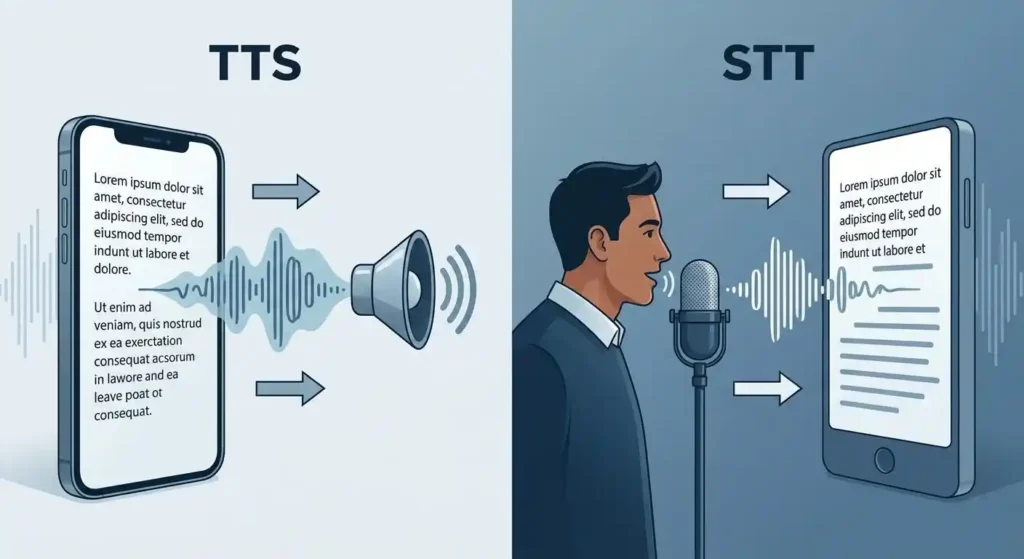
| TTS | Text-to-speech | Converts written text into spoken audio |
| STT | Speech-to-text | Converts spoken language into written text |
| TTYL | Talk to you later | A texting goodbye |
| BRB | Be right back | Indicates a temporary absence |
| BTW | By the way | Introduces additional information |
The most important distinction is TTS vs. STT: TTS goes from text → speech, while STT goes from speech → text.
Common Mistakes About TTS
Assuming TTS Always Means Text-to-Speech
Text-to-speech is the dominant meaning in technology-related conversations, but context can change the interpretation.
A shoe discussion may use TTS to mean true to size.
Assuming TTS Is Always Internet Slang
TTS is better described as a technology abbreviation than purely as slang. It can appear in technical, accessibility, gaming, social media, and everyday digital conversations.
Confusing TTS With STT
These abbreviations describe opposite processes.
TTS: written words become spoken audio.
STT: spoken audio becomes written words.
Assuming TTS Has a Romantic Meaning
TTS does not inherently mean flirting, attraction, affection, or rejection. If someone you like uses it, the surrounding conversation matters more than the abbreviation itself.
Ignoring the Conversation Topic
The easiest way to understand TTS is to look at the words around it.
Voice, audio, narration, accessibility, or AI → likely text-to-speech.
Shoes, clothing, size, or fit → likely true to size.
Related Internet Slang and Abbreviations
| Term | Meaning | Common Use |
|---|---|---|
| STT | Speech-to-text | Voice transcription and accessibility |
| TTYL | Talk to you later | Ending a casual conversation |
| BRB | Be right back | Temporarily leaving a chat |
| LOL | Laughing out loud | Showing amusement |
| IMO | In my opinion | Sharing an opinion |
| IDK | I don’t know | Expressing uncertainty |
These terms are related to TTS mainly through digital communication and messaging, although they do not perform the same function.
Real-World Conversation
Alex: “How did you make that voice for your video?”
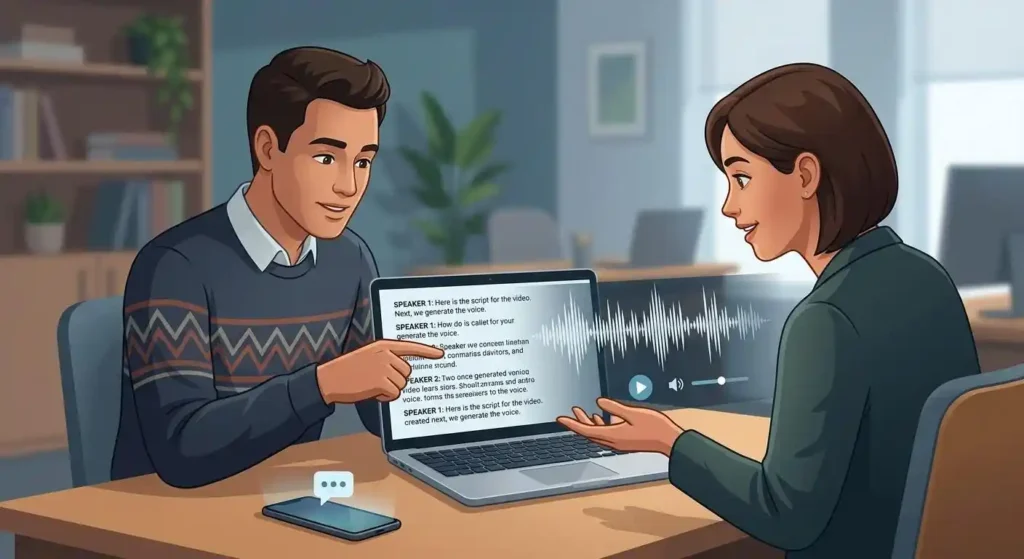
Sam: “I typed the script and used TTS.”
Alex: “So the computer reads it automatically?”
Sam: “Exactly.”
Here, TTS clearly means text-to-speech because the conversation is about creating a spoken voice from written text.
People Also Ask
What does TTS mean in texting?
TTS most commonly means text-to-speech when the conversation involves technology, voices, narration, or digital tools. It refers to converting written text into spoken audio.
What does TTS stand for?
TTS stands for text-to-speech. It is a widely recognized computing abbreviation for software or systems that change written text into spoken language.
Is TTS a slang word?
Not exactly. TTS is primarily a technology abbreviation, although people commonly use it casually in online chats when discussing voice features, gaming, videos, or automated narration.
What does TTS mean on social media?
On social media, TTS generally refers to text-to-speech, especially when people are discussing automated voices, video narration, or content created from written scripts.
What does TTS mean in gaming?
In gaming, TTS can refer to a text-to-speech feature that reads written messages aloud. The exact function depends on the game, platform, or community.
What does TTS mean when talking about shoes?
When someone discusses shoes, TTS commonly means “true to size.” For example, “Are these TTS?” asks whether the shoes fit according to the expected size.
Does TTS mean “talk to soon”?
It can be used that way in some informal online conversations, but “talk to soon” is not as established as “text-to-speech.” Context is important before choosing that interpretation.
Is TTS rude?
No. TTS itself is a neutral abbreviation. Whether a message sounds friendly, funny, direct, or dismissive depends on the surrounding wording and conversation.
Conclusion
TTS most commonly means “text-to-speech” in digital and technology-related conversations. It describes technology that converts written words into spoken audio and is commonly discussed in connection with videos, gaming, accessibility, and automated voices.
Context can change the meaning. In footwear or clothing discussions, TTS can mean “true to size,” while “talk to soon” appears as a less-established informal interpretation. When the context is unclear, looking at the surrounding message—or simply asking—will give you the most reliable.

Charlotte Reed creates captions and quotes built around moments, moods, and personal expression. Over three and a half years, she has worked on content covering travel experiences, lifestyle themes, relationships, events, social media posts, entertainment topics, and aesthetic styles. Her process involves studying language patterns, refining caption structure, and adjusting wording to match different occasions and visual themes.