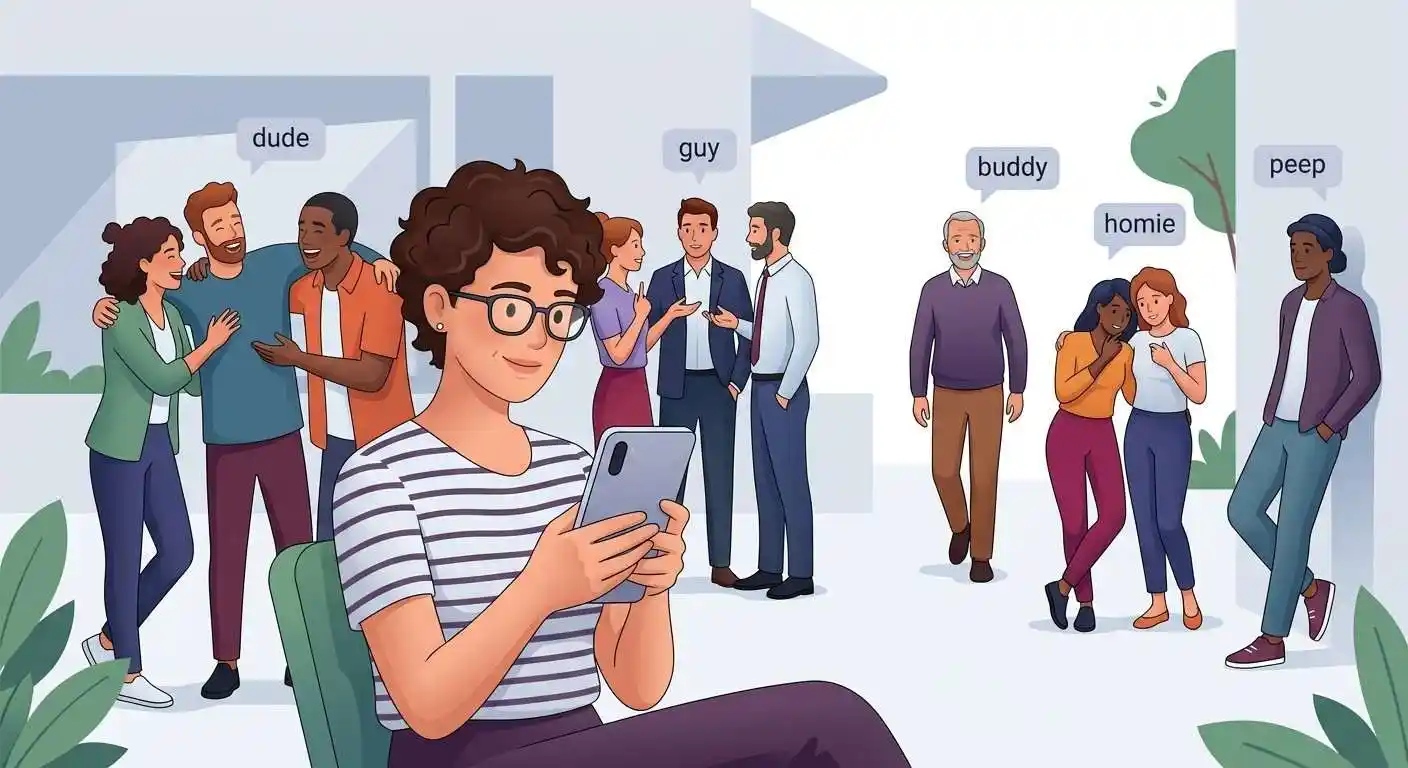
“Individual slang” generally refers to informal words or expressions used to describe one person or an individual in casual conversation. Depending on context, terms such as person, peep, dude, guy, buddy, homie, or individual can carry different levels of friendliness, familiarity, or informality.
Key Takeaways
- Individual slang is not one fixed slang word; it is a broad category of informal terms for a person.
- Common examples include peep, dude, guy, buddy, homie, and folks, although their meanings and uses differ.
- Some terms describe any person, while others imply friendship, familiarity, or a particular social context.
- The right term depends on tone, relationship, audience, and situation.
- Most individual-related slang is appropriate for casual conversations but may not suit formal writing.
- Slang can vary by region, community, platform, and context, so the same word may sound friendly in one situation and disrespectful in another.
Individual Slang Meaning
“Individual slang” is best understood as an informal way of referring to a person, someone, or a particular individual.
Unlike an abbreviation such as “IDK,” it is not normally one specific texting abbreviation with a single expansion. Instead, it describes a group of casual expressions that people may use instead of more formal words such as person, individual, friend, man, woman, or someone.
For example:
- “Who’s that dude?”
- “I met a cool peep today.”
- “That guy helped me out.”
- “He’s a good buddy.”
- “That person seems familiar.”
The exact feeling changes with the word. Dude can be casual and friendly, while buddy can suggest familiarity. Peep is informal, while individual itself is comparatively neutral and formal.
What Does Individual Slang Stand For?
There is no standard full form or acronym for “individual slang.”
The phrase simply describes informal language used to refer to or talk about an individual person.
If you encountered “individual slang” in a specific text, post, or message, the surrounding sentence matters. The sender may have been asking for a casual synonym for person, rather than referring to a particular internet abbreviation.
How Is Individual Slang Used?
People use individual-related slang in everyday conversations, text messages, social media posts, comments, and group chats.
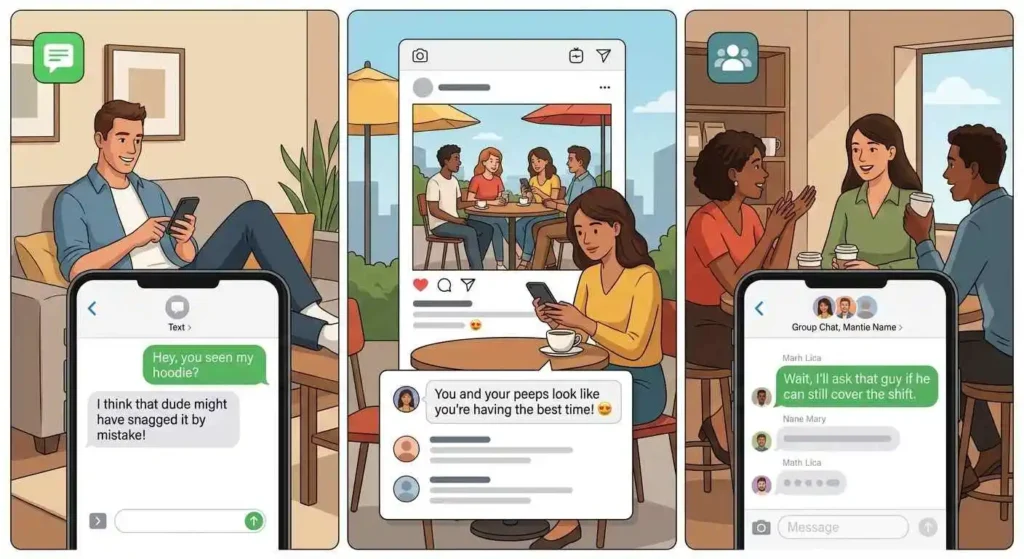
In Text Messages
Casual terms can make a message sound more relaxed:
“Who’s that dude?”
“I met this cool guy yesterday.”
“That peep was really helpful.”
On Social Media
Informal terms for people can appear in captions, comments, memes, and posts:
“Met some awesome peeps today.”
“That dude really knows what he’s doing.”
“One of my favorite people.”
In Group Chats
Friends may use words such as dude, bro, buddy, homie, or peep when talking about someone.
The choice depends heavily on the group. A word that sounds natural among close friends may sound strange or overly familiar with someone you barely know.
Real Chat Examples
Here are natural examples showing how individual-related slang can work in different situations:
- A: “Who’s that dude?”
B: “That’s Jake from my class.” - A: “I met a cool peep at the event.”
B: “Nice! Did you get their number?” - A: “That guy helped me find my bag.”
B: “That was nice of him.” - A: “Hey, buddy, you coming with us?”
B: “Yeah, give me five minutes.” - A: “That dude is hilarious.”
B: “I know, right?” - A: “I need someone to help with this.”
B: “Ask that guy over there.” - A: “We met some awesome peeps.”
B: “Sounds like a fun group.” - A: “That person seems familiar.”
B: “I think they were at the last game.” - A: “My homie just got here.”
B: “Tell them to come over.” - A: “Who’s the guy in the blue shirt?”
B: “That’s my cousin.” - A: “This dude keeps making jokes.”
B: “He sounds funny.” - A: “I made a new buddy today.”
B: “That’s great!” - A: “There were so many peeps at the concert.”
B: “I can imagine.” - A: “That guy gave me some good advice.”
B: “Sounds like a helpful person.” - A: “Hey dude, are you free later?”
B: “Probably. Why?” - A: “I saw this interesting person at school.”
B: “Do you know them?” - A: “My homie is coming over.”
B: “Cool.” - A: “That individual was responsible for the project.”
B: “That sounds more formal.” - A: “There are some cool peeps in this community.”
B: “Yeah, everyone seems friendly.” - A: “Who’s that person standing outside?”
B: “I’m not sure.”
How to Reply to Individual Slang
Because “individual slang” covers many different words, your response should depend on the actual term and the sentence where it appears.
Casual Replies
If someone says:
“Who’s that dude?”
You might reply:
“That’s my friend.”
or:
“That’s Alex from school.”
Friendly Replies
If someone says:
“I met some cool peeps today.”
A natural response could be:
“Nice! Sounds like you had fun.”
Funny Replies
If someone jokingly says:
“That dude is something else.”
You could respond:
“😂 He really is.”
Neutral Replies
When you are unsure about the slang, simply answer the question or ask for clarification:
“Which person do you mean?”
Flirty or Relationship Replies
Individual-related slang by itself usually does not establish romantic interest. If someone calls you “dude,” “buddy,” “guy,” or another casual term, interpret it alongside the rest of the conversation rather than assuming it is flirting or rejection.
Context & Relationship Meaning
The meaning of an individual-related slang term can change depending on who is speaking and who they are talking about.
From a Friend
A friend may casually call someone a dude, buddy, bro, homie, or peep without intending anything beyond friendliness.
From a Crush
If a crush uses a casual word such as dude or guy, the word alone does not prove how they feel. The surrounding conversation, wording, emojis, and overall relationship provide much more context.
From a Guy or Girl
The speaker’s gender does not automatically change the definition of an individual-related slang term. A word such as dude can be used in different ways depending on the person and situation.
In Dating
Informal terms can sometimes create a relaxed tone in dating conversations, but they should not be treated as hidden signals of attraction or rejection without additional context.
What Tone Does Individual Slang Have?
Individual-related slang can have several tones:
- Casual: “Who’s that dude?”
- Friendly: “Hey buddy!”
- Playful: “This dude is hilarious.”
- Familiar: “My homie is here.”
- Neutral: “That person helped me.”
- Informal: “I met some cool peeps.”
- Dismissive or negative: Some terms can sound disrespectful depending on how they are delivered.
The same word can feel completely different when punctuation, emojis, or the surrounding conversation changes.
Is Individual Slang Rude or Offensive?
Most common terms for an individual are not automatically rude or offensive. However, appropriateness depends on the specific word.
Words such as person and individual are generally neutral. Terms such as dude, buddy, guy, and peep are more casual.
For school assignments, professional emails, formal reports, or official communication, person or individual is usually safer than highly informal slang.
A slang term can also become disrespectful when it is used sarcastically, aggressively, or to belittle someone.
Who Uses Individual Slang?
There is no single age group that owns individual-related slang. Informal language is used across different communities and generations, although particular words can be more familiar in certain regions, social groups, or online communities.
For that reason, it is better to understand the specific word and context instead of assuming that every slang term belongs to Gen Z or another generation.
Other Meanings of “Individual Slang”
“Individual slang” does not have a separate standard technical meaning that needs extensive disambiguation.
However, the phrase can be interpreted in two ways:
- Slang for an individual person — informal words used to refer to someone.
- An individual’s personal slang — expressions or inside terms that a particular person or small group uses.
The second meaning is more context-dependent. Someone might create a personal expression or inside joke that is understood only by their friends.
Individual Slang vs. Similar Terms
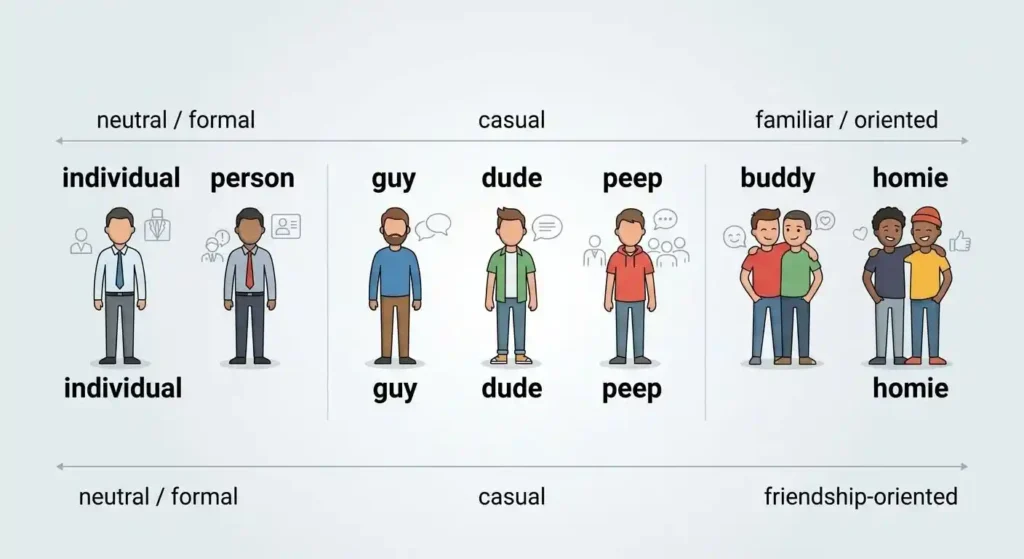
| Term | Meaning | Difference |
|---|---|---|
| Person | A human being | Neutral and widely appropriate |
| Individual | One particular person | More formal or precise |
| Dude | Informal term for a person | Very casual and conversational |
| Guy | Usually an informal reference to a person | Common in everyday speech |
| Buddy | Friend or familiar person | Often suggests friendliness |
| Peep | Informal term for a person | Casual and socially oriented |
| Homie | Close friend or trusted person | Stronger sense of familiarity |
The important distinction is that these words are not perfect synonyms in every situation. “Individual” can be formal, while “homie” implies a much closer relationship.
Common Mistakes About Individual Slang
Assuming Every Slang Word Means “Friend”
Not every casual word for a person means friendship. Guy, dude, and peep can refer to someone without indicating a close relationship.
Assuming Slang Has One Universal Meaning
Informal language is highly context-dependent. A term can sound friendly in one conversation and sarcastic in another.
Assuming “Dude” Is Always Gender-Specific
“Dude” is often used casually and does not necessarily tell you anything definite about the person’s gender or the speaker’s relationship with them.
Treating Casual Slang as Formal English
A word that works perfectly in a group chat may sound inappropriate in an academic assignment or professional email.
Overinterpreting a Slang Term in Dating
Calling someone “dude,” “buddy,” or “peep” does not automatically reveal romantic feelings. Look at the complete conversation instead.
Related Internet Slang
| Term | Meaning | Common Use |
|---|---|---|
| Dude | Casual term for a person | Friends and everyday conversation |
| Bro | Informal term for a friend or person | Casual chats and social media |
| Buddy | Friend or familiar person | Friendly conversation |
| Homie | Close friend | Casual social conversations |
| Peep | Informal term for a person | Groups and social settings |
| Guy | Informal reference to a person | Everyday conversation |
| Folks | Informal term for people or a group | Social and conversational language |
Real-World Conversation
Imagine someone sees a person they do not recognize at a gathering:
Alex: “Who’s that dude talking to Sam?”
Jordan: “That’s Mike. He’s in Sam’s class.”
Alex: “Oh, got it.”
Here, dude simply refers to a person in a casual way. It does not necessarily indicate friendship, disrespect, or romantic interest.
People Also Ask
What is slang for an individual person?
Common informal terms include dude, guy, peep, buddy, bro, and homie. The best choice depends on whether you mean a stranger, acquaintance, friend, or close friend.
What is a casual word for an individual?
Person is neutral, while dude, guy, and peep are more casual. Buddy and homie can suggest familiarity or friendship.
Is “individual” a slang word?
Usually, no. Individual is a standard English word and is generally more formal or neutral than slang terms such as “dude” or “peep.”
What is slang for a group of individuals?
Depending on context, people may use terms such as folks, peeps, crew, or guys. Some are more informal than others, and their appropriateness depends on the audience.
Does “dude” mean friend?
Not necessarily. “Dude” can refer casually to a friend, acquaintance, or even someone the speaker does not know well.
Does “buddy” always mean close friend?
No. “Buddy” often sounds friendly, but speakers can also use it casually for someone they are not particularly close to.
What is a slang word for a person online?
Online conversations use many informal terms, including dude, bro, peep, guy, homie, and buddy. The preferred term varies by community and context.
Is slang appropriate in formal communication?
Usually, informal slang should be avoided in formal emails, academic writing, applications, and professional documents. Neutral words such as person or individual are generally more appropriate.
Conclusion
“Individual slang” refers broadly to informal ways of talking about a person or individual, rather than one specific texting abbreviation. Terms such as dude, guy, peep, buddy, bro, and homie can all work in different contexts, but their tone and relationship implications vary.
For casual online conversations, slang can make communication feel relaxed and natural. For formal situations, person or individual is usually the clearer choice.

Charlotte Reed creates captions and quotes built around moments, moods, and personal expression. Over three and a half years, she has worked on content covering travel experiences, lifestyle themes, relationships, events, social media posts, entertainment topics, and aesthetic styles. Her process involves studying language patterns, refining caption structure, and adjusting wording to match different occasions and visual themes.